
How to use this checklist
This is the full 40-point launch checklist we run on client builds, published as a printable page: print it, or save it as a PDF straight from your browser’s print dialog, and physically tick the boxes on launch day. It expands our original website launch checklist article, which explains the why behind each item; this version is the operational tool, organised into pre-launch content, technical and legal checks, launch-day switches, and the week-one follow-ups almost everyone forgets. It costs £0 and works for any platform, whether the site cost £299 or £29,000.
Pre-launch: content checks
| # | Check | Why it matters |
|---|---|---|
| 1 | Every page proofread by someone who did not write it | Writers cannot see their own typos |
| 2 | Placeholder text and demo images all removed | Template remnants destroy credibility instantly |
| 3 | Phone number, email and address correct everywhere | Footer details are copied and forgotten |
| 4 | Prices and service details match what you actually sell | Old prices create refund arguments |
| 5 | Every image has descriptive alt text | Accessibility and image search both depend on it |
| 6 | Images compressed and sharp on mobile | Blurry or heavy images are the top visual complaint |
| 7 | Calls to action on every page, pointing somewhere real | Pages without a next step leak visitors |
| 8 | 404 page exists and offers navigation | Dead ends should recover, not strand |
Point 6 deserves its own reading if your images fail it: our guide to fixing blurry website images covers the sizing rules, and the free content planner helps if pages are still half-written.
Pre-launch: technical checks
| # | Check | Why it matters |
|---|---|---|
| 9 | SSL certificate installed; site loads on https | Browsers warn on insecure sites |
| 10 | All http and www variants redirect to one canonical URL | Split versions split your rankings |
| 11 | Old URLs mapped to new pages with 301 redirects | The single most-missed launch task |
| 12 | Every form test-submitted, and the email actually arrived | Silent form failure is invisible lost business |
| 13 | Mobile layout checked on a real phone, not a resized window | Most traffic is mobile |
| 14 | Page speed sanity-checked | Slow launches never get faster on their own |
| 15 | Backups configured and one restore tested | A backup you have never restored is a hope |
| 16 | Favicon and social sharing preview set | Links shared on day one look right |
Run point 14 through PageSpeed Insights before and after launch; scores on the live domain differ from staging.
Pre-launch: legal checks
| # | Check | Why it matters |
|---|---|---|
| 17 | Privacy policy published and linked in the footer | Required when you collect any personal data |
| 18 | Cookie consent working if you run analytics or ads | Consent rules apply to tracking |
| 19 | Terms, delivery and refund info for anything sold online | Consumer law expects them |
| 20 | Company details correct: legal name, registration if applicable | Trust and, for companies, a legal requirement |
The ICO’s small business guidance is the plain-English source for points 17 and 18.
Launch day: the switch list
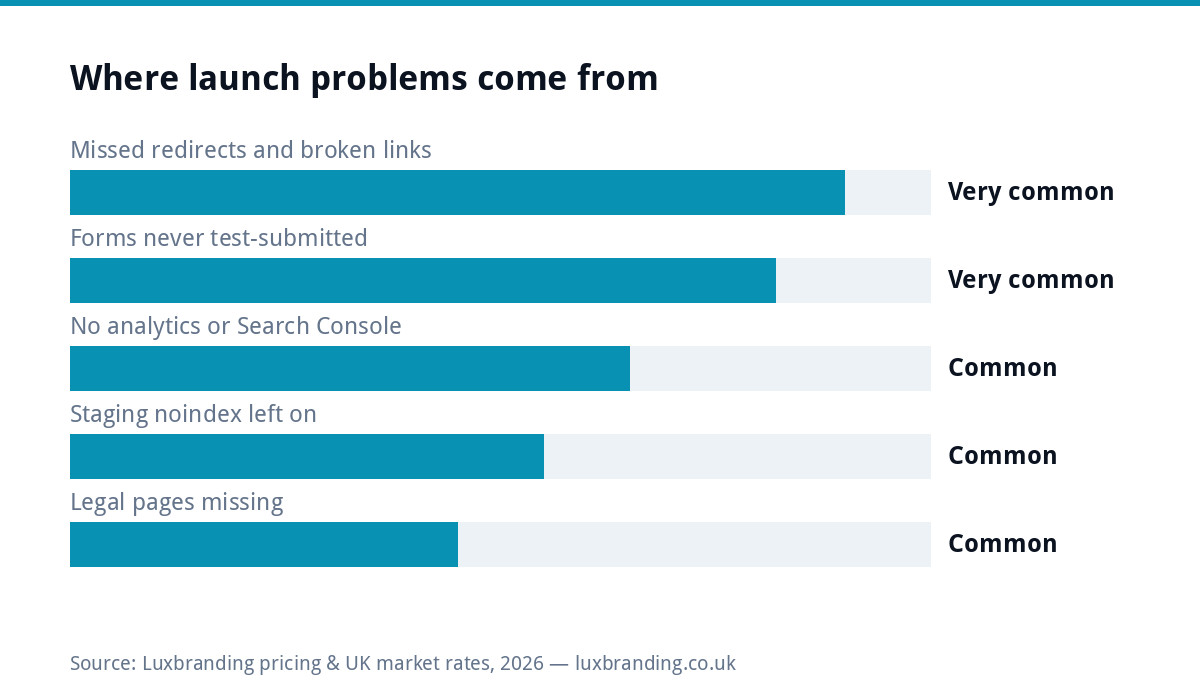
21: DNS pointed and propagation confirmed. 22: the one everyone forgets, staging noindex or “discourage search engines” switched OFF; the chart shows how often this survives launch. 23: sitemap submitted in Search Console. 24: analytics receiving live data, verified with a real visit. 25: forms re-tested on the live domain. 26: checkout or payment test transaction if you sell. 27: redirects spot-checked from old URLs. 28: site loads correctly on mobile data, not just wifi. 29: all staging and dev URLs password-protected or removed. 30: launch announced on your Google Business Profile, social channels and email list.
Week one: the follow-ups everyone skips
31: Search Console checked for crawl errors and indexing of key pages. 32: request indexing on your most important pages. 33: watch the 404 report and patch missed redirects. 34: confirm analytics events fire on your money actions. 35: read session recordings or at least the analytics flow for one confused-visitor pattern. 36: first backup verified post-launch. 37: uptime monitor pointed at the new site. 38: Google Business Profile website link updated, per the GBP checklist. 39: ask three real customers to use the site and say one confusing thing. 40: diarise a 30-day review of speed, rankings and enquiries.
The five most-skipped points
Across the launches we have run and rescued, the same five items get skipped: redirect mapping (11), live form testing (25), the noindex switch (22), the restore test (15), and the week-one 404 patrol (33). Not coincidentally, they map to the most common post-launch disasters: vanished rankings, silent enquiry loss, and the site that Google cannot see at all. If you only print one section, print those five. And if a launch has already gone wrong, our guides on a website being down cover triage.
How this differs from our original checklist
The original article is the education: it explains each phase in prose and is worth a read the first time you launch anything. This page is the execution tool: complete, numbered, printable, with the week-one section extended based on what actually goes wrong after real launches. Bookmark the article; print this one. Both are free, and both apply whether you built the site yourself or a studio did.
Who this checklist is for
Anyone shipping a website: the owner launching a DIY build at midnight, the freelancer who wants a client sign-off ritual, and the business commissioning a studio and wanting to verify the handover honestly. Working through all 40 points takes about two hours on a typical small site, and the split matters: everything in the pre-launch sections can and should happen days early, leaving launch day itself as ten calm switches rather than a scramble. If a provider built your site, hand them this list and ask which points they have covered; a good one will have ticked most before you asked, and the conversation about the rest is exactly the quality control you are paying for.
Adapting the checklist to your platform
The 40 points are platform-neutral, but the switches live in different places. On WordPress, the noindex trap is Settings, Reading, “discourage search engines”, and redirects are handled by a redirect plugin or your hosting rules. On website builders like Wix or Squarespace, SSL and redirects sit in the platform dashboard, and point 15’s restore test becomes checking what the platform’s version history actually restores. On e-commerce builds, extend point 26 into a full order rehearsal: place a real order, refund it, and confirm both emails arrived and stock adjusted. The checklist does not care where the switch is, only that a named person flipped it and ticked the box; adapt the locations, never the list.
The 30-day review: what point 40 should measure
Diarising the review is point 40; here is its agenda so it takes twenty minutes. Search Console: are your key pages indexed, and what queries are appearing? Analytics: which pages do visitors enter on, and where do they leave? Enquiries: count them against the month before launch, because that comparison is the launch’s actual verdict. Speed: re-run the homepage and one deep page. And the 404 report one final time, since stragglers surface for weeks. Write the five numbers down; they become the baseline every future change is judged against, which quietly upgrades your website from a project that ended into an asset being managed.
If the checklist finds problems
Finding failures before launch is the checklist working, not failing. Some fixes are ten-minute jobs you can do yourself; some, like a redirect map for a 200-page old site or a speed overhaul, are worth pricing professionally. Our speed optimisation service is £99 fixed and a full rebuilt site is £499, both on the public price list, which is often less than the revenue a botched launch quietly loses in its first quarter. Print the list, launch calm, and keep it for the next project; point 40 has a way of becoming point 1.
Get the UK Website Project Brief Template (free)
A two-page template for briefing any UK web designer: sitemap, integrations, audience and deliverables. Cuts revision rounds in half.
No spam. UK GDPR compliant. We only use your email to send this resource, unless you tick the box to hear from us.
Frequently asked questions
How do I save this launch checklist as a PDF? +
Use your browser's print function and choose "Save as PDF" as the destination. The page is structured in numbered tables and lists so it prints cleanly, and it costs nothing to use on any number of projects.
What is the most commonly missed step when launching a website? +
Redirect mapping from old URLs, closely followed by never test-submitting forms on the live domain and leaving the staging noindex setting on. Those three cause the classic post-launch disasters: lost rankings, lost enquiries and invisibility to Google.
When should I submit my new website to Google? +
On launch day: verify the site in Search Console, submit the sitemap, and request indexing on your key pages. Then check the coverage and 404 reports during week one and patch anything Google trips over.
Does this checklist work for a redesign as well as a brand-new site? +
Yes, and redesigns need it more: the redirect mapping, form retesting and 404 patrol points are exactly where redesigns lose rankings and enquiries that the old site had earned.
What legal pages does a UK business website need at launch? +
A privacy policy whenever you collect personal data, cookie consent if you run analytics or advertising tracking, terms with delivery and refund information if you sell online, and correct company details. The ICO publishes plain-English guidance for small businesses.