Quick answer
Etsy costs you roughly 9% to 11% of every sale once listing, transaction, payment and offsite advertising fees are counted. Your own website costs £999 to build and about £20 a month to run, then takes nothing per sale beyond payment processing. The crossover comes earlier than most sellers expect: at around £1,200 a month in Etsy revenue, a website has usually paid for itself inside a year. The mistake is treating it as a choice. Most sellers who graduate well keep both.
What Etsy actually takes
Etsy’s fees are individually small and collectively significant. Listing is 20 US cents per item, renewed every four months whether it sells or not. Transaction fee is 6.5% of the item price including delivery. Payment processing in the UK is 4% plus 20p. Offsite advertising is 12% or 15% of any order that came through an Etsy-bought advert, and if you turn over more than a threshold amount you cannot opt out of it.
| Monthly Etsy revenue | Typical fees taken | Kept per year | Lost per year to fees |
|---|---|---|---|
| £500 | about £52 | £5,376 | £624 |
| £1,200 | about £126 | £12,888 | £1,512 |
| £2,500 | about £262 | £26,856 | £3,144 |
| £5,000 | about £525 | £53,700 | £6,300 |
At £2,500 a month, Etsy’s cut is roughly three times the entire annual cost of running your own shop. That is the arithmetic that eventually moves everybody.
What Etsy gives you that a website does not
Traffic. This is the whole of it, and it is not a small thing. Etsy has buyers already searching, and a new listing can sell on its first day. A brand new website has nobody on it and will not until you do something about that.
Anyone telling you to leave Etsy on day one is ignoring the only real advantage it has. The seller who closes their shop and opens a website usually sells less, not more.
What your own site gives you that Etsy never will
The customer. Etsy does not give you the buyer’s email address for marketing. You cannot tell last year’s customers that this year’s collection has landed. On your own site you own that list, and repeat custom is where craft businesses actually make money.
No competitor sitting under your product. Etsy shows similar items underneath everything you list. You are paying a fee to be shown alongside the people undercutting you.
Your own brand. Buyers on Etsy remember Etsy. Buyers on your own site remember you, which is what makes the second sale cheaper than the first.
Margin. The fees stop.
When to graduate, honestly
Three signals, and you want at least two of them.
You are consistently over about £1,200 a month on Etsy. Below that, the fees are cheaper than the effort of driving your own traffic. Above it, you are paying more in fees than a site would cost.
You have repeat customers asking whether you sell anywhere else. That is demand you are currently handing back to the platform.
Your products are searched for by name, or your brand is. If people find you by typing what you make rather than browsing, you can capture that traffic yourself.
How to do it without losing sales
Keep the Etsy shop. Build the website alongside it. Put the website address on every insert card and package. Move your best repeat buyers first with a reason to switch, usually a small discount that is still cheaper for you than Etsy’s cut. Let the platform carry on finding new customers while your own site takes the returning ones. Sellers who do it this way rarely see a dip.
What the site itself costs
A proper small shop, meaning your own domain, a real product catalogue, UK VAT handled, delivery rules and a payment provider that is not taking a platform cut, is £999 to build and around £20 a month to run. Payment processing is roughly 1.5% plus 20p on UK cards through Stripe, against Etsy’s 4% plus 20p, before any of the other fees.
If your catalogue is genuinely tiny, a one-page site at £299 with a handful of buy buttons is sometimes enough to start.
The two fee structures side by side
| Cost | Etsy | Your own shop |
|---|---|---|
| Listing an item | 20 cents, renewed every 4 months | Nothing |
| Transaction fee | 6.5% of item plus delivery | Nothing |
| Payment processing | 4% plus 20p | About 1.5% plus 20p |
| Advertising fee on some orders | 12% to 15% | Nothing |
| Monthly platform cost | None | About £20 |
| Build cost | None | £299 to £999 once |
| Customer email list | You do not get one | Yours |
| Competitors shown on your page | Yes | No |
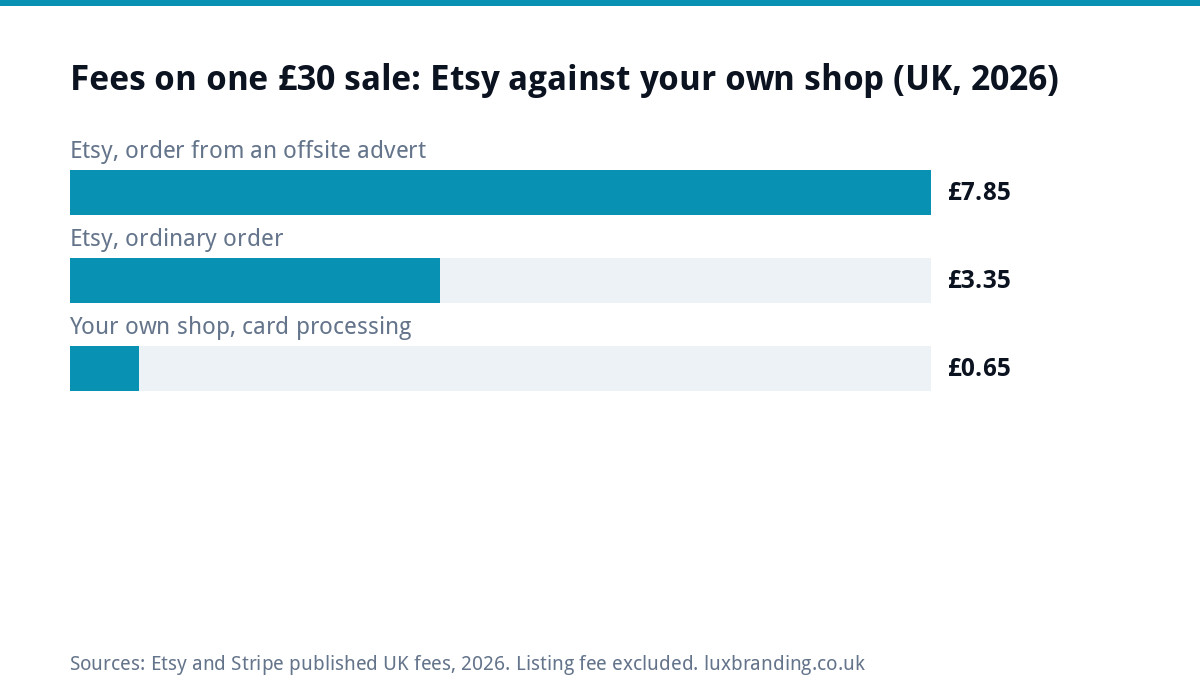
To see what those percentages mean on a real order, take a £30 sale with delivery included in the price. On Etsy, the 6.5% transaction fee is £1.95 and payment processing at 4% plus 20p is £1.40, so £3.35 goes in fees before the listing fee. If the order came through Etsy’s offsite adverts, the 15% advertising fee adds another £4.50, taking the total to £7.85. On your own shop, card processing at about 1.5% plus 20p is roughly 65p. The monthly platform cost and the build are fixed, so the gap on each order is what pays for them: at about £2.70 saved on every ordinary £30 sale, a £20 monthly platform fee is covered by the eighth order of the month.
Why the email list is the whole argument
Every other difference is arithmetic. This one is structural.
A craft or product business makes its money on the second, fifth and tenth order, not the first. The first order barely covers the cost of finding the customer. On Etsy you find a customer, pay for the privilege, and then have no way to reach them again except by hoping they remember your shop name among the thousands they browsed.
On your own site, that buyer joins a list. When the new range lands you tell them, it costs you nothing, and a meaningful share buy again. Sellers who make this move usually report that the site itself is unremarkable and the mailing list changed the business.
What to move first
Not everything, and not your bestsellers on day one. Move the products with the highest margin and the least price competition, because those are the ones where Etsy’s cut hurts most and where buyers are least likely to be comparison shopping. Leave your most-searched item on Etsy where it keeps pulling new people in.
Put the website on the insert card in every parcel, with a reason to visit that Etsy cannot match: an offcut sale, early access, a made-to-order option. Repeat buyers move first, new buyers keep arriving through the platform, and nothing drops.
The tax and admin part
Selling on your own site makes you responsible for things Etsy was quietly handling. UK VAT registration once you cross the threshold. Distance selling rules, which give consumers fourteen days to change their mind on most items. A returns policy that is actually published. None of it is difficult, but it is the reason to build on a platform that handles VAT and delivery rules properly rather than bolting a payment button onto a page.
What the first three months on your own site actually look like
Worth setting expectations, because this is where sellers lose their nerve and conclude the site was a mistake.
Month one is quiet. Almost all of your orders still come from Etsy, and the handful arriving through the site are people you told about it directly. That is normal and it is not a failure. You have not yet given anybody a reason to find you.
Month two is when repeat buyers start arriving, because the insert cards you have been putting in parcels since launch are now sitting in a few hundred homes. This is also when the mailing list becomes worth something, usually around the first send.
Month three is when the search traffic begins, assuming the product pages are written for what people actually type rather than for what you call things internally. Craft and product searches are long and specific, which works in your favour: there is far less competition for the exact phrase describing what you make than for the category it sits in.
The sellers who give up do so in month one, on the evidence of month one. The sellers who succeed treat the first quarter as construction rather than trading, and keep Etsy running throughout so that nothing depends on the new thing working immediately.
If you want the full cost picture before committing, we publish every price on one page, and what hosting actually costs covers the ongoing side that catches people out.
Related reading
For the wider picture, e-commerce website costs in the UK sets the ranges, why an online store gets no sales covers the traffic problem honestly, and Shopify against WooCommerce compares the two platforms you would actually choose between.
Etsy’s current fee schedule is published on etsy.com, UK payment processing rates on stripe.com, and VAT thresholds at gov.uk.
Get the UK Website Project Brief Template (free)
A two-page template for briefing any UK web designer: sitemap, integrations, audience and deliverables. Cuts revision rounds in half.
No spam. UK GDPR compliant. We only use your email to send this resource, unless you tick the box to hear from us.
Frequently asked questions
What percentage does Etsy take in the UK? +
Roughly 9 to 11 per cent once you count the 6.5 per cent transaction fee, 4 per cent plus 20p payment processing, listing fees and offsite advertising fees of 12 to 15 per cent on advertised orders.
At what point is my own website worth it? +
Around £1,200 a month in Etsy revenue. Below that the fees cost less than the effort of driving your own traffic. Above it, Etsy is taking more per year than a website costs to build and run.
Should I close my Etsy shop when I launch a website? +
No. Etsy provides buyers you do not have to find. Keep it for new customers and use your own site for repeat ones, which is where the margin is.
What does an online shop cost to build in the UK? +
A proper small shop with your own domain, catalogue, UK VAT and delivery rules is around £999 to build and about £20 a month to run. A very small catalogue can start on a one-page site at £299.
Can I get customer emails from Etsy? +
Not for marketing. Etsy does not hand over buyer email addresses for you to market to, which is the single biggest reason craft sellers eventually want their own shop.