
Quick answer
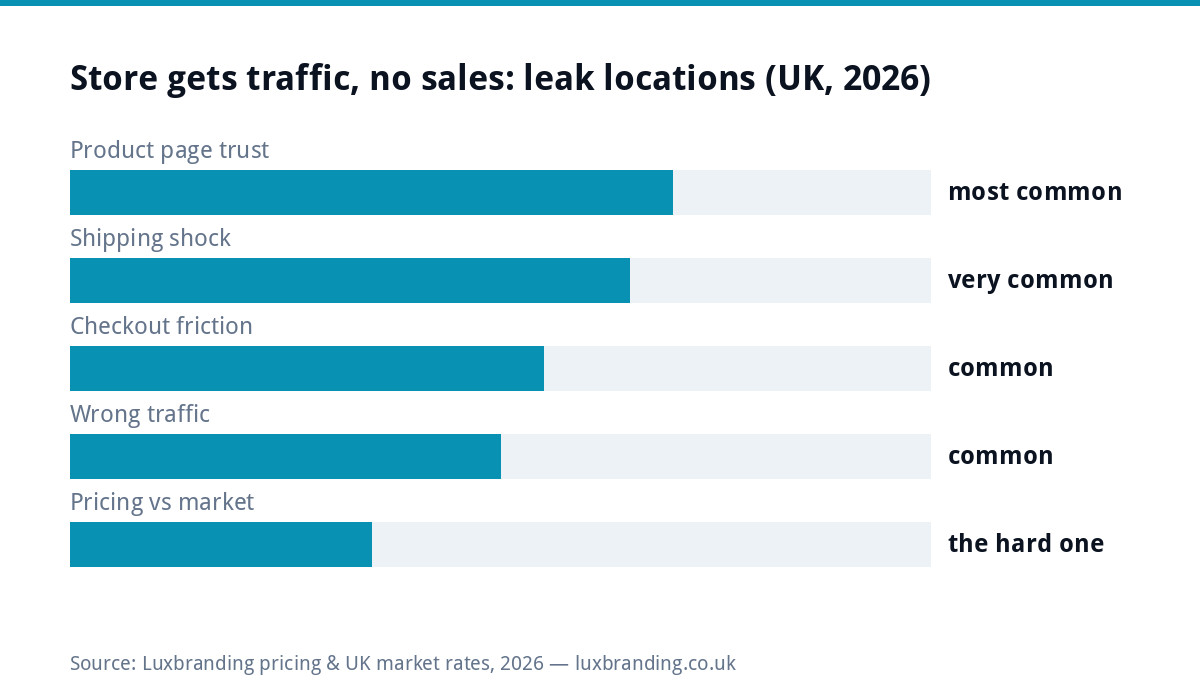
Traffic without sales means a leak between arrival and payment, and the leaks live in a checkable order: product-page trust (the most common), shipping shock, checkout friction, wrong traffic, and only then pricing. Your analytics funnel names the stage; this guide names the fixes, most of which cost £0. Resist the instinct to discount first: cheap prices do not fix broken trust, and the diagnosis order exists because stores keep solving leak five while drowning at leak one.
First: read the funnel (five minutes, names your leak)
Open analytics and get four numbers for the last month: sessions, product-page views, add-to-carts, purchases. The largest percentage cliff is your diagnosis: views but few carts = product pages (leak 1); carts but abandoned before checkout = shipping shock (leak 2); checkouts started, not finished = friction (leak 3); barely any product views at all = wrong traffic (leak 4). Benchmarks for calibration: small stores typically convert 1 to 3% overall; add-to-cart around 5 to 10% of product views is healthy territory. One month of these numbers beats every opinion anyone (including us) has about your store.
Leak 1: the product page trust test
A stranger buys from a screen when the page out-answers their doubt, and small-store product pages routinely fail the checklist: photos from multiple angles, in context, zoomable, honestly lit (the single biggest lever; the sharpness rules apply doubly here); the answers to obvious questions in the description: dimensions, materials, sizing against a known reference, what is in the box; social proof: reviews on the page, imported from wherever they live; reassurance rails: returns policy linked beside the button, delivery time stated, payment icons visible; and a business that exists: real about page, contact route, address in the footer, because carding-shy UK shoppers check. Fix the top five products first and watch the add-to-cart rate move before touching anything else.
Leaks 2 and 3: shipping shock and checkout friction
Shipping. The cart-abandonment classic is arithmetic ambush: £4.99 revealed at step three of checkout. Kill the surprise: delivery cost (or “free over £40”) on the product page itself, thresholds visible in the cart, and if margins allow, prices that absorb it under a “free delivery” banner, which converts the same money better. Checkout. Every field and click sheds buyers: guest checkout ON (forced account creation is the most-cited abandonment reason in every industry survey), address lookup rather than seven fields, wallets (Apple/Google Pay) enabled because a thumbs-only phone buyer is your median customer, and error messages that say what is wrong. WooCommerce and Shopify both support all of it; stores just have to switch it on, which is a configuration afternoon on our e-commerce service’s checklist, not a rebuild. If your platform fights these basics, that is a different conversation: the e-commerce cost guide covers what proper foundations cost.
Leaks 4 and 5: wrong traffic, and the pricing conversation
Wrong traffic. A thousand visitors from a viral craft-tips post convert like tourists at a trade counter. Check sources: traffic from product-intent searches and shopping ads converts; traffic from tangential content, giveaway audiences and bought follower spikes browses. The fix is upstream: aim the ads audit at buying keywords, and grow the searches where purchase intent lives. Pricing, last and honestly. Once trust, shipping and friction are genuinely fixed, if comparison against like-for-like competitors still says you are out of market, the moves are repositioning (better photography and story move the reference class), bundling (raise perceived value instead of cutting price), or accepting the margin maths and adjusting. What never works: discounting into a store that still fails leak one, which just sells distrust cheaper. Full-store diagnosis with numbers is exactly what our free audit starts and the e-commerce service finishes; prices on the price list.
The five leaks at a glance
| Leak | Funnel tell | First fix | Cost |
|---|---|---|---|
| 1. Product-page trust | Views, few carts | Top-5 products to the checklist | £0 + photos |
| 2. Shipping shock | Carts abandoned pre-checkout | Delivery cost on the product page | £0 |
| 3. Checkout friction | Checkouts started, not finished | Guest checkout + wallets on | £0 config |
| 4. Wrong traffic | Few product views at all | Source audit; pause junk spend | £0 (saves money) |
| 5. Pricing | All above fixed, still silent | Reposition or bundle before cutting | Strategy |
Trust at store level (the checks before the product page)
Some visitors bounce before any product page, on store-level doubt, and UK shoppers run a fast checklist: does the footer name a real business with contact details, is there a returns policy findable in one click, do the payment options include ones with buyer protection, does the about page show humans, and does anything look template-abandoned (placeholder text, 2023 copyright, empty social links)? Each is minutes to fix and none needs design skills. The legal layer doubles as trust: UK distance-selling rules require clear returns information and business identity anyway (plain-English basics on gov.uk), so compliance and conversion are the same afternoon’s work. A store that passes this sweep converts its product-page fixes twice as hard, because the visitor arrives at the product already half-persuaded the business is real.
Email capture: the leak’s consolation prize
Even a fixed store converts a minority on first visit, so harvest the majority: a modest first-order incentive for an email address (banner or exit prompt, not a full-screen ambush), and the basic abandoned-cart email that platforms include, which recovers a meaningful slice of the shipping-shock walkouts on autopilot. UK rules are light here but real (consent, unsubscribe that works; the same email marketing basics that govern all sending). A store adding email capture typically finds it becomes the second-biggest revenue channel within months, which reframes the no-sales crisis usefully: traffic was never the asset; the asset is permission to try again.
The one-week fix plan
Day 1: pull the funnel numbers, name the leak. Days 2 to 3: rebuild the top five product pages to the trust checklist. Day 4: shipping visibility and threshold. Day 5: checkout pass (guest on, wallets on, fields minimum). Day 6: source review, pause plainly-wrong traffic spend. Day 7: re-read the numbers and let them, not mood, say what moved. Stores that run this loop monthly compound; stores that redesign the logo every quarter instead stay stuck, which is the entire difference the funnel discipline buys.
What NOT to do while fixing (the panic moves)
The leaks have panic-response twins that make things worse: sitewide discount banners (trains the audience to wait, cements the distrust a broken page created), popup blizzards begging for the sale (friction dressed as urgency), redesigning the logo/theme (the leak was never the font), and buying more of the same traffic to pour through the same holes. Each feels like action; none touches the funnel stage the numbers named. The discipline that separates stores that recover from stores that thrash: change one leak at a time, reread the same four numbers weekly, and let a fortnight of data outvote every opinion, including the founder’s. The one-week plan above exists to channel exactly this energy somewhere that compounds.
Get the UK Website Project Brief Template (free)
A two-page template for briefing any UK web designer: sitemap, integrations, audience and deliverables. Cuts revision rounds in half.
No spam. UK GDPR compliant. We only use your email to send this resource, unless you tick the box to hear from us.
Frequently asked questions
Why is my online store getting visitors but no sales? +
Five leaks cover nearly every case, in checking order: product pages that fail the trust test (photos, detail, reviews), shipping costs revealed too late, checkout friction (forced accounts, clunky payment), traffic that was never going to buy, and pricing genuinely out of market. Analytics shows which stage loses people.
What is a normal conversion rate for a small online store? +
Industry benchmarks commonly cite 1 to 3% as typical for small e-commerce, varying by sector and traffic source. Below ~0.5% with real product-intent traffic means a fixable leak; the diagnosis order in this guide finds it.
Where do I see where customers abandon in my store? +
Your analytics funnel: sessions → product views → add-to-cart → checkout start → purchase. The biggest percentage drop names your leak: product-view-to-cart failing is a product-page problem; cart-to-checkout is shipping shock; checkout-to-purchase is friction or payment trust.
Do I need to offer free shipping? +
You need to kill the surprise, not the charge: show delivery cost on the product page (or bake it into prices and say "free delivery"). Late-revealed shipping is the classic cart-abandonment trigger; a visible threshold ("free over £40") also lifts order values.
Could it just be my prices? +
Only conclude that AFTER the trust, shipping and friction leaks are fixed, because underpriced stores with broken product pages still do not sell. If fixed leaks plus fair comparison still say yes, the answers are repositioning, bundling, or honest margin maths, not a race to the bottom.