
Quick answer
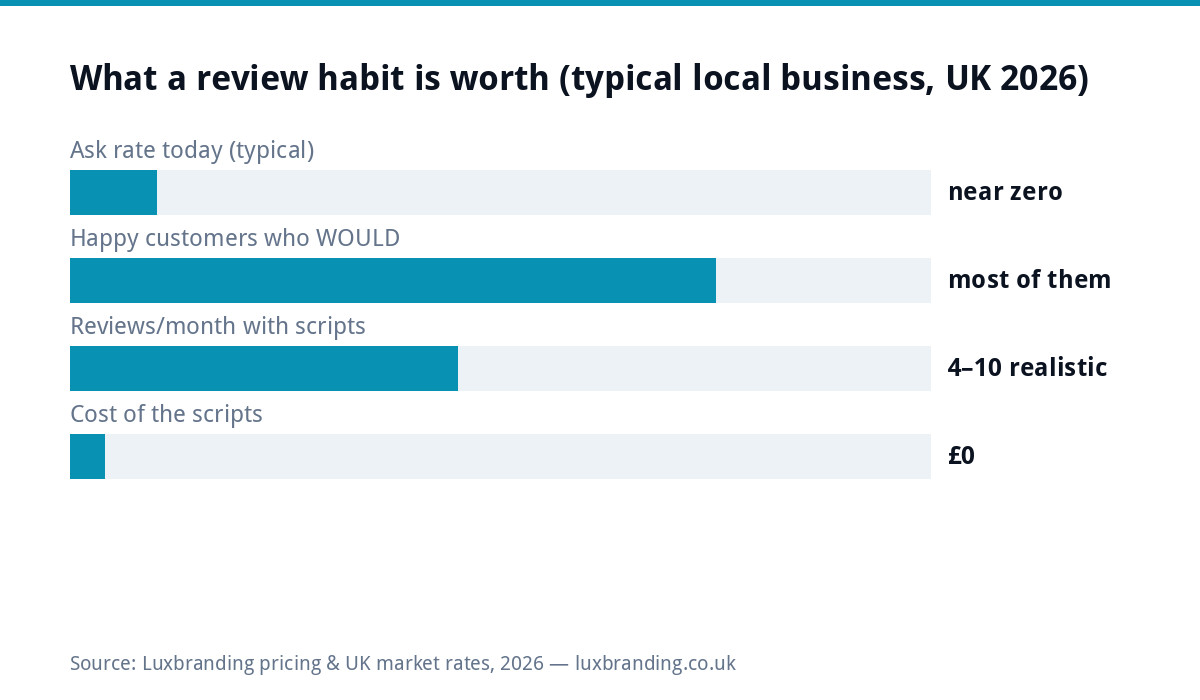
Most happy customers would leave a review; almost nobody asks them. The scripts below fix the asking: copy, personalise the bracketed bits, save as templates, and send at the happy moment with your direct review link. Realistic yield for a local business running the habit: 4 to 10 reviews a month, which in most local markets is the difference between page-one presence and wallpaper. Cost: £0 and thirty seconds per ask.
The scripts (copy from here)
| Situation | The script |
|---|---|
| Text, after a job (trades, services) | “Hi [name], thanks again for choosing us for [the job]. If you’re happy with how it turned out, a quick Google review would mean a lot, it’s how small firms like ours get found: [link]. Either way, enjoy the new [thing]! [Your name]” |
| The compliment reply (in person, then text) | Them: “That looks brilliant.” You: “Really glad you think so! Would you mind saying that in a Google review? Takes a minute and honestly helps us loads. I’ll text you the link now.” |
| Email, after delivery (projects, B2B) | Subject: “Thanks [name], and one small favour”. “Now that [project] is wrapped up, thank you for being great to work with. If you have two minutes, a Google review describing what we did for you helps other [businesses like theirs] find us: [link]. No pressure at all, and shout if you ever need anything.” |
| Counter/QR (cafes, salons, retail) | Sign by the till: “Enjoyed it? A 1-minute Google review keeps a small [cafe/salon] like ours going. Scan to say hi →” (QR to the review link) |
| The regular (long-time customers) | “[Name], you’ve been coming to us for ages and we’ve never asked: would you leave us a Google review? Regulars’ reviews are the ones people trust most: [link]” |
| The gentle second ask (once, a week later) | “Hi [name], no worries if not, but if you did get a minute for that review it’d still be hugely appreciated: [link]. Thanks either way!” |
Why these work (the mechanics under the politeness)
Each script carries the four elements that move ask-to-review conversion: timing at peak satisfaction, because willingness decays by the day; the direct link, because every step you remove (searching your name, finding the button) roughly doubles completion; a reason that dignifies the ask (“it’s how small firms get found”) which reframes the favour as supporting a local business rather than feeding an ego; and the graceful exit (“either way / no pressure”), which paradoxically raises follow-through because nobody reviews under obligation. Personalising the bracketed job detail matters more than any wording tweak: templates that feel like templates get template results.
The rules (so the habit never becomes a problem)
Google’s review policies draw clear lines: ask freely, but never pay or incentivise (discount-for-review breaches policy and looks like bribery to readers), never gate (software that surveys first and routes only happy customers to Google is explicitly banned and increasingly detected), never bulk-submit from your own device or wifi (“hand me your phone, I’ll do it” clusters reviews on one IP and pattern-matches fraud), and never fake, which is the fast lane to the suspension guide. The clean habit is also simply better marketing: steady genuine reviews with real job details are the ones future customers actually believe, and their keywords (“fitted our bathroom”, “sorted the boiler same day”) quietly feed the searches you want to win.
Trade and sector variants (the ask, tuned)
The skeletons flex per sector with one line’s difference. Trades: tie the ask to the walkthrough moment and name the job (“if you’re happy with how the bathroom’s turned out…”), because job-specific reviews convert future customers searching that exact work. Cafes and salons: the counter QR does the volume; staff’s verbal nudge at a compliment does the quality; never card-for-review incentives, which cross the policy line. B2B and professional services: the email variant after a milestone, with the dignifying reason upgraded (“a sentence about the project helps other firms like yours find us”), and LinkedIn recommendations asked in the same breath where they matter to your buyers. Photographers and events: ask when delivering the gallery, satisfaction’s absolute peak, with the venue named in the suggested mention. Same bones everywhere: happy moment, direct link, dignified reason, graceful exit.
The monthly numbers (thirty seconds of scorekeeping)
The habit stays alive when it is visibly working, so keep the crudest possible scoreboard: asks sent and reviews landed, monthly, in one note line. Two things emerge fast: your true ask-to-review rate (a third to a half is normal when the timing and link discipline hold; far lower means the ask is late or linkless), and the compounding total against local competitors, checkable in one search. When a month reads zero asks, the system broke somewhere human (owner busy, trigger moment unowned), which is fixable in a way “we should get more reviews” never is. Measurement this small feels beneath a business; it is exactly the size that survives running one.
What to do with them once they arrive
Reviews compound only if deployed: reply to each (a warm line for the good ones, the scripts for the hard ones), surface the best three verbatim on your website with first names, quote them in proposals and social posts (screenshot-of-review posts are the highest-trust content in local social), and mine the recurring praise for positioning, because when five reviews independently say “tidy and on time”, that phrase belongs in your headline. The reviews you asked for become the marketing you no longer have to write, which is the quiet second return on a habit that already pays once in rankings.
Wire it into the week (or it stays a good intention)
The scripts only earn when sending is automatic: save the review link as a phone shortcut and the scripts as message templates; pick the trigger moment for YOUR business (invoice sent, job signed off, table cleared) and attach the ask to it every time; give the ask an owner in a team; and reply to every review that arrives, because replies double the asset (the response scripts cover the hard ones, and a warm one-liner covers the rest). Track nothing fancier than a monthly count. Businesses that run this loop stack thirty-plus genuine reviews a year on autopilot, which in local search terms is a moat; the £199 profile setup builds the machine around it, and the scripts stay free either way, on principle, like this whole price list is public on principle.
Objections from inside the business (answered once)
The scripts fail more often to internal resistance than customer refusal, so the standard objections, retired: “it feels pushy” (the graceful-exit line exists precisely so it is not, and customers report feeling flattered, not pressured); “our work speaks for itself” (to the customers who already found you; reviews are how the NEXT ones do); “we’ll do it when things calm down” (the ask takes thirty seconds inside a moment you are already having); and “what if they leave a bad one” (someone unhappy enough to review badly will do so unasked, and the response scripts handle it; the ask only changes whether the happy majority ever speaks). Teams that hear these answered once tend to run the habit; the scripts were never the hard part.
Get the UK SEO DIY Audit Checklist (free)
A 32-point checklist UK SMEs can run against their own website in an afternoon. Surfaces the quick wins before paying for a paid audit.
No spam. UK GDPR compliant. We only use your email to send this resource, unless you tick the box to hear from us.
Frequently asked questions
How do I ask a customer for a Google review? +
Right after the happy moment, personally, with the direct link: "Really glad you're pleased with it. Would you mind leaving us a quick Google review? It genuinely helps: [link]." The scripts below give tested variants for text, email and in person.
When is the best time to ask for a review? +
At peak satisfaction: job just finished and admired, problem just solved, compliment just given. Same day beats next week by a distance; the compliment moment ("this looks brilliant") is the single best trigger, answered with the ask.
How do I get my Google review link? +
In your Business Profile dashboard there is a share-review-form link (a short g.page address). Save it as a phone shortcut and in your templates; making the customer search for you loses most of them.
Is it against the rules to ask for reviews? +
Asking is fine and normal. What breaches Google's policies: paying or incentivising reviews, review-gating (filtering happy customers toward Google and unhappy ones away), bulk asks from one device/IP, and fake reviews, which risk profile suspension.
How many reviews does a small business need? +
Enough for recency and volume to read as alive: in most local markets, a steady flow (a few per month) beats a big stale number. The habit matters more than the total, which is exactly what scripts systematise.