
Quick answer
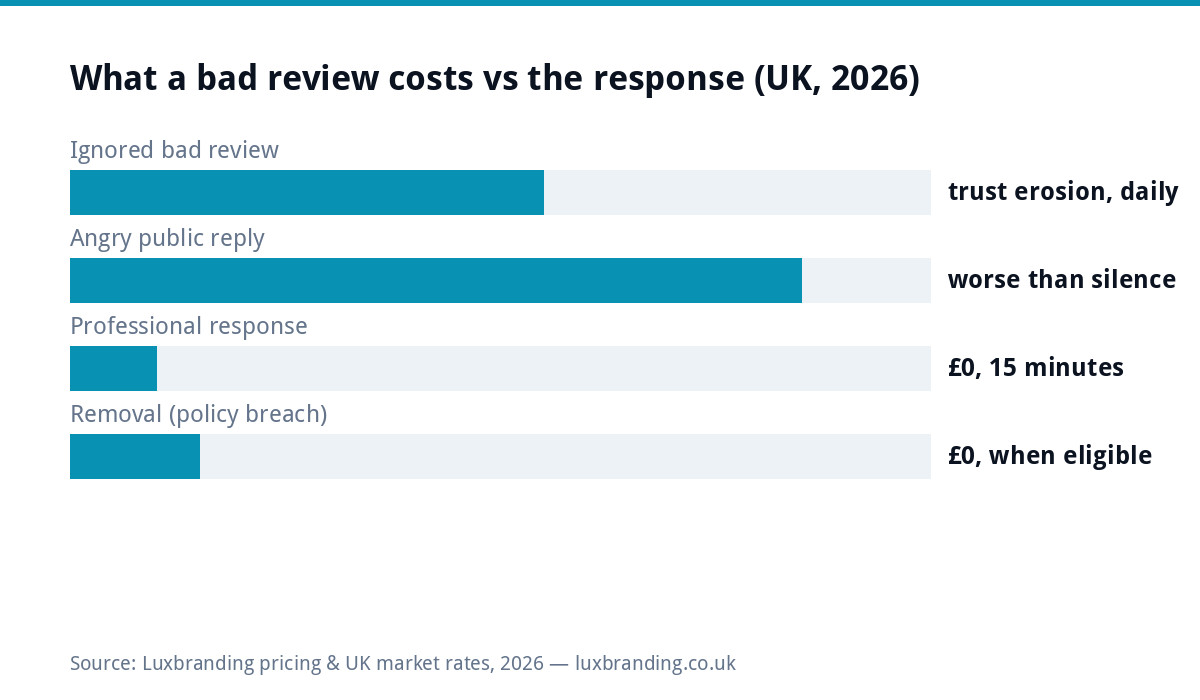
Respond to every negative review, within days, never within the angry hour, and write for the hundreds of future customers who’ll read the exchange, not the one reviewer. The formula: acknowledge specifically, own what’s yours, state the fix, move resolution offline, stay brief. Removal is possible only for policy-breaching reviews (fake, competitor, offensive); for honest-but-harsh ones, the reply IS the remedy. Scripts for every scenario below, free, fifteen minutes, and worth more than most marketing spend.
The reframe that fixes your reply before you write it
A negative review feels like a verdict; it’s actually a stage. Research on consumer behaviour consistently shows readers weight how businesses HANDLE criticism as heavily as the criticism itself, a flawless 5.0 reads as curated, while a 4.6 with gracious, specific responses reads as real and safe to hire. That means your reply’s job is not to win the argument, correct the record line-by-line, or even satisfy the reviewer (pleasant if it happens). Its job is to show the next hundred readers exactly what dealing with you looks like when something goes wrong, which is, quietly, the question every buyer is really asking.
Scripts by scenario (adapt the voice, keep the bones)
| Scenario | The reply skeleton |
|---|---|
| Legitimate complaint | “Thanks for the honest feedback, [name], the delay on your [job] wasn’t the standard we aim for, and I’m sorry. We’ve [specific fix made]. I’d like to put it right, please call me directly on [number]., [Your name]” |
| Partly fair, partly not | Own your part specifically; skip the rebuttal entirely. “You’re right that [fair bit], that’s on us and we’ve [fix]. I’d welcome the chance to talk through the rest: [number].” |
| Factually wrong but genuine customer | One calm correction, no pile-on: “Our records show [one neutral fact, no personal details]. Happy to straighten this out directly: [number].” |
| Never a customer / wrong business | “We’ve no record of working with you and believe this may be intended for another business, we’ve flagged it to Google. If we’re mistaken, please contact us on [number].” Then flag it. |
| Abusive or unhinged | Shortest of all: “This doesn’t reflect any interaction we recognise, and we’ve reported it. Genuine concerns are always welcome on [number].” Readers can tell. |
Universal rules inside every skeleton: use their name and one specific detail (proves it’s not a template), sign a human name (accountability reads as confidence), keep it under 100 words (long replies look like guilt), and take the resolution OFFLINE, the public thread is for demonstrating character, not conducting the negotiation.
The best answer to one bad review is a steady flow of good ones; use our scripts for asking happy customers for reviews.
Worked example: one reply, dissected
Review: “Absolute cowboys. Quoted one price then charged more, and left mess everywhere. Avoid.” The reply that wins the readers: “Thanks for the feedback, Mark, sorry the job ended on this note. The extra cost came from additional work we agreed mid-job, but you’re right that we should have re-confirmed it in writing before continuing, and that’s now standard for us. The mess is simply on us, no excuses. I’d genuinely like to make this right: 07xxx, ask for Dan.” Notice what it does: names him (real, not template), gives context in one clause WITHOUT calling him a liar, concedes specifically twice, announces a process change (readers love this, it’s proof the criticism landed), and hands over a name and number. Fifty-nine words. Readers finish it trusting Dan more than they would have without the bad review, which is the whole game, and why “cowboys” sitting un-replied is the only genuinely losing outcome.
The pattern question (when the review is trying to tell you something)
One bad review is weather; the same bad review three times is climate. Before filing a response and moving on, check the pattern: if “didn’t turn up when promised” or “final bill surprised me” recurs across months, the reviews have located an operational leak that no reply-craft fixes, and fixing it is worth more than a hundred five-stars. The practical move: keep a two-column note of every sub-four-star review’s core complaint and date. Repeats become your improvement list; the public replies then get to say “we’ve changed how we schedule/quote” and MEAN it, which readers can smell. This is the growth secret hiding in review management: your angriest customers are doing unpaid quality-assurance consultancy, and the businesses that mine it quietly out-operate the ones that only out-reply.
Reviews on other platforms: same skeletons, one difference
Checkatrade, Trustpilot, Facebook and TripAdvisor reviews all reward the identical reply discipline, with one platform nuance worth knowing: several (Trustpilot notably) run their own flagging processes with different evidence standards than Google’s, and trade platforms often mediate disputes directly, sometimes more responsively. Reply publicly with the same skeletons everywhere, keep the resolution offline, and centralise the pattern-tracking across platforms in one note; the customer reading you on Checkatrade tomorrow is the same person who read you on Google today, and consistency across both is itself a trust signal.
If reviews have vanished rather than been posted, our guide to Google reviews that have disappeared covers five causes.
The five-minute response workflow (make it unmissable)
Turn the advice into a system so it survives busy weeks: review notifications ON (profile settings, many owners discover reviews weeks late); a saved drafts note with the five skeletons above, personalised once in your voice; the 24-hour rule for anything that raised your pulse (draft hot, post cold); a named owner of replies, in most small firms, whoever answers the phone best writes replies best; and the monthly pattern check from the section above, calendared with the other profile upkeep. Fifteen minutes a month, total. Businesses that run this loop stop fearing the notification, which, given that review anxiety is why most bad replies get written at 11pm, might be the workflow’s biggest single benefit.
The traps that turn one bad review into a story
Each of these has sunk a local reputation: the GDPR trap, never confirm a reviewer’s address, job details, invoice amounts or dispute specifics publicly, even correcting lies; “we can’t discuss client details publicly, but…” is your armour. The war, replying to their reply to your reply; one response, then silence, whatever they add. The bribe, “remove it and we’ll refund you” breaches Google’s rules and reads as guilt to everyone watching; offer the fix unconditionally. The legal-threat reply, genuinely defamatory reviews exist and UK law provides routes, but announcing lawyers in a review reply convinces every reader you’re terrifying to work with; take real legal concerns to an actual solicitor, quietly. The sock-puppet defence, friends-and-family five-stars to bury it are detectable, against policy, and a suspension risk (see our suspension guide for how that ends).
Removal: the narrow real route
Google removes reviews that breach its content policies, not reviews that hurt. Qualifying: fake reviews from non-customers, competitor sabotage, hate/harassment, off-topic content (politics, a different business), and conflicts of interest. Flag via your profile’s review-management tools, be patient (days to weeks), and keep expectations calibrated, honest one-stars from real customers stay, which is why the reply skill matters more than the removal button. Meanwhile the strongest medicine is dilution: a steady flow of genuine reviews makes any single bad one statistically boring, the ask-every-happy-customer habit from our reviews guide, systematised in the £199 profile setup. A 4.7 across two hundred reviews with graceful replies is, commercially, a fortress, and every part of building it is on the price list or free.
Get the UK SEO DIY Audit Checklist (free)
A 32-point checklist UK SMEs can run against their own website in an afternoon. Surfaces the quick wins before paying for a paid audit.
No spam. UK GDPR compliant. We only use your email to send this resource, unless you tick the box to hear from us.
Frequently asked questions
Should I respond to a negative Google review? +
Always, but you're not writing to the reviewer. You're writing to every future customer who reads it. A calm, specific, solution-shaped reply routinely does more for trust than another five-star review; silence reads as guilt and anger reads as risk.
How quickly should I reply to a bad review? +
Within a couple of days, but never within the first angry hour. Draft it, sleep on anything heated, then post. Speed matters less than tone; a measured reply on day two beats a defensive one in minute ten.
Can I get a negative Google review removed? +
Only if it breaches Google's policies: fake/never-a-customer reviews, competitor sabotage, offensive content, off-topic rants, conflicts of interest. Flag it via the profile, add context through the official channels, and reply publicly meanwhile, removal takes days to weeks WHEN it qualifies, and most honest-but-harsh reviews don't.
What should I never write in a review response? +
Arguments about who's right, customer details (a GDPR trap, never confirm someone's job details, address or dispute specifics publicly), accusations of lying, legal threats, or discounts-for-removal offers (which breach Google's rules and read as bribery to onlookers).
Do negative reviews actually hurt my business? +
Less than the response to them does. A 4.6 with well-handled criticism outperforms a suspicious 5.0. Volume and recency of good reviews dilute the sting fast, the real damage comes from patterns (same complaint thrice) and from replies that show the business at its worst.