The short answer
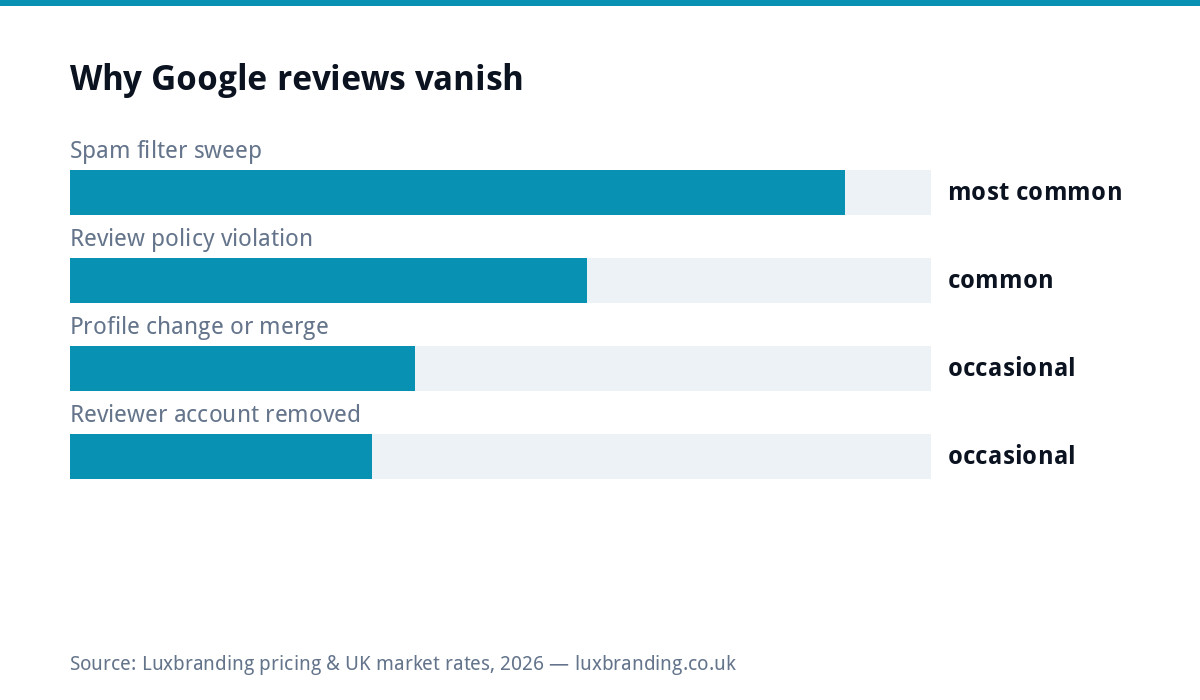
Google reviews disappear for one of a handful of reasons: an automated spam-filter sweep (by far the most common), a policy violation in the review text, the reviewer’s own account being deleted or restricted, or a change to your Business Profile such as an address move, a merge, or recovery from suspension. Most filtered reviews are never coming back and Google will not tell you which rule tripped, so the productive response is a quick diagnosis, one well-formed support case for genuinely wrongly-removed reviews, and then a steady rebuilding habit rather than a fight you cannot win.
First: confirm they are actually gone
Before diagnosing anything, check the difference between missing and delayed. New reviews can take several days to appear, especially from new Google accounts, and the count shown in Maps sometimes lags the profile itself. Open your profile in a private browser window (so you see what the public sees), note the visible review count, and compare it against what you believed you had. One review missing is a filter or a reviewer-side event. A sudden drop of five, ten or more overnight is a sweep or a profile-level event, and the causes below split along exactly that line.
Cause 1: the spam filter sweep
Google runs continuous automated detection against fake-review networks, and periodically it tightens the model and re-scores old reviews. When that happens, legitimate reviews get caught in the same net, particularly short ones (“Great service!”), reviews from accounts with little other activity, reviews left on the business’s own premises Wi-Fi, and bursts of reviews arriving in a short window. Nothing appears in your account; the number simply drops. Google’s own help pages confirm that removed reviews are generally not reinstated and that it does not notify businesses which reviews were taken or why; the policies being enforced are listed in the prohibited and restricted content rules.
Cause 2: a policy violation in the review itself
Reviews mentioning competitors by name, containing links or phone numbers, written by (or clearly about) employees, offered in exchange for a discount, or duplicating text posted elsewhere all violate review policy and get removed when detected, sometimes months after posting. The one that catches decent businesses out most often is incentivised reviews: “leave us a review for 10% off” breaches the policy on both sides, and when Google detects the pattern it removes the whole cluster. If you have ever run a review incentive, that is very likely your answer.
Cause 3: the reviewer, not you
A review lives on the reviewer’s Google account. If they delete the review, delete their account, or have their account suspended for activity elsewhere, every review they ever left vanishes with them. There is nothing to appeal because nothing was done to your business. This is the usual explanation when one old review from a real customer quietly disappears.
Cause 4: something changed on your profile
Profile-level events take reviews with them. Recovering from a suspension can bring the profile back before its reviews catch up (they usually return within days, but not always all of them). A duplicate-listing merge moves or drops reviews. Changing address or category can trigger a re-verification that temporarily hides them. If your reviews vanished around the same time as a suspension or reinstatement, read our guide to a suspended Business Profile, because the review problem is downstream of the profile problem and fixes with it.
What is recoverable, and what is not
| What happened | Recoverable? | What to do |
|---|---|---|
| Filter sweep took real reviews | Rarely | One support case; then rebuild steadily |
| Policy violation (links, incentives, staff) | No | Stop the practice that caused it |
| Reviewer deleted account or review | No | Nothing; it was theirs to remove |
| Suspension / reinstatement in progress | Usually yes | Wait 1-2 weeks after reinstatement, then escalate |
| Duplicate listing merge | Sometimes | Support case citing both listings |
How to raise it with Google properly
There is exactly one worthwhile route: the Business Profile help centre’s contact flow (support.google.com/business), signed in as the profile owner. Make the case easy to grant: state the number of reviews missing, the date they disappeared, that they came from genuine customers, and any profile event that coincided. Screenshots of the before state help enormously, which is why the prevention section below tells you to keep them. Expect a template first reply; answer it once with the same facts. If the reviews were filter-removed, expect a polite no, and stop there. Repeated cases about the same reviews get profiles flagged, not reviews restored.
Rebuild faster than you lost them
The businesses that recover from a review wipe are the ones with a steady asking habit, because a profile gaining two or three reviews a week from varied, real accounts is both filter-resistant and quick to replace losses. Ask every happy customer at the moment of delight, vary the wording, never incentivise, and never batch (“we texted all 200 past customers on Saturday” is exactly the burst pattern the filter eats). Our free review request scripts give you word-for-word asks for text, email and in person, and our guide to responding to negative reviews covers the other half of the reputation job.
Prevention: the five-minute monthly habit
Once a month, screenshot your profile’s review count and star rating, and export nothing else; the screenshot is your evidence pack if a sweep ever hits. Check that your profile details have not been “suggested-edited” into inaccuracy, keep posting the occasional photo, and keep the asking habit running. A profile that Google sees actively and honestly maintained is measurably less likely to be caught in enforcement side-effects, and when it is, reinstatement conversations go better with an owner who can show the history.
Where this sits in the bigger picture
Reviews are one leg of local visibility alongside profile completeness, categories, photos and your website’s local signals. If the review scare has you looking at the whole setup, our Business Profile setup cost guide explains what a professional overhaul involves, and our Business Profile optimisation service (£199) rebuilds the profile end to end: categories, attributes, photos, posts and a review pipeline that grows the steady way. Every price we charge is public on the pricing page.
What not to do while you rebuild
Three tempting responses make things worse. Buying reviews, even a discreet handful to “top back up”, plants exactly the network signature the filter exists to find, and enforcement against purchased reviews takes the genuine ones down with them. Review gating (asking only happy customers by pre-screening with “how did we do?” surveys) breaches policy and shows up statistically. And mass-messaging your entire customer history in one weekend produces the burst pattern that triggered many wipes in the first place. Slow and real is not just the compliant route; after a filter event it is the only route that sticks.
If a competitor is spamming you with fake negatives
The mirror problem: reviews vanishing is bad, but fake one-star reviews arriving is worse, and the same machinery applies in reverse. Report each fake review through the profile’s report option, citing the specific policy (conflict of interest, off-topic, spam), and note that removal takes days to weeks and succeeds on pattern-evident fakes far more often than on plausible-sounding ones. Meanwhile respond publicly and calmly once per fake so future readers see the pattern named. Our guide to responding to negative reviews includes wording for exactly this situation.
The honest summary
Missing reviews feel like theft, but chasing individual restorations is almost always wasted energy. Diagnose which of the five causes fits, file one good support case if a profile event or merge is implicated, fix any practice (incentives, staff reviews, bursts) that invited enforcement, and put the energy into a review-earning habit that makes any single loss trivial. Six months of steady asking beats six weeks of arguing with a filter that does not negotiate.
Get the UK SEO DIY Audit Checklist (free)
A 32-point checklist UK SMEs can run against their own website in an afternoon. Surfaces the quick wins before paying for a paid audit.
No spam. UK GDPR compliant. We only use your email to send this resource, unless you tick the box to hear from us.
Frequently asked questions
Why did my Google reviews suddenly disappear? +
Usually an automated spam-filter sweep, which periodically re-scores old reviews and removes ones that look risky (short text, inactive accounts, bursts). Other causes: policy violations in the review, the reviewer deleting their account, or a profile event like a suspension or merge.
Can I get removed Google reviews restored? +
Rarely. Filter-removed reviews are generally not reinstated and Google will not say which rule tripped. The exceptions worth one support case: reviews lost during a suspension, reinstatement or duplicate-listing merge, which often do return or can be restored.
Do reviews come back after a Business Profile suspension? +
Usually, within days to two weeks of reinstatement, though not always all of them. Wait two weeks after the profile returns before raising a support case about any that are still missing.
Are "review us for a discount" offers against Google policy? +
Yes. Incentivised reviews breach policy for both the business and the reviewer, and when Google detects the pattern it removes the whole cluster at once, often months later. It is one of the most common causes of a sudden multi-review drop.
How do I protect my Google reviews in future? +
Screenshot your review count monthly as evidence, earn reviews steadily (two or three a week from varied real customers, never batched or incentivised), and keep the profile actively maintained. Steady, organic patterns are what the filters are built to trust.