
Score your brand in ten minutes
This is a complete brand audit you can run yourself, today, without a consultant. Score each of the ten items below from 1 (a mess) to 5 (nailed), be honest rather than kind, add them up, and read your band at the end. Ten minutes with this page tells you what a £500 brand audit would: exactly where your brand is leaking credibility, and which fixes are cheap. Do it with your website, your social profiles and a recent invoice or flyer open in other tabs, because the whole exercise is about looking at your brand the way a stranger does.
1. Logo files (score 1-5)
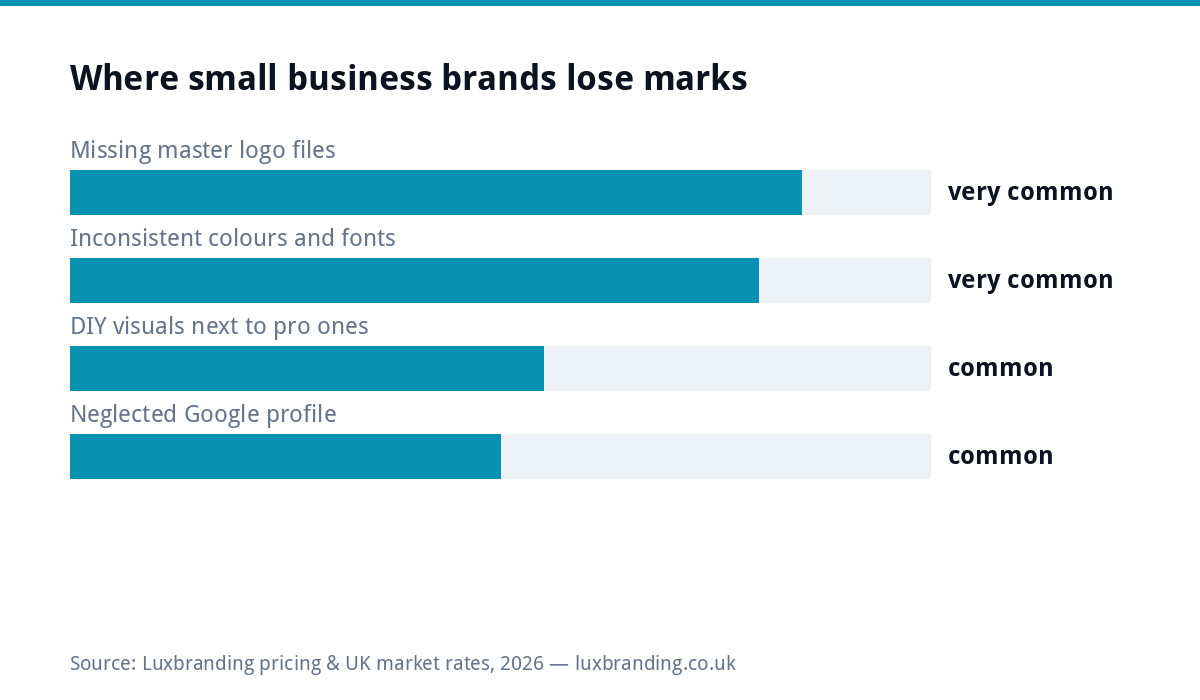
Can you, right now, lay hands on your logo as a vector file (SVG, EPS or AI), a transparent PNG, and a white version for dark backgrounds? Score 5 if all three are in a folder you control. Score 3 if you have one decent PNG. Score 1 if your “logo file” is a screenshot cropped from your own website. This is the most commonly failed item in the whole audit, and it silently caps everything else: signwriters, embroiderers and printers all need the vector. If you scored low, a £79 file rebuild fixes it without redesigning anything; the full list of what you should hold is in our guide to logo sizes and formats.
2. Visual consistency across touchpoints (1-5)
Open your website, your Facebook or Instagram, and your last printed item side by side. Same logo version? Same colours? Same general feeling? Score 5 for indistinguishable siblings, 3 for a family resemblance, 1 if they look like three different businesses. Inconsistency is expensive precisely because each piece was probably fine alone; it is the collection that tells customers nobody is steering.
3. Colour palette (1-5)
Do you know your exact brand colours as hex codes, and do the website, socials and print actually use them? Score 5 for a written palette in use everywhere, 3 for “it’s sort of navy and orange” applied by eye, 1 for whatever each tool defaulted to. Colour is the fastest brand recognition signal there is, and it costs nothing to fix: pick the codes once, write them down, use them ruthlessly.
4. Typography (1-5)
Same question for fonts: named, written down, used consistently on the site and in materials? Score 5 for a heading font and body font applied everywhere, 1 for a different font on every document because Word, Canva and the website each chose their own. Two fonts, used always, beat six fonts used creatively.
5. Photography and imagery (1-5)
Look at the images representing your business. Score 5 for real photos of your actual work, team or premises, consistently treated. Score 3 for a mix of real and stock. Score 1 for the same smiling call-centre stock models your competitor also uses, or phone snaps with bins in the background. Customers cannot verify your skills from a website, so they judge the evidence you show; real beats glossy, and consistent beats both.
6. Tone of voice (1-5)
Read your homepage, an invoice email and a recent social post aloud. Same person talking? Score 5 if the voice is recognisable and consistent, whether that is warm, blunt or technical. Score 1 if the website says “we are passionate about delivering excellence” while your emails say “cheers mate, sorted”. Most small businesses have a genuinely likeable natural voice in person and a beige corporate one online; the audit point is the gap.
7. Website first impression (1-5)
Open your site on your phone as if you were a stranger. Within five seconds: is it obvious what you do, where you do it, and what to tap to start? Score 5 for instantly clear and fast, 3 for clear after some scrolling, 1 for slow, dated or confusing. Harsh but true: this single item carries more commercial weight than the other nine combined, because it is where the audit stops being cosmetic and starts being revenue.
8. Social profiles (1-5)
Check your active profiles: current logo as the avatar, correct cover image, bio that says what you do and where, link that works, last post within a month. Score 5 for all of them, 1 for an abandoned page with a pixelated logo from two rebrands ago. An abandoned profile is worse than none, because it looks like a closed business.
9. Print and paperwork (1-5)
Business cards, invoices, quotes, van, workwear, signage: do they carry the current logo, colours and phone number? Score 5 for a matched set, 1 if the van has the old number and the invoice is a default template. Paperwork is a brand touchpoint customers handle at the exact moment money changes hands, which makes a scruffy invoice a strangely expensive saving.
10. Google presence (1-5)
Search your business name. Score 5 if your Business Profile appears with correct hours, real photos, recent reviews and your website linked. Score 3 for a claimed but thin profile, 1 for unclaimed, wrong or absent. You can check and edit everything through Google’s own Business Profile editing guide, and our setup cost guide covers what a professional overhaul involves.
Your score: what the bands mean
| Total | Band | What it means | Priority move |
|---|---|---|---|
| 42-50 | Strong brand | Consistent and credible; protect it | Consider a trade mark via gov.uk |
| 32-41 | Solid but leaking | Good bones, visible inconsistencies | Fix your two lowest-scoring items this month |
| 22-31 | Inconsistent | Customers see three different businesses | Write the palette and fonts down; align everything to them |
| 10-21 | Rebuild the basics | The brand is costing you work | Start with logo files and the website, in that order |
Run it as a team, not a solo confession
If anyone else works in the business, have two or three people score independently before comparing. The gaps are the insight: the owner scores tone of voice a 4 because they wrote it, the newest hire scores it a 2 because they can see it reads nothing like how anyone speaks. Items where scores diverge by two or more points are where the brand is inconsistent in ways insiders have stopped noticing. Average the scores for your total, but argue about the divergent items first, because they are free to fix and nobody had permission to mention them before.
Repeat it quarterly and keep the scores
The audit’s real power is the trend line. Write the date and total somewhere permanent and rerun it every quarter: a brand moving 26 to 31 to 38 across nine months is compounding credibility, while a static score means the fixes are not landing. It also catches drift early: new staff posting off-palette graphics, a price list printed in the wrong font, a Google profile edited by a well-meaning relative. Ten minutes a quarter is the cheapest brand management programme that exists.
Turning the score into a plan
Whatever you scored, resist the urge to fix everything at once. Take your two lowest items and fix only those; run the audit again in a month and take the next two. Low scores on items 1-4 (files, consistency, colour, type) usually mean the foundations were never documented, which is exactly what a brand identity project produces: our brand identity service (£299) delivers the logo suite, palette, typography and usage rules that turn eight of these ten items into a checklist you pass automatically. If you are briefing any designer, ours or anyone else’s, the free design brief template forces the decisions this audit surfaced. And if the audit revealed a deeper question, whether the brand is worth investing in at all versus starting fresh, our comparison of cheap and expensive logo design and the full logo cost guide map what each level of investment actually buys. Every price we charge is public on the pricing page.
Get the UK Branding Budget Worksheet (free)
A printable worksheet: decide what your brand needs now and price it against fixed published prices and the IPO trademark fee.
No spam. UK GDPR compliant. We only use your email to send this resource, unless you tick the box to hear from us.
Frequently asked questions
What is a brand audit? +
A structured review of every place your brand meets customers (logo, colours, fonts, website, socials, print, Google) scored for consistency and credibility. This checklist version scores ten touchpoints out of 5 for a total out of 50, with bands telling you what to fix first.
How often should I audit my brand? +
Twice a year for a stable business, and always after a rebrand, a new website, or new staff taking over social media, because those are the moments inconsistency creeps in. The ten-minute version here is frequent-friendly by design.
What do most small businesses fail on? +
Missing master logo files (no vector, no transparent version) and inconsistent colours and fonts across website, social and print. Both are cheap to fix: a file rebuild costs £79 for one layout, and writing down your palette and fonts costs nothing.
What is a good brand audit score? +
42-50 out of 50 means a strong, consistent brand. 32-41 is solid but leaking. 22-31 means customers see a different business at each touchpoint. 21 or below means the brand basics need rebuilding, starting with logo files and the website.
Do I need to pay for a professional brand audit? +
Not to find the problems; this checklist surfaces the same issues honestly. Paying makes sense at the fixing stage: a brand identity project (£299 at our studio) documents the logo suite, palette, typography and rules that make most audit items pass automatically.