
Quick answer
After buying a small business, budget £299 for a brand identity refresh or £1,999 for a complete rebrand package with a new website, and decide the name question on evidence: keep the name if customers chose the business for it and it carries reviews, rankings and local recognition; replace it if it is tied to the previous owner personally, describes something the business no longer does, or has a reputation you paid a discount for. Either way, refresh the identity rather than leaving the old owner’s DIY logo in place. The legal and listings admin (Companies House, HMRC, Google, directories, domains) costs little but decides whether you inherit the goodwill you paid for or lose it in the first month.
This guide gives you a keep-or-replace decision table, the sequence for a post-acquisition rebrand, the admin that has to happen regardless, and a realistic cost and timeline.
Keep the name or replace it? The decision table
| Situation | Keep | Replace | Middle route |
|---|---|---|---|
| Name is a surname of the seller (“Dave Smith Electrical”) | Only if Dave is staying on for a handover year | Yes, over 12 months | “Smith Electrical” without the first name, then evolve |
| Strong Google reviews and rankings under the name | Yes | Rarely | Rebrand the look, keep the name |
| Name describes one service, business does several | No | Yes | Add a descriptor line for a year first |
| Bought at a discount because of reputation | No | Yes, quickly and visibly | None; a half-hidden rename looks worse |
| Merging with a business you already run | Depends which name is stronger locally | Fold the weaker into the stronger | Dual-brand for 6 months, then one |
| Name clashes with a trade mark or a larger firm | No | Yes, before you invest in signage | None |
| Name is fine, logo is a 2009 clip-art job | Yes | No | Refresh the identity only |
The most common outcome is the middle column of the last row: the name has value, the look does not. That is a rebrand without a rename, and it is the cheapest and least risky version.
What you actually bought: the goodwill
When a small business changes hands, most of the price above the value of the vans and stock is goodwill: the reviews, the rankings, the regulars, the recognition of the name and the livery. A rebrand that throws that away in month one is paying for an asset and then setting fire to it. Before touching anything, list where the goodwill lives: the Google Business Profile and its reviews, the Checkatrade or Trustpilot profile, the domain and its search rankings, the Facebook page, the phone number, the customer list. Every one of those transfers with the business if you keep the accounts and edit them, and every one is lost if you create new ones. Our Google Business Profile guide covers claiming and editing an existing listing.
The admin that happens whatever you decide
Buying the business does not update the records. If you bought the limited company, the ownership changes at Companies House but the company name stays until you change it; if you bought the assets and trade into your own company, the old company name is not yours to use unless the sale agreement transfers it. The Government’s guidance on company changes you must report lists the filings, and the Companies House register shows what is currently recorded. If staff came with the business, the TUPE rules on business transfers apply to their contracts regardless of what you call the firm.
Then the practical list: bank account name, insurance, HMRC and VAT, trade-body memberships, gas or electrical registration numbers, the domain registration and hosting (in your name, not the seller’s), the social account admin rights, and the phone contract. Owners who skip this find the domain expiring in the seller’s inbox a year later; our note on what happens when a domain expires is a cautionary tale.
If you keep the name: refresh, do not restart
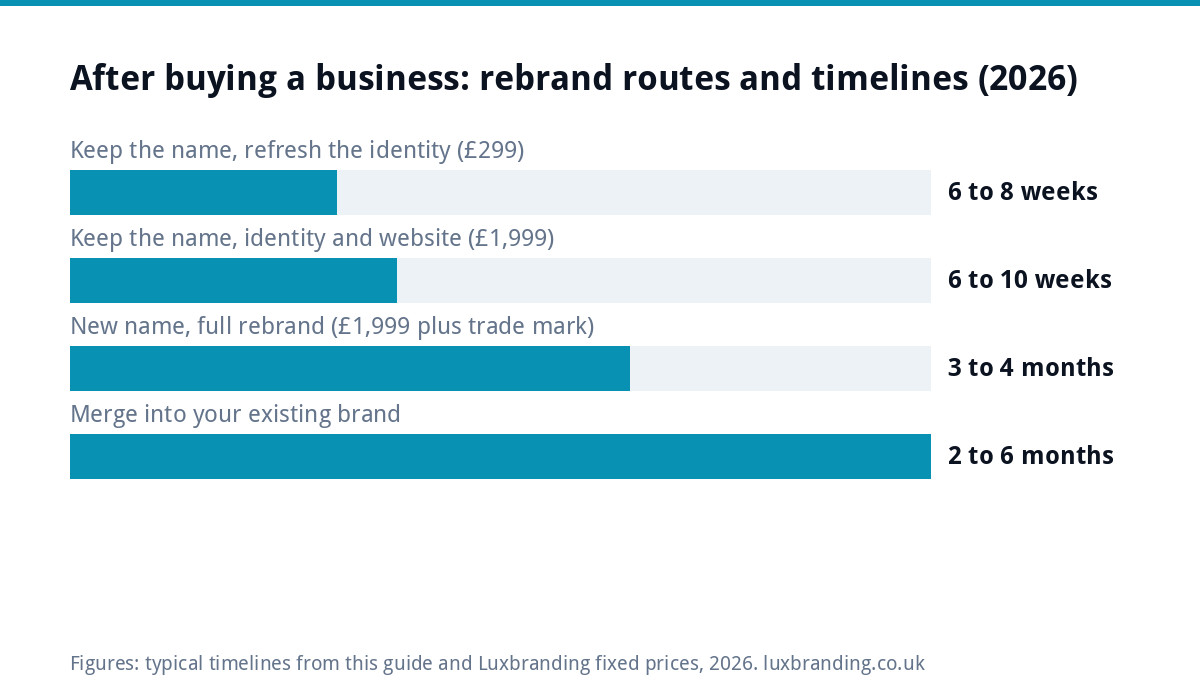
Keep the name, keep every listing, and rebrand the identity: a redrawn logo that respects the old one (customers should recognise it as an evolution), a proper colour palette, typography, stationery, social templates and guidelines. Then roll it through the vans, workwear, website and documents in the usual order. This is a standard rebrand, and the timeline in how long a rebrand takes applies: six to eight weeks for a small firm. A brand identity at £299 covers the design side if the website is fine; the package covers it if the website needs rebuilding too. The signs that the old logo needs more than a polish are in signs your logo needs a redesign.
If you replace the name: bridge, then switch
A rename after an acquisition needs a bridge period so the goodwill walks across with you. The pattern that works:
- Months 0 to 2: take over, keep the old name and look, fix the admin, meet the regulars. Do not change anything customers see.
- Months 2 to 4: design the new brand. Check the new name on the Companies House register, the domain and the trade mark register first; the Government’s trade mark registration guide explains the search and filing. Our business name checker does the first pass.
- Month 4, launch day: edit (never recreate) every listing to the new name, switch the website with redirects from the old domain, send the announcement email, and put “formerly [Old name]” on every document that involves money.
- Months 4 to 16: keep the “formerly” line, keep the old domain redirecting, keep the old phone number live. Drop the old name only when nobody has asked about it for three months.
The announcement itself, including the email and the three questions customers always ask, is covered step by step in how to announce a rebrand to customers.
The website and the domain
The website is where rankings and enquiries live, so it is where an acquisition rebrand can quietly lose the most. Keep the old domain and redirect every page to its equivalent on the new site, page by page, not everything to the homepage. Keep the Google Business Profile pointed at the domain that holds the rankings until the redirects have settled. If the site itself is dated, rebuild it as part of the rebrand; a custom WordPress website is £499 on its own, while the package includes our premium custom WordPress build of up to 14 pages, which is £1,499 on its own. The website redesign cost guide covers what a rebuild with migration involves.
Cost and timeline for a post-acquisition rebrand
| Route | Design cost (fixed) | Production (vans, workwear, signage) | Timeline |
|---|---|---|---|
| Keep name, refresh identity | Brand identity £299 | Livery and workwear re-done to the new identity | 6 to 8 weeks |
| Keep name, refresh identity and website | Complete rebrand package £1,999 | As above | 6 to 10 weeks |
| New name, full rebrand | Complete rebrand package £1,999 plus trade mark filing fee | As above plus signage, redirects, listing edits | 3 to 4 months including the bridge period |
| Merge into your existing brand | Brand identity refresh £299 if your brand needs updating | Re-liver the acquired vans to your brand | 2 to 6 months dual-brand, then one |
Production costs depend on vehicles and headcount; the vehicle signage cost guide and the rebranding cost guide give the bands, and every design price is on the price list.
Mistakes specific to acquisitions
- Creating new listings instead of editing old ones. Reviews and rankings do not follow you to a new profile.
- Changing the name in month one. Regulars have not met you yet; they see a stranger with a new name and assume the business closed.
- Leaving the domain, socials or phone in the seller’s name. You do not control what you do not own.
- Announcing “under new management”. To customers it reads as “the good people left”. Say what is better now instead.
- Keeping a name you were told was the reason for the discount. A reputation problem needs a visible, explained clean break, not a quiet one.
A worked example
A buyer takes over a two-van landscaping firm (an illustrative example, not a client) that trades under its retiring founder’s surname and has excellent Google reviews. The surname has value and the seller agrees to a six-month handover, so the buyer keeps the name, drops the founder’s initial from the trading name, and commissions a full identity refresh with the old green kept as a nod to the original. Vans are re-livered in week five, the website is rebuilt with the same domain, and the Google profile is edited rather than replaced. The announcement email, signed by both the seller and the buyer, goes out on launch Monday with the line “same team, same guarantees, same number”. Eight weeks after completion the business looks new, the reviews are intact, and the phone still rings for the name the buyer paid for.
Get the UK Branding Budget Worksheet (free)
A printable worksheet: decide what your brand needs now and price it against fixed published prices and the IPO trademark fee.
No spam. UK GDPR compliant. We only use your email to send this resource, unless you tick the box to hear from us.
Frequently asked questions
Should I change the name of a business I have bought? +
Keep it if customers chose the business for it and it carries reviews, rankings and local recognition. Replace it if it is the seller's personal name, describes a service the business has outgrown, clashes with a trade mark, or has a reputation you paid a discount for.
Will I lose the Google reviews when I take over a business? +
Not if you take over the existing Google Business Profile and edit it. Creating a new profile for a new name loses every review and the ranking history.
How long after buying a business should I rebrand? +
Take over and fix the admin for the first two months without changing what customers see, design during months two to four, launch in month four, and keep a 'formerly' line for a year. Six to eight weeks is enough if you keep the name and only refresh the identity.
What does a post-acquisition rebrand cost? +
Design is fixed price: a brand identity refresh is £299 and a complete rebrand package with a rebuilt website is £1,999, plus a trade mark filing fee if you rename. Van livery, workwear and signage are priced by quantity.
What admin must I update after buying a business? +
Companies House filings, HMRC and VAT, the bank account name, insurance, trade-body and registration numbers, the domain and hosting, social account admin rights and the phone contract. Staff contracts transfer under the TUPE rules.