
Your domain expired and the website is down: the short version
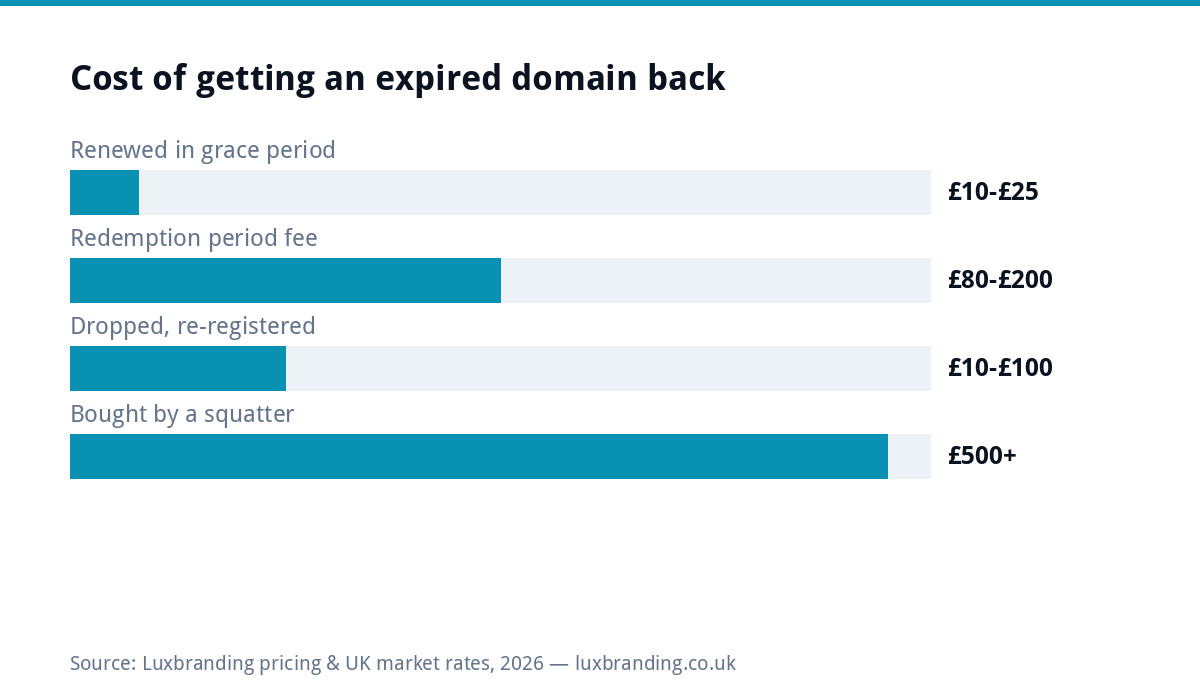
Do not panic and do not wait. If your domain expired in the last few weeks, you can almost certainly get it back for a normal renewal fee of £10 to £25. Wait longer and it enters a redemption phase where registrars charge £80 to £200 to restore it. Wait longer still and it drops back onto the open market where anyone, including domain squatters who monitor expiring names, can register it. Every day you delay moves you one column right on the chart below, so the correct move is to find your registrar and renew today.
What actually happens when a domain expires
Nothing is deleted on day one. The domain stops resolving, so the website disappears and email stops, but ownership sits in a series of buffer periods designed to let forgetful owners recover. The exact timings vary by registrar and by ending (.com and .co.uk run different systems), but the shape is always the same: a grace window where renewal costs the normal price, a redemption window where it costs a restore fee, and then release to the open market.
| Stage | Typical window | Cost to recover | Risk |
|---|---|---|---|
| Expiry + grace period | 0-30 days (registrar-dependent) | Normal renewal, £10-£25 | Site and email down, nothing lost yet |
| Redemption period | ~30 days (.com) | £80-£200 restore fee plus renewal | Painful but recoverable |
| Pending delete / suspension | ~5 days (.com) | Cannot renew, must wait for drop | Anyone can catch it at release |
| Released to market | after ~65-90 days total | £10-£100 if you catch it, £500+ from a squatter | You may lose it permanently |
For .uk domains the system is more forgiving: Nominet suspends the domain around 30 days after expiry and cancels it roughly 60 days later, and its domain support pages set out the exact sequence. Either way, the window is measured in weeks, not months.
Step 1: confirm the domain is really the problem
An expired domain has a distinctive signature: the website is down AND email to your domain bounces AND the site often shows a registrar parking page (“this domain has expired”) rather than an error. If the site is down but email still works, your problem is more likely hosting; work through our website down checklist instead. To check definitively, look the domain up on ICANN’s lookup tool (or Nominet’s WHOIS for .uk): it shows the expiry date and the registrar of record in seconds, no login needed.
Step 2: find out who the registrar is
The lookup from step 1 names the registrar, and it is frequently not who you expect. Domains bought years ago by a web designer often sit at a trade registrar you have never heard of, under an account you have never had. If the account email was at the now-dead domain, password resets go into the void, and you will need the registrar’s account-recovery process: proof of business identity, sometimes a company letterhead. Start that process the same day, because it can take longer than the grace period. If the domain was registered by a designer you can no longer reach, our guide to recovering from a vanished web developer covers the ownership paper-chase in detail.
Step 3: renew, even at the redemption price
If you are in grace, renew and pay the normal fee; the site and email usually return within a few hours to a day as DNS propagates. If you are in redemption, swallow the £80 to £200 restore fee. It stings, but compare it with the alternative: a squatter’s asking price, a rebrand, new signage, new stationery and every printed advert pointing at a domain someone else owns. Against that, £200 is the cheapest exit you will ever be offered. While you are in the account, turn on auto-renew and update the billing card before you log out.
Step 4: if it already dropped
Once the domain releases, it is first-come first-served. Check the lookup: if it shows available, register it again immediately at the normal price and you have dodged the whole drama. If a drop-catching service or squatter got there first, you have three options: buy it back (expect £500 into four figures for a domain with visible trading history), wait out their registration year in the hope they let it lapse, or move to a new domain. If the name is your registered trade mark, Nominet and ICANN both run dispute procedures that are cheaper than litigation, but they take months. For most small businesses the honest arithmetic usually favours negotiating or moving on quickly rather than fighting.
The email problem is worse than the website problem
While the domain is down, email to it bounces back to senders with a permanent-failure message. Customers assume you have closed; invoices and enquiries evaporate silently. When the domain comes back, send-and-receive resumes, but anything sent during the outage is gone forever, so check in with recent enquirers, your accountant and any supplier expecting payment. If this outage exposed how fragile your setup is, our business email setup guide shows what a properly configured domain mailbox costs and why it beats a Gmail address for exactly this kind of resilience.
Why domains expire without anyone noticing
It is nearly always one of four causes: the renewal reminders went to a dead email address, the card on file expired, the person who managed it left the business, or the domain sat in a supplier’s account and the supplier stopped trading. None of these announce themselves. The fix is boring governance: domain in your own account, registered to a role address like admin@ that outlives staff changes, auto-renew on, calendar reminder a month before expiry as a belt-and-braces check.
Prevention: the five-minute checklist
First, confirm you control the registrar account today, not the day of the emergency. Second, turn on auto-renew and consider renewing for five or ten years at once; the discount is small but the protection is total. Third, put the domain in the business’s name with a role email as the contact. Fourth, unlock nothing: registrar locks against transfer should stay on. Fifth, if your site also feels slow or neglected generally, treat this scare as the prompt for a wider health check; our guide to a suddenly slow website is a good companion audit.
Where managed hosting fits
The reason this failure mode is so common is that domains, hosting and email are usually three separate subscriptions at three suppliers with three renewal dates. Our website management and hosting service exists to collapse that into one monitored relationship at £20 a month: we watch the renewals, the certificates, the backups and the updates, so the first sign of trouble is a message from us rather than a parking page. Full details, alongside every other price we charge, are on the pricing page.
The honest timeline for getting back online
Renewed in grace: hours to one day. Restored from redemption: one to three days including the registrar’s processing. Re-registered after a drop: same day for the domain, but DNS, hosting and email records must be rebuilt if the old zone is gone, so allow a day or two. Bought back from a squatter: weeks of negotiation. The pattern is unmissable: every stage is slower and dearer than the one before it, so wherever you are in the sequence when you read this, act now rather than tomorrow.
Get the UK Website Project Brief Template (free)
A two-page template for briefing any UK web designer: sitemap, integrations, audience and deliverables. Cuts revision rounds in half.
No spam. UK GDPR compliant. We only use your email to send this resource, unless you tick the box to hear from us.
Frequently asked questions
My domain expired. Can I still get it back? +
Almost certainly, if you act quickly. Within the grace period (up to ~30 days) you pay a normal renewal of £10 to £25. After that, a redemption period lets you restore it for £80 to £200. Only after roughly 65 to 90 days does it drop to the open market.
How long after expiry does a .uk domain get deleted? +
Nominet suspends a .uk domain around 30 days after expiry and cancels it roughly 60 days after that, at which point it becomes available to register again. Renew during suspension and it comes back at the normal price.
What is a domain redemption fee? +
A restore charge registrars apply after the grace period ends, typically £80 to £200 on top of the renewal. It is painful but far cheaper than the alternatives once the domain drops: squatter buy-backs commonly start at £500.
Does email come back when I renew the expired domain? +
Send-and-receive resumes once DNS propagates, usually within hours to a day. But every email sent to you during the outage bounced permanently and is gone, so contact recent enquirers and suppliers once you are back up.
How do I stop my domain expiring again? +
Hold the domain in your own registrar account (not a designer's), set the contact to a role address like admin@, turn on auto-renew with a current card, and consider renewing for five or ten years at once.