Quick answer
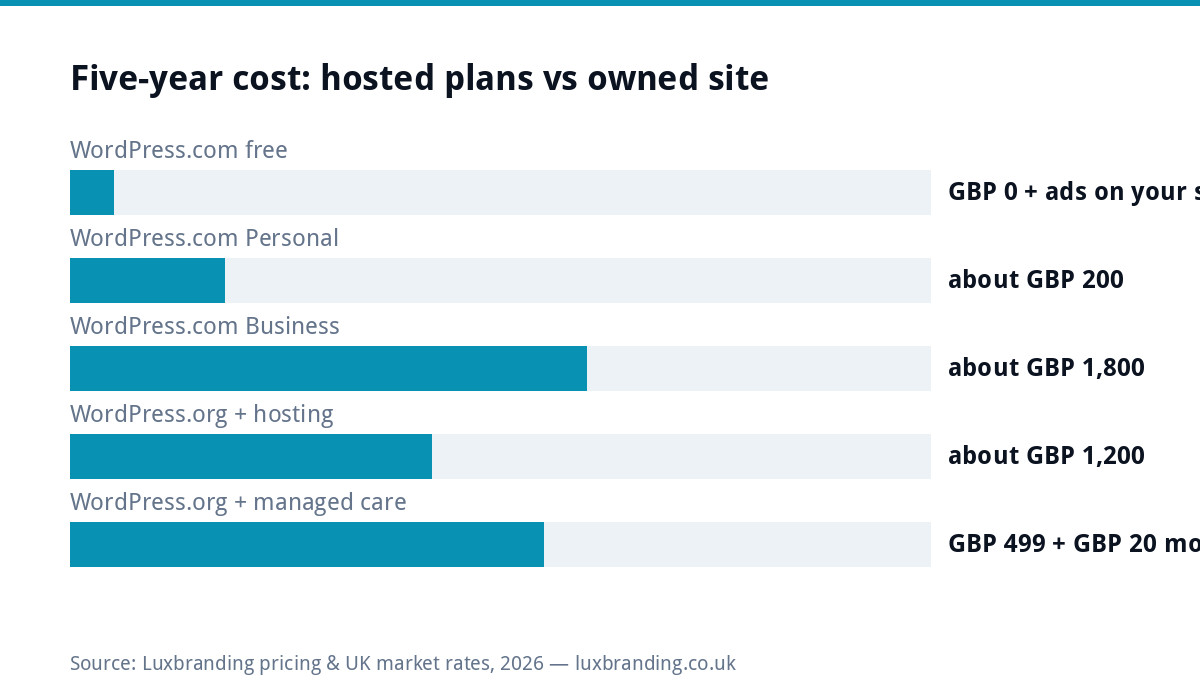
WordPress.com and WordPress.org are different products sharing a name. WordPress.org is the free open-source software behind over 40 percent of the web; you host it anywhere for roughly £5 to £20 a month and own everything. WordPress.com is a commercial hosting platform running that software for you, with plans from £0 to £45+ a month and real restrictions on the lower tiers. For a UK business, the typical five-year maths: a professionally built self-hosted site costs £499 once plus hosting, while the WordPress.com plan tier that allows plugins costs around £300 to £400 every year. This guide untangles the confusion properly, because choosing the wrong one is a genuinely expensive mix-up.
Why the confusion exists
One organisation created the software and gives it away at WordPress.org; a related company sells hosting for it at WordPress.com. Search for “WordPress” and the commercial site usually outranks the free one, so thousands of business owners sign up for a hosted plan believing it is “the” WordPress, then discover the plugin they need requires the expensive tier. Meanwhile “self-hosted WordPress” sounds technical and off-putting, when in practice it means any £5-a-month hosting account with one-click installation. Same software, opposite ownership models.
What WordPress.com is
A managed platform: they run the servers, updates and security, and you rent space on their terms. The published plans run from free, which puts their ads on your site and a subdomain in your URL, through personal and premium tiers with custom domains and design options, up to business-class tiers at roughly £25 to £45 a month, which is where plugin and theme installation finally unlocks. The honest praise: it is genuinely low-maintenance, and for a hobby blog the free tier is unbeatable. The honest criticism: the tier a business actually needs costs more per year than owning the equivalent site outright, forever.
What WordPress.org is
The software itself, free, installed on hosting you choose. You get the full plugin ecosystem from day one, any theme, full code access, your own analytics and advertising choices, and a database you can export and move to any host on the planet. The costs are the hosting (roughly £5 to £20 a month, covered in our hosting cost guide), a domain around £12 a year, and either your time or a professional build; ours is £499 fixed. The trade: freedom and ownership in exchange for responsibility for updates and backups, which is exactly what £20-a-month managed care exists to absorb.
The costs compared properly
| Factor | WordPress.com (business tier) | WordPress.org (owned) |
|---|---|---|
| Software | Included in plan | Free |
| Typical yearly cost | £300–£540 per year, forever | £60–£240 hosting + £12 domain |
| Build cost | DIY on their templates | DIY free, or £499 professional build |
| Plugins and themes | Higher tiers only | All of them, from day one |
| Ownership and portability | Content exportable; site is theirs | Everything yours; move hosts freely |
| Maintenance | Handled by platform | You, or managed care at £20 a month |
Ownership: the difference that surfaces later
On the hosted platform, your content is exportable but the site itself, its plan-dependent features and its terms belong to the platform; prices can rise and features can move between tiers, and your only vote is leaving. On an owned site, the files and database are yours, so the worst any host can do is prompt you to move them. This is the same rented-versus-owned distinction that runs through platform lockouts and builder subscriptions alike, and it is why our comparison of Wix versus a custom website reads so similarly: the label changes, the structure does not.
Who should choose WordPress.com
Hobby bloggers, writers testing an idea, community projects and anyone for whom the site is a pastime rather than infrastructure: the free and personal tiers are honestly excellent for this, and zero-maintenance is worth real money. A solo consultant who publishes essays and never needs booking, e-commerce or lead tooling can also live happily on a mid tier. The platform’s weakness is not quality; it is that its pricing curve bends steeply exactly where business needs begin.
Who should choose WordPress.org
Almost any trading business. The moment you want a booking plugin, a proper contact-form stack, local SEO tooling, WooCommerce, or just freedom from per-feature tier upgrades, self-hosted wins on both capability and five-year cost. It is also the version every professional studio builds on, which is why comparison guides like our WordPress versus Wix versus Squarespace treat “WordPress” as meaning the .org version by default. If your site is meant to generate revenue, own it.
Worked example: the five-year maths
A trades business needs a five-page site with a quote form and local SEO plugins. Route A, WordPress.com: the tier allowing plugins at roughly £300 to £400 a year is £1,500 to £2,000 over five years, DIY-built on a template. Route B, owned: a £499 professional build plus managed care at £20 a month is £499 plus £1,200, about £1,699, with the build done for you, every plugin available, and an asset you own at the end. Similar money; entirely different outcomes. Drop the managed care and self-maintain, and Route B falls to roughly £800 all-in. The five-year view almost always lands the same way: renting is only cheaper when you need very little.
What each version lets a business do
Plans change, so treat the tiers below as a snapshot and check the current WordPress.com plans page before you commit. The pattern has held for years, though: on the hosted platform, the features a business relies on sit in the upper tiers, while the self-hosted software locks none of them.
| What you need | WordPress.com | WordPress.org |
|---|---|---|
| Your own domain name | Paid plans | Yes, from any registrar |
| No platform adverts on your pages | Paid plans | Yes |
| Installing plugins, such as booking or SEO tools | Business tier and above | Yes, from day one |
| Selling online with WooCommerce | Business or Commerce tier | Yes, with the free plugin |
| File and database access | Business tier and above | Yes, full access |
| Choosing where the site is hosted | No | Yes, any host |
Read the table from the left and it tells the same story as the cost comparison: every row a trading business cares about either costs more on the hosted platform or is not available below the business tier. Read it from the right and the only thing you give up is having someone else apply the updates, which you can buy separately and cancel whenever you like. If you are unsure which rows apply to you, write down the three things your site must do in its first year, such as taking bookings, sending quote requests to the right inbox and ranking in local search, and check them against the table before you sign up to anything.
Three myths that muddy the choice
“Self-hosted WordPress is insecure.” Unmaintained sites are insecure on any platform. A .org site with updates applied and backups running, the exact scope of routine managed care, has an excellent security record; the software runs a huge share of the web, including newsrooms and governments. “You need to be technical to self-host.” Installation is one click at nearly every host, and a professionally built site arrives finished; the ongoing work is applying updates, which is a checkbox, not a career. “WordPress.com is the official one.” Both are legitimate; the software’s official home is the .org project. The commercial platform simply outspends it on visibility, which is precisely why this article needed writing. None of the myths survive contact with the pricing table above, which is where the decision actually lives.
Switching from .com to .org
If you are already on WordPress.com and hitting the walls, migration is routine: export the content, import it into a self-hosted installation, rebuild menus and design, and redirect the domain, which transfers cleanly if you registered it yourself. Plan a quiet week, follow a proper cutover list like our launch checklist, and expect a short rankings wobble rather than a cliff if redirects are done properly. The longer you wait, the more content there is to move; sites rarely migrate themselves thinner.
The verdict
WordPress.com is a fine product being accidentally bought by the wrong customers. If the site is a hobby, use it happily. If the site is how customers find and pay a business, the owned route costs less over any horizon past year two and removes every tier wall before you hit it: build once from £499 on our fixed price list, host anywhere, and never ask a platform’s pricing page for permission to add a feature. The name on both products is WordPress; the question is whose website it is.
Get the UK Website Project Brief Template (free)
A two-page template for briefing any UK web designer: sitemap, integrations, audience and deliverables. Cuts revision rounds in half.
No spam. UK GDPR compliant. We only use your email to send this resource, unless you tick the box to hear from us.
Frequently asked questions
What is the difference between WordPress.com and WordPress.org? +
WordPress.org is the free open-source software you install on hosting you choose and own outright. WordPress.com is a commercial platform that hosts that software for you on plans from free to £45+ a month, with plugin access reserved for higher tiers.
Which WordPress is better for a small business? +
Self-hosted WordPress.org in almost all cases: full plugin access from day one, complete ownership, and lower five-year costs. WordPress.com suits hobby blogs and projects where zero maintenance matters more than capability.
How much does a self-hosted WordPress website cost? +
The software is free; hosting runs roughly £5 to £20 a month and a domain about £12 a year. A professional build is £499 fixed, and optional managed care at £20 a month covers updates, backups and monitoring.
Can I move my site from WordPress.com to WordPress.org? +
Yes, it is a routine migration: export your content, import it to a self-hosted installation, rebuild menus and design, and redirect your domain. Done with proper redirects, expect a short wobble rather than a rankings cliff.
Why does WordPress.com cost more for businesses? +
Because the features businesses need, especially plugin and theme installation, sit in tiers around £300 to £540 a year. Over five years that exceeds the cost of building and running an equivalent owned site, without the ownership.