Quick answer
Recover in this order: domain first (it’s the business asset, everything else is replaceable), hosting access second (hosts can verify a paying business owner), the site itself last, because worst case, a rebuild costs £299 to £499, which is routinely less than months of chasing a ghost. And while the site is still online, everything is recoverable: copy your content today, before any unpaid invoice somewhere takes it offline.
Hour one: copy everything while it’s up
Whatever else is true, your site is live right now and might not stay that way, developer-held hosting eventually lapses. Spend an hour saving every page (browser “Save page” or copy text into documents), downloading images you care about (right-click, largest versions), and screenshotting layouts you’d want recreated. Export anything exportable: WooCommerce orders, form entries, anything with an export button you can still reach. This hour converts the worst-case scenario from “lost the business’s website” to “need it rebuilt from complete materials”, a solved, priced problem.
The recovery ladder
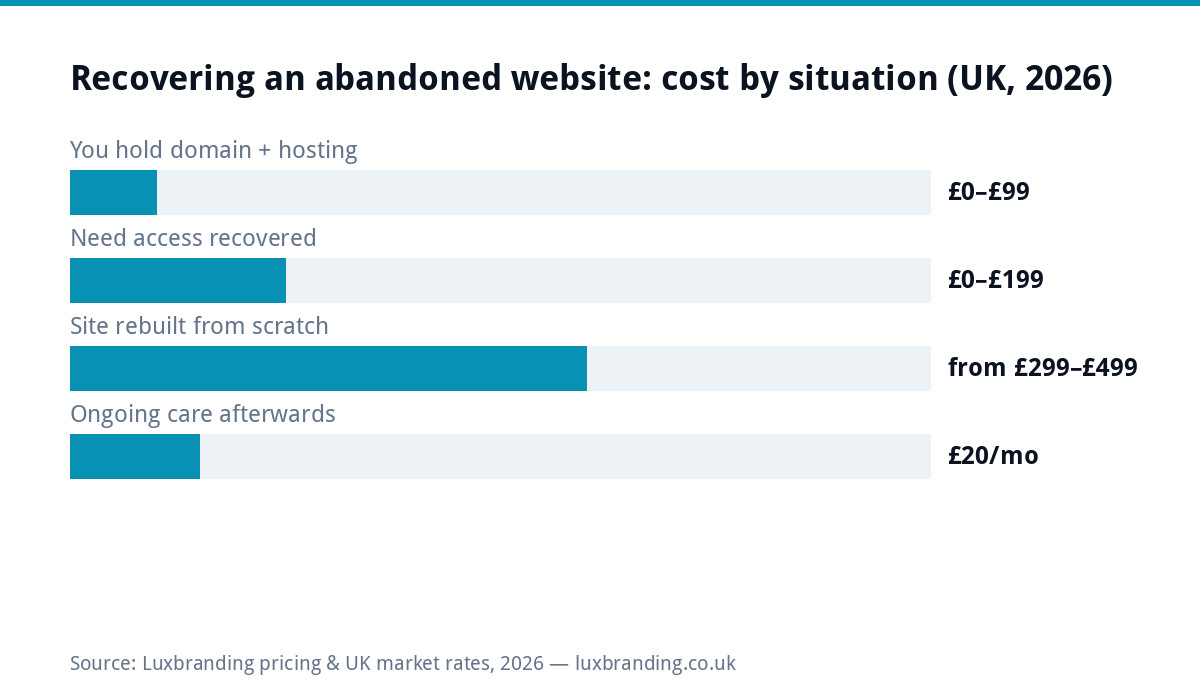
| What you’re missing | The move | Typical cost |
|---|---|---|
| Just the developer (you hold domain + hosting) | New developer takes over with your logins; change every password | £0 plus any fixes, the lucky tier |
| Hosting access | Identify the host from DNS, contact support with business ID + payment proof; they deal with this weekly | Usually free; sometimes a verification dance |
| Domain control | Registrar dispute process (Nominet for .uk); business name + trading evidence carry weight | Free to £199 depending on route; takes weeks |
| Everything | Register a new domain if forced (last resort), rebuild from your hour-one materials | £299 one-page / from £499 full site |
Finding out what you actually control (15 minutes)
Three lookups establish your position. Domain: a WHOIS search on your domain shows the registrant, you, the developer, or privacy-masked (then check whose email receives renewal notices). Hosting: free DNS-lookup tools reveal which company serves your site; that’s who support-tickets go to. Site admin: try yourdomain.co.uk/wp-admin, if it’s WordPress and any staff email ever had an account, password-reset may just work. Ten minutes of lookups regularly turns “he took everything” into “actually I control the domain and the host will let me in”, the most common happy ending in this genre.
If they held your email too (do this before anything else)
A nasty variant: some developers set up clients’ email on the same hosting they controlled, meaning the vanished developer can potentially read your email, and every password reset you attempt flows through territory they hold. If your business email lives on the site’s hosting (check: does your email domain match the website domain, and did the developer set it up?), prioritise it above the website itself: get hosting access via the host-support route first, or move email to your own provision immediately (our hosting guide covers email-included options; migration preserves the address because you own the domain). Until email is secured, don’t trigger password resets on anything important, bank, suppliers, ads accounts, because you may be resetting them into someone else’s inbox.
Choosing the replacement so history doesn’t repeat
The vetting questions, informed by exactly how you got here: In whose name will the domain and hosting be registered? (Only acceptable answer: yours.) Will I have my own admin access from day one? Where do backups go and how do I reach them without you? What happens if you’re unavailable, is there documentation another developer could pick up? And what does handover include if we part ways? A professional answers all five without flinching, they’re the industry’s honest norms, and anyone bristling at “what if you disappear?” has told you the risk assessment. Our own answers are boringly simple: your accounts, your access, daily off-site backups, standard WordPress any developer can inherit, and management (£20/month) you can cancel into a handover rather than a hostage situation.
When rebuild beats recovery
Sunk-cost thinking keeps businesses chasing access to sites that weren’t good enough to chase. Run the honest comparison: recovery = weeks of admin for the old site as it was; rebuild = £299 (one-page) or from £499 (full custom) for a current, faster site you fully control, live in days from the materials you saved in hour one. If the old site was underperforming anyway, and abandoned sites usually were, the disappearance is the push a redesign was waiting for. Meanwhile the recovered-or-new site goes on proper managed hosting (£20/month) where backups, updates and a phone number are part of the deal.
Copy-paste: the two messages that start recovery
To the host (find them via the DNS lookup above): “I’m the owner of [business name], whose website [domain] is hosted with you under an account managed by our former developer, [name if known], who is no longer contactable. I need to establish access to our hosting account. I can evidence ownership of the business and domain: [Companies House number / VAT number / payment records if you ever paid hosting invoices]. Please advise your account-recovery process.” Hosts have a process; naming your evidence up front skips a round-trip. To the developer (one message, every channel, then stop): “Hi [name], I need the login details and any files for [domain] so we can maintain the site. Happy to pay any outstanding invoice or a reasonable handover fee. If I don’t hear back by [date, a week out], I’ll arrange recovery through the host and registrar directly, no hard feelings either way.” Polite, deadlined, and it converts silence into permission to proceed. Most of these situations resolve at one of these two messages; the ladder above catches the rest.
What limbo actually costs (the case for deciding fast)
The expensive part of this situation is rarely the fix, it’s the months of not-fixing. While ownership is chased: the site drifts stale (wrong prices, dead offers, last year’s hours quietly costing trust), nothing can be improved so every marketing idea queues behind the blockage, security updates aren’t happening (an unmaintained WordPress is a hacked WordPress on a timer), and, the compounding one, competitors’ sites spend those months earning the rankings yours can’t contest. Put crude numbers on it: if the site influences even two jobs a month and limbo halves its effectiveness, a quarter of drift costs more than the £299 to £499 rebuild that ends the saga this week. That’s the decision framework hiding under the emotion: chase ownership for exactly as long as the recovery ladder justifies, the twenty-minute audit, the host ticket, the registrar process where the domain warrants it, and the moment the timeline stretches past weeks, rebuild and redirect your energy to the business. Ghosts don’t pay opportunity costs; you do.
The un-hostage-able setup (adopt today, whoever builds next)
Three ownership rules prevent every version of this story. The domain sits in YOUR registrar account, your card, your email, a developer needing DNS changes gets delegated access, never ownership. Hosting is billed to you in your account; the developer is an invited user you can uninvite. You hold an admin login you’ve tested, and backups exist somewhere you can reach (managed hosting does this daily). Add the paperwork line from our designer-version of this guide, files delivered, rights assigned on payment, and a vanishing supplier becomes an inconvenience, not a crisis. It’s the web equivalent of the logo handover checklist, and every rebuild price is on the price list.
Get the UK Website Project Brief Template (free)
A two-page template for briefing any UK web designer: sitemap, integrations, audience and deliverables. Cuts revision rounds in half.
No spam. UK GDPR compliant. We only use your email to send this resource, unless you tick the box to hear from us.
Frequently asked questions
My web developer has disappeared. Can I get my website back? +
Usually, yes, in stages. The domain matters most (check who the registrant is), then hosting access (the host's support can often verify you as the paying business owner), then the site files. Worst case, a rebuild costs £299 to £499, often less than months of chasing.
Who owns my website if the developer registered everything? +
The domain belongs to whoever is named registrant. If that's the developer, you have a recovery process ahead (registrars have dispute procedures for business names, and Nominet handles .uk disputes). The site's copyright follows your contract; practically, control of accounts matters more than legal theory.
My website is still online but I can't update it. What do I do? +
Don't panic and don't cancel anything yet: while it's live, it's recoverable. Copy every page's content and images now (browser save is fine), identify the host from DNS records, and contact the host's support with proof of business identity and any payment records.
How much does it cost to move my website to a new developer? +
With access, a straightforward WordPress migration is often free from the receiving host or a small one-off job. Without access, budget a rebuild: £299 for a one-page site, from £499 for a full custom site, frequently cheaper than a drawn-out recovery.
How do I stop this happening again? +
Three rules: the domain is registered to YOU at your own registrar account; hosting is billed to your card in your account (developer gets access, not ownership); and you hold an admin login plus periodic backups. Any provider who resists those is telling you something.