
Quick answer
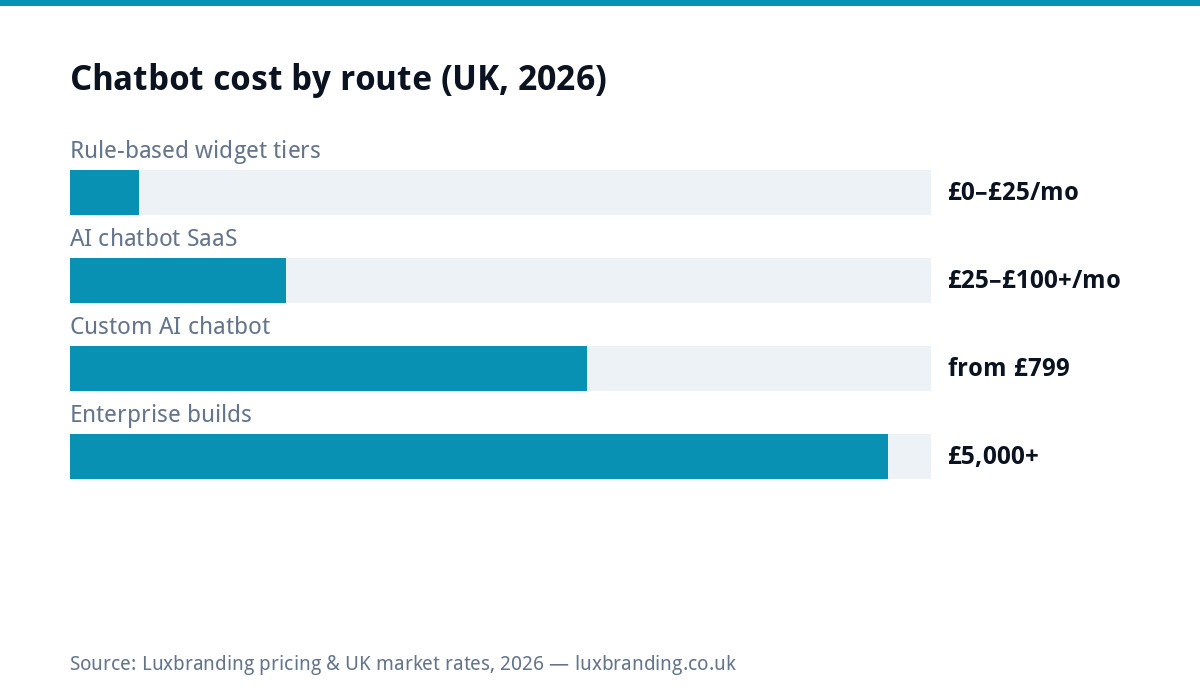
UK chatbot pricing in 2026 splits three ways: rule-based chat widgets at £0 to £25/month (scripted menus, really a guided FAQ), AI chatbot SaaS at £25 to £100+/month per published tier pricing (Tidio, Intercom-class tools), and custom AI chatbots from £799 as a one-off build, trained on your actual services, prices and policies, running on your site with small usage costs after. Enterprise builds run £5,000+. The split that matters isn’t price, it’s the answer to one question: do you want a bot that deflects questions, or one that answers them?
What changed (and why the old advice is stale)
Two years ago the honest advice was “chatbots annoy people; get a contact form.” That was rule-based bots, the click-a-menu mazes everyone learned to hate. Modern AI bots changed the calculation: given your real content, they answer free-typed questions specifically (“do you do boiler service plans?” “how much is a rewire in a 3-bed?”) and capture the enquiry when they can’t. The technology reached useful before most small businesses noticed, which is exactly when being early is worth something. The catch stayed the same: a bot is only as good as what it’s been given, generic bot, generic answers, annoyed customers.
Route by route
| Route | Published cost | What you get | The catch |
|---|---|---|---|
| Rule-based widget | £0 to £25/mo | Scripted menus, canned answers, lead capture | The maze effect, customers bail the moment their question isn’t on the menu |
| AI SaaS tiers | £25 to £100+/mo | Real AI answers, fast setup, vendor dashboard | Per-seat/conversation pricing climbs; training depth limited; their branding on your chat |
| Custom AI build | from £799 one-off | Trained on your content, your branding, your escalation rules, no per-use fees to a middleman | Needs your content organised (that’s most of the build); small API usage costs |
| Enterprise | £5,000+ | CRM integration, multi-channel, compliance workflows | Overkill below serious enquiry volume |
What the £799 build actually involves
The work is mostly editorial, not magical: gathering and structuring what the bot must know (every service, price, area covered, policy, the questions your inbox actually receives), connecting an AI model to that knowledge so answers come from YOUR facts rather than the model’s general training, designing the escalation and lead-capture flow, when the bot hands off to your email/phone/WhatsApp and how it captures the lead when you’re closed, and testing against real enquiry patterns before it meets a customer. Then it runs on your site, on-brand, with API usage typically costing pennies per conversation at published model rates. It’s a standard scope within our AI tools and automation service (from £799), and the wider automation landscape, what else is worth automating first, is in our AI automation guide.
The 90-minute content exercise that decides bot quality
Since a bot is only as good as its diet, here’s the prep that separates useful from infuriating, and it’s your work, not the developer’s, because only you know the answers. Open your sent-mail and messages; copy the last thirty real customer questions verbatim (their words, not your categories, customers ask “how much to do my drive” not “resin driveway pricing enquiry”). Write the answer you WISH you’d sent to each: specific, with the price. Add the boring canon: services, prices, areas, hours, payment terms, guarantee, lead times. Then the edge list: the five questions you dread, answered honestly (even if the answer is “that needs a survey, here’s how to book one”). Ninety minutes of this produces a bot that sounds like your best day; skipping it produces the generic deflector everyone rightly hates. It’s also, not coincidentally, excellent raw material for your website FAQ and blog content, the same questions rank on Google.
The no-go list: what a good bot refuses to answer
Part of training a bot well is deciding what it must NOT attempt, the escalation list, agreed before launch. Ours typically includes: firm quotes for work that needs a survey (the bot gives the from-price and books the survey, guessing totals erodes trust and margins); complaints (a bot handling an angry customer multiplies the anger; instant human handoff with an apology template); anything legal, safety or compliance-adjacent (“is my fuse box dangerous?” gets “here’s how to reach us right now”, not an essay); discount negotiation (the bot states prices, humans hold pricing authority); and personal-data requests beyond the minimum needed to book a callback. Each no-go answer follows the same shape, brief, honest about being escalated, and captures contact + context so the human arrives informed. Counter-intuitively, a bot with confident boundaries reads as MORE trustworthy than one that answers everything: customers recognise the difference between “I’ll get Dave to call you about that” and improvisation, in silicon exactly as in staff.
Measure it like a salesperson, not a gadget
A bot is staff; review it like staff. Monthly, three numbers: conversations handled (is it being used?), leads captured out of hours (its clearest wage), and escalation/stump rate (what it couldn’t answer, the training backlog). Read ten transcripts: where do people rephrase in frustration? That’s a bad answer to fix. Where do they ask something great you never thought to put on the website? That’s content. Businesses that do this monthly ratchet their bot into a genuinely good first responder within a quarter; businesses that don’t have a widget. The same discipline applies whether you built custom or subscribed, the difference is that on custom, every improvement is yours to make rather than a feature request in someone’s queue.
The maths: what an answered question is worth
Chatbot ROI is lead arithmetic. Count last month’s enquiries that arrived outside your response hours, add the visitors who left without asking (your analytics’ exit pages hint at them), and price a converted lead for your business. A trades firm converting one extra £400 job a month from after-hours questions pays for the £799 build in two months; a consultant whose enquiries are rare and bespoke gets more from a good contact page. The honest filter: if your last twenty enquiries cluster around ten questions, a bot multiplies you; if all twenty were unique, it’s triage at best. And measure it like anything else, conversations, captures, and which questions stumped it (those are next month’s training and, often, next month’s blog content).
When SaaS beats custom (fairness demands it)
The £799 build isn’t always the answer, so here’s the honest SaaS case. Choose subscription AI chat when: you want it live THIS week (SaaS onboarding is genuinely fast; custom takes days-to-weeks including your content prep); your needs are vanilla FAQ + lead capture and the vendor’s training depth suffices; your team already lives in a helpdesk ecosystem whose chat tier bundles in; or you’re still validating whether visitors will use chat at all, a month-to-month subscription is a cheap experiment, and the transcripts it produces become the training corpus if you later build properly. The crossover back to custom arrives on the familiar triggers: per-conversation pricing climbing with success, the vendor’s answers staying stubbornly generic about YOUR services, branding limits, or wanting the bot wired into your booking/quoting flow, integration being the place where subscriptions gate hardest and custom shrugs. Rent to learn, build to keep: the same sequencing logic as every build-vs-buy call in this series.
Mistakes that make bots hated
Every anti-chatbot sentiment traces to the same five sins: pretending to be human (always label the bot, trust dies when the illusion does); trapping people (a visible “talk to a human” path from message one); answering everything badly instead of some things well (train narrow and deep, escalate the rest); popping up instantly on arrival like a needy shop assistant (let people read first); and set-and-forget (unread conversation logs are the roadmap to a better bot, unread). Avoid those and even a modest bot outperforms a contact form after hours; commit them and you’ve paid to lose leads. Whether a bot or a human-staffed live chat suits you better is its own comparison, we’ve written it up separately, and every build price is on the price list.
Get the UK Software Project Brief Template (free)
A two-page template for scoping any custom software project: user roles, features, integrations, timeline and success criteria.
No spam. UK GDPR compliant. We only use your email to send this resource, unless you tick the box to hear from us.
Frequently asked questions
How much does a chatbot cost for a UK small business? +
Rule-based chat widgets run £0 to £25/month, AI-powered SaaS chatbots £25 to £100+/month at published tier prices, and a custom AI chatbot trained on your business content costs from £799 as a one-off build (plus small monthly AI usage costs).
What's the difference between a rule-based and an AI chatbot? +
Rule-based bots follow scripted menus (click options, get canned answers); they're really guided FAQs. AI chatbots understand free-typed questions and answer from the content they've been given. The difference shows the moment a customer asks something slightly off-script.
What does a custom AI chatbot include that SaaS doesn't? +
Training on YOUR content (services, prices, policies) so answers are specific rather than generic; your branding rather than a vendor's widget; control over escalation to a human; and no per-seat or per-conversation fees climbing with usage. SaaS wins on setup speed.
Do chatbots have ongoing costs? +
SaaS is all ongoing: the subscription. Custom builds carry small AI usage fees (typically pennies per conversation at published API rates) and occasional retraining when your services change. Both need someone reading the conversations occasionally. That's where the improvement lives.
Are chatbots actually worth it for small businesses? +
For businesses whose enquiries cluster around the same questions (prices, availability, coverage areas, opening hours), a good bot answers instantly at 11pm and captures the lead. For complex consultative sales it's a triage tool, not a closer. The worst outcome is a bad bot: it costs less to have none than to frustrate.