
Quick answer
UK SaaS development in 2026 prices by stage, not by product: no-code prototypes run on tool subscriptions (£0 to £100/month) plus your evenings; a genuinely lean MVP, one core workflow, accounts, payments, builds from £1,999 to £5,000; standard agency MVP quotes sit at £15,000 to £50,000 (real, and often justified by what they include); and scale-stage products go £50,000+. The most expensive mistake in the sector isn’t picking the wrong builder, it’s buying a later stage than the idea has earned.
Why the quotes differ by 10x for “the same thing”
Three honest reasons. Scope inflation: “like Xero but for dog groomers” describes a decade of product; the buildable version is one workflow from it. Process pricing: a £30k agency quote buys discovery workshops, design sprints, dedicated PM and QA ceremony around the code, legitimate at funded-startup scale, optional before validation. And multi-tenant plumbing: proper SaaS needs accounts, roles, billing, data isolation, but modern stacks and payment platforms have commoditised most of it, which is precisely what makes the lean tier possible. The £1,999 to £5,000 build isn’t the £30k build discounted; it’s a different discipline: standard stack, one workflow, ruthless scope, the shape our web application service quotes flat after scoping, sharing the economics of our web app cost guide.
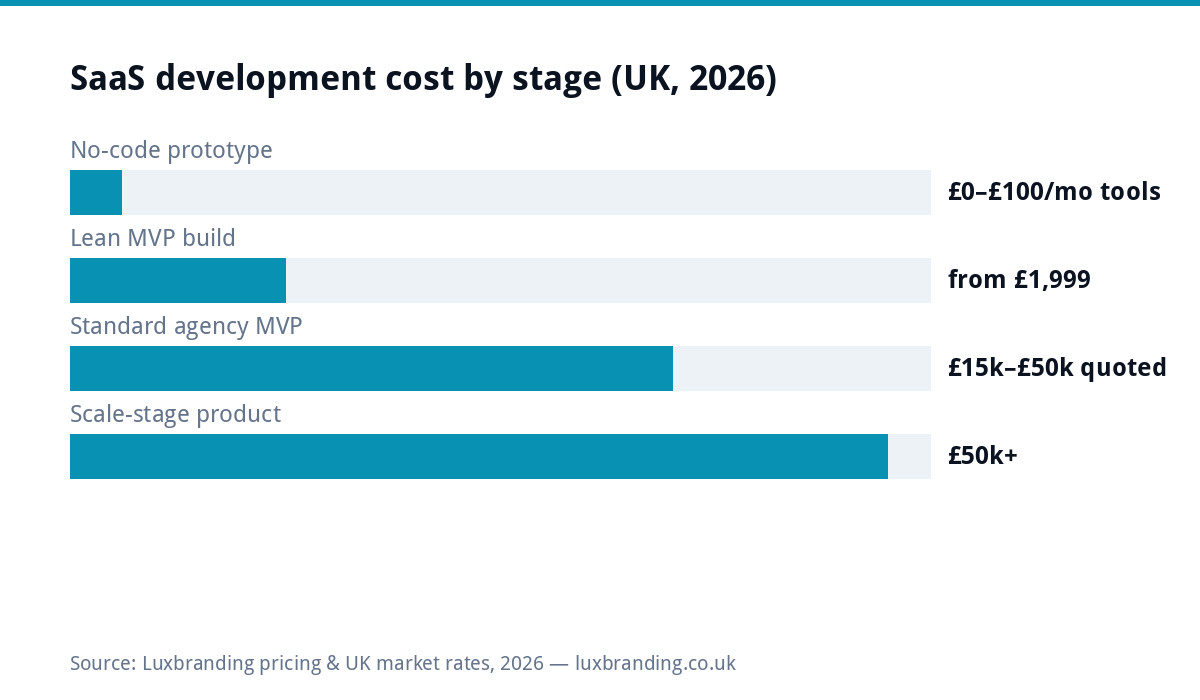
Stage by stage
| Stage | Cost | Goal | Graduate when |
|---|---|---|---|
| Validation | £0 to £300 total | Prove people WANT it: landing page + waitlist + conversations | Strangers (not friends) say they’d pay |
| Prototype | No-code subs | Prove the workflow works end to end | Users complete it without you driving |
| Lean MVP | £1,999 to £5,000 | Prove people PAY: real product, one workflow, Stripe live | Paying users + feature demands you didn’t invent |
| Product | £15k to £50k | Build what paying users demonstrated they need | Revenue funds the roadmap |
| Scale | £50k+ | Team features, integrations, enterprise plumbing |
The table’s real message: each stage buys information, and skipping stages means paying build prices for guesses. £20k spent before ten strangers validated the idea is the standard SaaS tragedy; £2k spent proving nobody wants it is a bargain.
The costs after the build (nobody’s pitch deck includes them)
SaaS is a running commitment: infrastructure (tens of pounds monthly at the start, scaling with usage), payment processing at published rates (~1.5 to 3% + pence per transaction), the support inbox (real hours the moment real users exist), and continuous development, a SaaS that stops improving starts churning. Rule of thumb worth adopting: budget ongoing capacity equal to a meaningful slice of the build cost annually, whether as a development retainer (from £349/month) or in-house time. And the boring one: backups, security updates and monitoring from day one, a SaaS holding customer data is a different responsibility from a brochure site, which is half of what software maintenance exists to carry.
The brand line-items founders forget
A SaaS needs a saleable identity earlier than founders expect, and the costs are pleasantly small next to the build: a checkable name (search the obvious trademark registers and app stores before falling in love, renaming after launch costs users, not just money), the domain (a sensible .co.uk or .com at standard prices beats a £2k premium domain at MVP stage), a professional logo (£129) that survives being a favicon. SaaS logos live at 16 pixels in browser tabs, which is exactly the simplicity test, and a landing page whose design doesn’t undercut the product’s promise (buyers CAN’T see your code quality; they judge it by your pixels, fairly or not). Budget £450 to £600 all-in for the identity layer and do it once at validation stage, it’s the same landing page doing double duty, rather than rebranding between MVP and launch. What’s NOT needed yet: brand guidelines documents, mascots, or a naming agency; that’s scale-stage money cosplaying as progress.
The £300 validation playbook (stage one, expanded)
Since the whole thesis is “buy information cheaply before buying code”, here’s stage one in full. A one-page landing site describing the product as if it exists, problem, solution, pricing, “join the waitlist” (£299 built properly, or DIY free); a modest ad budget or forum/community legwork driving the RIGHT hundred visitors to it; and the metric that matters: what percentage leave an email against a stated price? Then the part founders skip, fifteen actual conversations with waitlist joiners: what do they use today, what would make them switch, would they pay from month one? Total spend: £0 to £300 and a fortnight. The outcomes are all wins: strong signal → build the MVP with evidence and often with pre-committed first users; weak signal → you just saved £20,000 and six months, the cheapest failure available anywhere in business; mixed signal → the conversations tell you which adjacent problem is the real one, which is worth more than most £5k discovery workshops. No-code prototypes slot after this stage, not before it, even a prototype is expensive next to a landing page that nobody converted on.
The UK-specific lines on the budget
A few costs are distinctly British and worth pencilling early. VAT: once your SaaS revenue crosses the registration threshold you’re charging and reconciling VAT, and if you sell to consumers in the EU, digital-services VAT rules apply from the first sale; billing platforms handle much of this mechanically (their “merchant of record” tiers exist precisely for it, at a published percentage premium). Data protection: holding customer data means UK GDPR from day one, a privacy policy that’s true, a lawful basis for what you store, deletion on request, and if you’re storing anything sensitive, design choices to match; none of this is expensive at MVP scale, all of it is expensive retrofitted. Contracts: your terms of service ARE a product component, template-plus-review beats both extremes of copy-paste and £5k bespoke lawyering at MVP stage. None of these should stop a build; all of them belong in the written scoping, which is why ours asks.
Choosing who builds it (five questions that sort the field)
Whoever you shortlist, freelancer, lean studio, agency, the same five questions expose fit. What’s the smallest version of my idea you’d build first, and what would you cut? (Good builders cut; bad ones nod.) What stack, and why that one? (Listen for “boring and proven”, run from “exciting”.) Who owns the code and can another developer take it over? (Repo in YOUR account, standard stack, documented.) What are the running costs at 10 users and at 1,000? What happens after launch, support, fixes, iteration terms? The pattern in good answers is de-risking YOUR money rather than maximising the build; it’s the same handover-and-ownership hygiene as our developer-disappeared guide teaches from the other end, applied before anything can go wrong. Our answers come in writing during scoping. Our web applications service starts at £1,999: you order online at that price, we agree the scope and confirm a fixed quote in writing before any build work begins.
Lean-build discipline (how £1,999 stays £1,999)
Flat-priced MVPs survive on scope honesty, so here’s the contract both sides should want: ONE core workflow, written as a sentence before quoting (“tradesperson creates a quote, client approves online, job appears in the diary”); standard proven stack, no exotic choices to look clever; buy-not-build for everything commoditised (auth, payments, email, services solved these); admin over polish (your customers’ UI matters; yours can be plain for a year); and a parked list, every good idea that isn’t the workflow goes on it, gleefully, for version two. Scope creep isn’t a builder problem or a client problem; it’s what happens without the sentence. Our written scoping exists to write it, and if what you actually need is a booking system or internal CRM rather than a public SaaS, those are cheaper problems wearing the same buzzword, we’ll say so. Prices on the price list.
Get the UK Software Project Brief Template (free)
A two-page template for scoping any custom software project: user roles, features, integrations, timeline and success criteria.
No spam. UK GDPR compliant. We only use your email to send this resource, unless you tick the box to hear from us.
Frequently asked questions
How much does it cost to build a SaaS product in the UK? +
UK agencies commonly quote £15,000 to £50,000 for an MVP and £50,000+ for scale-stage builds. A genuinely lean MVP (one core workflow, standard stack) can be built from £1,999 to £5,000. No-code prototypes cost tool subscriptions and your time. Stage discipline is everything.
Why do SaaS quotes vary so wildly? +
Because "SaaS" spans a login-plus-one-workflow tool and a multi-tenant platform with billing, roles and integrations. Quotes also price the process around the code: agencies quoting £30k include discovery workshops, design sprints and project management a lean build strips out.
What should a first SaaS version actually include? +
One workflow that solves the core problem, user accounts, payments (Stripe-class), and honestly little else. Every additional feature before paying users exists is money spent guessing. The classic MVP failure is building year-three features with year-zero knowledge.
Can I build a SaaS with no-code tools instead? +
For validation, yes: no-code platforms can carry a prototype to first users at subscription prices. Limits arrive with scale, custom logic and per-user platform fees; many products validate on no-code then rebuild properly. That sequence is a feature, not a failure.
What are the ongoing costs after launch? +
Hosting/infrastructure (tens of pounds monthly early on, scaling with users), payment processing (published ~1.5 to 3% + pence), support and maintenance, and continued development, because the product is never finished. Budget ongoing capacity, not just the build.