
Quick answer
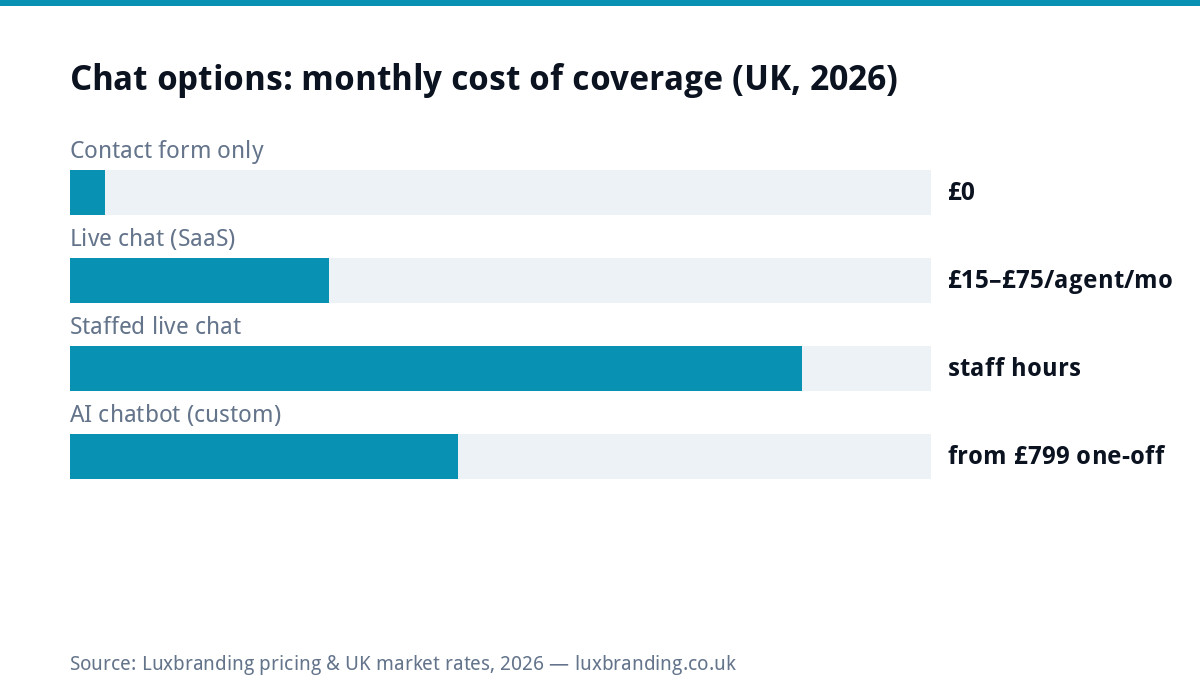
Wrong question, honestly, the real choice is between three coverage models. Live chat (software £15 to £75/agent/month published, plus the real cost: a human present) converts brilliantly and fails catastrophically when unstaffed. AI chatbots (custom builds from £799 one-off) answer instantly, always, at a lower ceiling. The hybrid, AI front-line, humans joining when actually available, is what wins for most UK small teams, because it matches the truth of small-business staffing: sometimes there, mostly not.
What each is actually good at
| Live chat (staffed) | AI chatbot | |
|---|---|---|
| Response time | Seconds, when someone’s there | Instant, always |
| Coverage | Your working hours, honestly fewer | 24/7 including the 9pm quote-hunters |
| Complex/consultative questions | Excellent, humans probe and adapt | Triage at best; escalates |
| Repetitive questions (prices, areas, hours) | Expensive use of a human | The sweet spot |
| Real cost | £15 to £75/agent/mo software + staff attention | from £799 build + pennies per conversation |
| Failure mode | The silent widget, worse than nothing | Bad training, generic answers annoy |
The staffing truth nobody prices in
Live-chat vendors sell software; what converts is presence, and presence is the expensive part. A visitor who opens chat expects an answer in under a minute, miss that window and you’ve done worse than having no chat, because you promised and failed in real time. For a five-person business, honest arithmetic says chat is staffable a few hours a day at best; the other twenty hours the widget either lies (“we’re online!”), disappoints (“leave a message”, a form with extra steps), or sits behind the AI. That’s why the pure-live-chat recommendation quietly assumes a receptionist the average small business doesn’t have, and why the £799 bot isn’t competing with your best-case chat coverage, it’s competing with your REAL coverage: mostly-absent.
The hybrid pattern, concretely
The setup that fits how small firms actually operate: the AI bot fronts every conversation, trained on your services, prices, areas and policies per our chatbot cost guide, answering the 70% of questions that repeat. When you’re at the desk, you watch conversations and jump in live (takeover, human-labelled); when you’re on a roof or asleep, the bot answers what it can and captures the rest as a lead with full context (“asked about rewiring costs in Sale, wants a callback Thursday”). Customers get instant answers always and humans sometimes, the honest inverse of live chat’s humans-sometimes-and-silence-mostly. This is a standard scope within our AI tools service (from £799), and the wider what-to-automate-first question lives in the automation guide.
The baseline both options must beat
Fairness to the humble contact form: it’s free, it never lies about availability, and a GOOD one, short, mobile-friendly, promising and delivering a response time, converts respectably. Chat of either kind earns its cost only by beating that baseline where it’s weak: immediacy (a form is a message in a bottle; chat answers the “are you actually there?” question), qualification (a bot gathers job details and photos conversationally, where forms with ten fields die), and after-hours capture (the 9pm browser fills in chat more readily than forms, lower commitment per keystroke). If your current form converts fine and response times are honest, chat is an optimisation, not an emergency, measure your form’s completion rate before buying anything (analytics shows starts vs submissions; a big gap is the signal chat exploits). And whatever you run, the response-time promise is the whole game: “we reply within 2 working hours” kept beats “instant chat” broken, in every channel, forever.
A hybrid in practice: one trades firm’s week
Concrete beats abstract, so picture a three-person heating firm running the hybrid. Monday 9am: the office manager has fourteen overnight conversations in the log, eleven answered fully by the bot (prices, areas, “do you fit brand X”, all from the trained content), three captured as leads with context: one boiler quote request with photos attached, booked by lunchtime. Midweek, desk hours: she watches the chat panel while doing admin; when a conversation smells like a big job (bot flags budget questions), she takes over live, “Hi, it’s Dawn, I’ll jump in here”, and converts a bathroom-heating enquiry the bot would only have triaged. Saturday, everyone on jobs: the bot holds the fort solo; Sunday’s log shows the weekend’s captures waiting. The economics of that week: after-hours enquiries that previously bounced off a contact form became Monday’s booked work, the £799 build’s share of one boiler job, and nobody’s evening was interrupted by a chat ping. That’s the pattern at its best, and its honest dependency is visible too: Dawn reads the logs. The tool multiplied attention; it didn’t replace it.
Setup effort, compared honestly
Cost tables hide the labour difference, so here it is. Live chat SaaS: an afternoon to install and brand the widget, then the real setup begins: rotas, notification discipline (who answers when a chat pings mid-job?), canned responses, and the honest-hours configuration most businesses skip. Ongoing effort is the whole product. AI chatbot: front-loaded instead, the 90-minute content exercise from our chatbot cost guide, build and training (days on a custom job), testing against real questions, then ongoing effort drops to a monthly transcript review. The hybrid adds a takeover workflow to learn (ten minutes) on top of the bot’s setup. The pattern: live chat is cheap to start and expensive to sustain; bots are the reverse, which is why the staffing-honesty question earlier decides more than any feature comparison. Match the model to the effort you’ll ACTUALLY sustain in month six, not week one.
The privacy line both options must respect
Chat transcripts are personal data, names, contact details, sometimes the sensitive circumstances behind an enquiry, so UK GDPR applies to bots and humans alike. The practical minimums: say what happens to chat data in your privacy policy (retention, who processes it, the chat/AI vendor is a processor worth naming); don’t hoover chat history into marketing lists without consent (capturing a lead who ASKED for a callback is fine; auto-subscribing everyone who typed is not); give the bot a data-minimisation instinct, it needs a name and number to arrange a quote, not a life story; and if conversations can touch health, finances or similar, escalate those to humans by design. None of this is onerous, all of it is checkable in an afternoon, and “our chat vendor is US-based, is that fine?” is answered in their data-processing agreement, which reputable vendors and custom builds alike put one search away. Compliance done boringly is a selling point in B2B chats, incidentally: businesses notice.
Decide by your enquiry pattern (two minutes)
Read your last twenty enquiries. Mostly the same ten questions (price, availability, area, turnaround)? AI-first, you’re paying humans to be an FAQ. Mostly unique, consultative, high-value conversations? Human-first: staffed chat during set hours, honest offline behaviour otherwise, bot optional as after-hours triage. Arriving mostly after hours? The bot isn’t optional, that’s your lost-lead window, and it’s exactly when being findable pays or wastes. Barely any enquiries at all? Neither tool is your problem, traffic is; spend there first. And whichever route: label bots as bots, give every conversation a path to a human, and read the transcripts monthly, they’re your customers telling you, verbatim, what your website failed to answer. Prices, as always, on the price list.
Further reading: Tidio published pricing · Intercom published pricing.
Get the UK Software Project Brief Template (free)
A two-page template for scoping any custom software project: user roles, features, integrations, timeline and success criteria.
No spam. UK GDPR compliant. We only use your email to send this resource, unless you tick the box to hear from us.
Frequently asked questions
Which is better for a small business: an AI chatbot or live chat? +
Live chat converts better WHEN someone answers within seconds, and that is the catch: unstaffed live chat is worse than nothing. AI chatbots answer instantly around the clock at lower quality ceilings. The practical winner for most small teams is a hybrid: AI answers instantly, humans take over when available or when the bot escalates.
How much does live chat cost compared to a chatbot? +
Live chat software runs £15 to £75 per agent per month at published prices, but the real cost is staffing: someone must actually be there. A custom AI chatbot is from £799 one-off plus small usage fees, and never goes to lunch. Different products: presence vs software.
Do customers hate chatbots? +
They hate BAD chatbots: pretending to be human, trapping people in menus, answering nothing specific. Well-trained AI bots that answer real questions (prices, availability, coverage) and hand off gracefully score fine. After hours, the comparison isn't bot vs human; it's bot vs silence.
Can I have both a chatbot and live chat? +
That's the pattern that wins: AI front-line answers instantly 24/7; when you're at the desk you jump into conversations live; when you're not, the bot captures the lead with context. Most modern setups (including custom builds) support exactly this handover.
What does an unanswered live chat cost? +
More than no chat: an ignored "we're online!" widget breaks a promise in real time. If honest coverage is a few hours a day, set the widget's hours truthfully or put the AI in front. The silent live-chat box is the sector's biggest self-inflicted wound.