
Quick answer
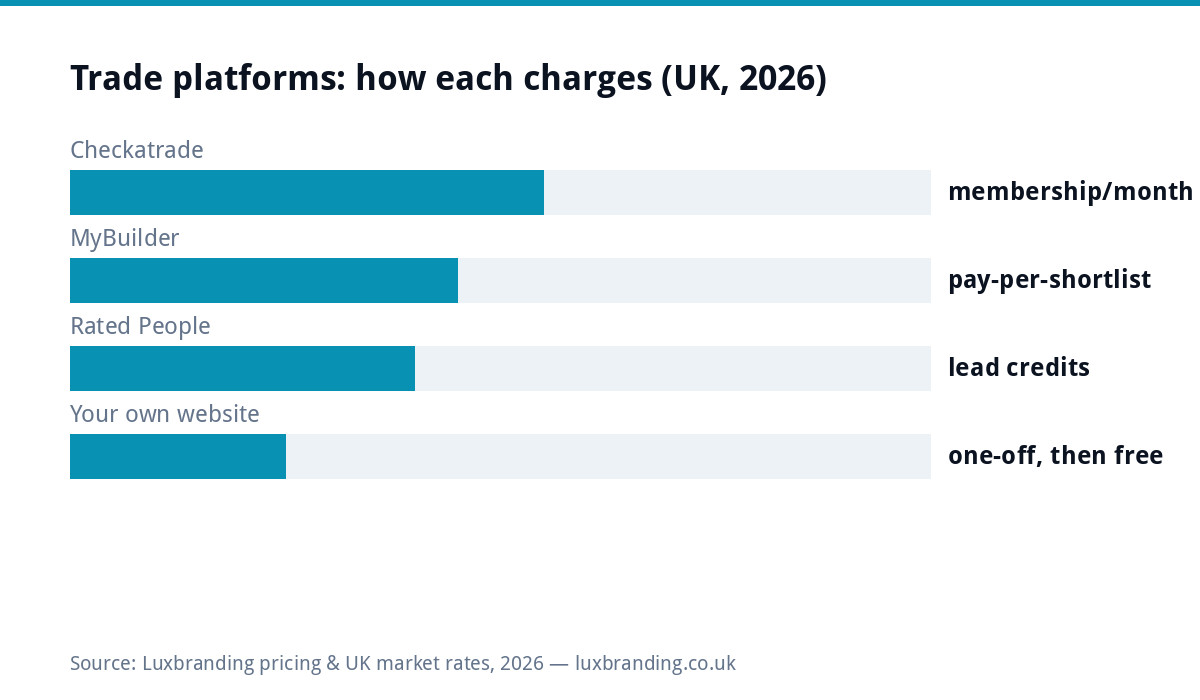
Different machines with different bills, membership models typically costing low-hundreds of £ per month against per-lead fees in the £5 to £35 class: Checkatrade sells monthly membership (a branded directory presence working while you sleep), MyBuilder sells shortlists per job (homeowners post, you pay to pitch the ones you want). Membership suits established trades wanting steady coverage; pay-per-lead suits new trades and gap-filling around a diary. The fee structures reward different behaviours, the traps differ, and the endgame for most trades is the same third option both platforms would rather you forgot: the owned site that rents from nobody.
How each actually charges (and what that does to behaviour)
Checkatrade’s membership model (fees vary by trade and area; theirs to quote) buys presence: profile, reviews, the brand’s TV-built trust halo. Its economics reward staying visible and stacking reviews; its risk is paying through quiet months and renewals creeping. MyBuilder’s pay-per-shortlist model charges when you express interest in a posted job, so you control spend job-by-job; its economics reward fast response and sharp job selection, and its risk is shortlist fees on jobs that ghost, which stings exactly when selection discipline slips. Neither fee is inherently better; they suit different diaries. The behavioural tell: membership platforms fill from their brand’s search traffic, lead platforms from homeowners in active-project mode, so lead quality complaints (universal to both) really reflect WHERE each platform’s homeowners are in their decision.
Head to head by what actually matters
| Checkatrade | MyBuilder | |
|---|---|---|
| You pay | Monthly, regardless of jobs | Per shortlist you choose |
| Best when | Established, reviews stacked, steady coverage wanted | New, diary-gap filling, testing an area or trade |
| Lead style | Inbound: homeowners find your profile | Marketplace: you pitch posted jobs, fast |
| Review asset | Strong on-platform; mirror to Google or it stays rented | Present, thinner brand pull |
| Fee trap | Quiet-month membership; renewal creep | Shortlist fees on ghost jobs; discipline decay |
| Exit cost | Profile and reviews stay behind | Low: stop buying |
Making either pay: the operating rules
Platform ROI is mostly operator behaviour, and the rules are the same on both. Speed: reply in minutes, not evenings; first competent contact anchors most homeowner decisions, and slow responders subsidise fast ones. Selection: on pay-per-lead especially, pursue only jobs matching your profit pattern; the discipline IS the margin. Profile quality: real job photos, specific trade descriptions and current certifications convert shortlists on both platforms, the same content that powers your quotes and site. The quote itself: platform jobs are comparison contexts by construction, so the professional written quote wins them disproportionately. And the double-dip: every platform customer should end as a GOOGLE review (yours forever) and a saved contact, because the platforms’ quiet business model is owning relationships you created; politely take yours home.
Trade and area nuances (which model fits which reality)
The models’ fit varies by trade shape. Emergency-led trades (plumbers, locksmiths, electricians on callouts) suit inbound membership presence, because their customers search-and-phone rather than post-and-wait; a posted “burst pipe” job is stale by the time shortlists form. Project trades (builders, landscapers, kitchen fitters) fit the marketplace model’s posted-job rhythm, where homeowners genuinely gather quotes over days. Dense urban areas sharpen pay-per-lead competition (five fast responders per job) while thinner rural coverage favours membership visibility, sometimes as the only listed trade for miles. And multi-trade firms should resist listing everything everywhere: the platform profile that converts is the specialist one, the same focus rule as the page-per-service principle on your own site. Match the model to how YOUR customers actually buy, and half the platform-disappointment stories never happen.
A fair trial: how to test either platform properly
Platform verdicts are usually vibes plus one bad week; run a real trial instead. Commit to ninety days on ONE platform with the operating rules above genuinely followed (minutes-fast responses, selective pursuit, complete profile with real photos), and track four numbers in a note: fees paid, leads pursued, jobs won, revenue landed. At day ninety the maths speaks: cost per won job against your margin says continue, renegotiate your usage, or stop, and the same log tells you WHY (losing at shortlist = profile/quote problem; winning few pursuits = selection problem; good ratios but thin volume = coverage problem, the membership model’s argument). Trades that run this discipline stop having platform opinions and start having platform numbers, which is also exactly the evidence that makes the eventual owned-site rebalancing decision (the £499 build both platforms quietly compete with) obvious rather than brave.
Reviews: the portability question nobody asks until leaving
Platform reviews are the asset that keeps trades renewing, and the trap is structural: years of reputation living on a profile you rent. The defence is running duplication from day one: every platform-won customer gets the Google review ask too, so your owned profile grows in lockstep, and the best platform reviews get quoted (as text, honestly attributed) on your own site. Then platform exit, if it ever comes, costs visibility but not reputation, and renewal conversations happen with options instead of hostages. It is the same own-your-assets principle as the domain rule in our web guides, applied to the reputation layer, and it costs one extra text per happy customer.
The rent-vs-own endgame (both platforms’ quiet competitor)
Run any trade’s numbers over three years and the pattern repeats: platform fees (membership or accumulated leads) total four figures, while a £299 to £499 owned site plus a worked Business Profile compounds toward “electrician [town]” enquiries that cost nothing per lead, forever. The mature stack most successful trades land on: ONE platform run properly (whichever model fits the diary) for demand today, the owned channels growing underneath, and spend rebalanced yearly as the free channel strengthens; the full channel maths including ads sits in our Checkatrade vs Google Ads companion. Platforms are rocket fuel, not the rocket; every price for the owned parts is on the price list.
Beyond the big two (the rest of the field, briefly)
The same two charging models repeat across the wider field: Rated People and TrustATrader run lead-credit and membership variants, Bark spans trades and services on pay-per-lead, and local Facebook groups are the free chaotic cousin that occasionally out-converts everything for small jobs. Evaluate any of them with this page’s same three questions: how does it charge, where are its homeowners in their decision, and what happens to your reviews if you leave? The answers sort every platform ever launched, which is why the operating rules and the ninety-day trial matter more than the brand names, and why the owned website stays the only channel whose answers are all “yours”.
The unglamorous summary: pick the model that matches how your customers buy and how fast you can answer a phone, run it with the operating rules for ninety days, keep duplicating every review to Google, and let your own four numbers, not forum anecdotes, decide the renewal. Platforms reward operators; the trades who treat them as systems to be worked, rather than verdicts to be received, are the ones whose fees keep making sense.
Get the UK SEO DIY Audit Checklist (free)
A 32-point checklist UK SMEs can run against their own website in an afternoon. Surfaces the quick wins before paying for a paid audit.
No spam. UK GDPR compliant. We only use your email to send this resource, unless you tick the box to hear from us.
Frequently asked questions
What is the difference between Checkatrade and MyBuilder? +
The charging model: Checkatrade sells monthly membership (directory presence + its brand), MyBuilder charges per lead you choose to pursue (homeowners post jobs, trades pay to be shortlisted). Membership suits steady coverage; pay-per-lead suits dipping in around a diary.
Which is better for a new trade business? +
Pay-per-lead platforms let a new trade buy work job-by-job without a membership commitment, which suits week one. Established trades with reviews accumulated often get more from membership models plus, increasingly, their own ranking website that rents from nobody.
What are the common complaints about trade platforms? +
The recurring ones across platforms: lead quality (tyre-kickers, price-shoppers, dead numbers), paying for shortlists that go nowhere, fee creep at renewal, and racing four other trades to every phone call. Managing which jobs you pursue, and how fast, matters more than platform choice.
Can I use Checkatrade or MyBuilder AND my own website? +
That is the strongest position: platforms for demand today, your own site compounding toward free enquiries, and your reviews mirrored to Google (which you own) rather than living only on rented profiles. Every platform-won customer can become an owned review and a repeat.
How fast do I need to respond to platform leads? +
Minutes matter: homeowner posts get multiple responses and the first competent replier anchors the conversation. Trades that treat platform leads as answer-now interrupts convert multiples of those who reply that evening; if you cannot respond fast, pay-per-lead maths turns against you.