Quick answer
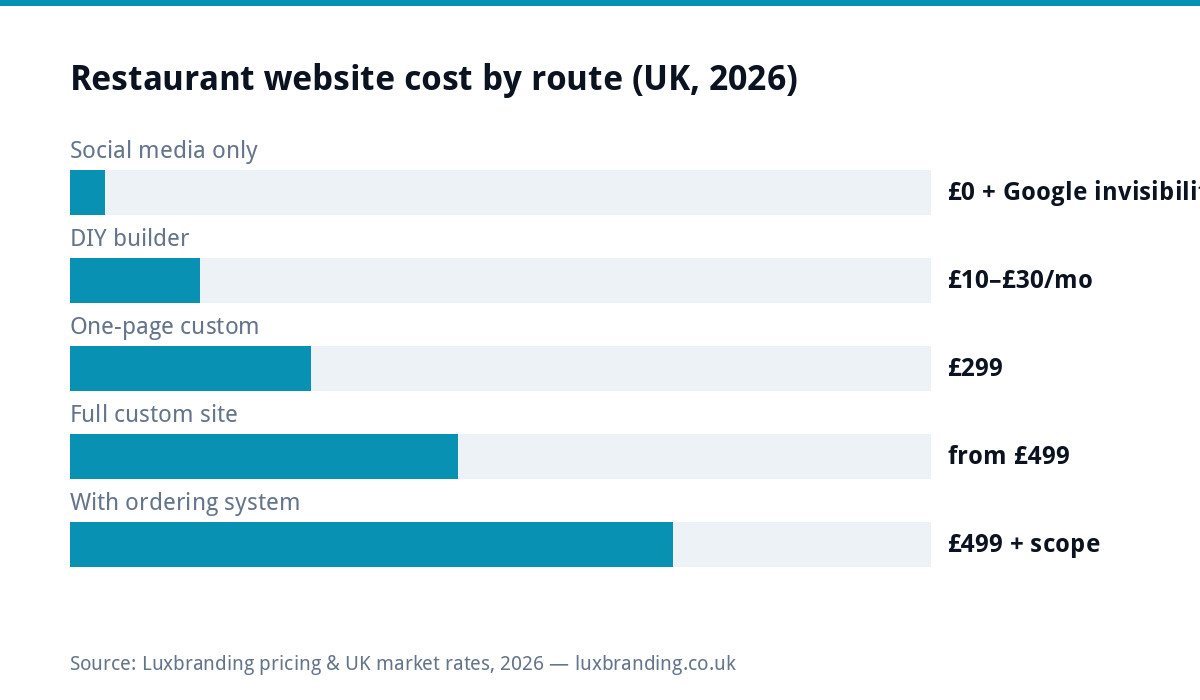
A restaurant website in the UK costs £299 (custom one-pager: menu, hours, booking, location, genuinely enough for many venues) or from £499 (full site) in 2026, with booking widgets from free and commission-free online ordering as a scoped addition. The number that reframes the whole purchase: delivery apps’ published commissions run 20–35% of every order, the website that recaptures even part of that traffic is the rare marketing spend with a direct, calculable payback.
Where restaurant customers actually come from
Two searches drive the sector: “restaurants near me / [cuisine] [town]” on Google and Maps, where your Google Business Profile and website decide if you appear, and repeat/referral customers checking tonight’s hours and menu before setting out. A social-only presence serves neither: Instagram is your shop window for people who already follow you, invisible to the hungry stranger searching. The site + profile combination is how the searching public finds you; the £299–£499 question is just how much site that takes, and for a single-location venue the answer is usually: less than you think, done better than the chains.
What each tier buys a venue
| Tier | Cost | Covers | Right for |
|---|---|---|---|
| One-page custom | £299 | Menu (as text), hours, map, booking link, gallery, the essentials done beautifully | Cafés, takeaways, single-menu venues |
| Full custom | from £499 | Separate menu/events/private-hire/story pages, room to grow | Restaurants with functions, events, multiple menus |
| + Booking | free widget → platform subscription | Table bookings without phone tag | Any venue taking reservations |
| + Direct ordering | scoped (or flat-fee platform) | Collection/delivery orders, commission-free | Venues doing steady app volume, see the maths below |
The commission maths (do this one on a napkin)
Take your monthly delivery-app revenue and multiply by the published commission band (20–35% depending on app and plan). A takeaway doing £4,000/month through apps is paying £800–£1,400/month for the channel. Nobody should abandon the apps, they bring customers you don’t have, but every REPEAT customer ordering through an app is paying rent on a relationship you already own. The play: apps acquire, your site retains. A “order direct and save” push (box in every bag, sign on the counter, link in bio) moving even a quarter of regulars to commission-free direct ordering pays for the entire website in weeks. This is the same rent-vs-own logic as every channel decision, sharpened by hospitality’s brutal margins.
Bookings: widget, platform, or build
Three tiers, honestly ranked for a UK venue. Free/cheap widgets (a bookings form, or Google’s own Reserve options where available): fine for low-volume tables; enquiries arrive as emails; you manage the diary. Booking platforms (OpenTable-class, published per-cover or subscription pricing): real diary management, reminders, no-show tools, at per-cover fees that sting at volume, plus the familiar catch that the platform markets its whole roster to YOUR diners; read the marketing-consent settings closely. Custom booking built into your site: your rules (deposits on Saturdays, table-size logic), no per-cover fees, the guest data yours, the maths mirrors the booking-system cost guide, and the same volume thresholds decide it. Most venues sensibly climb the ladder: widget while small, platform when the phone won’t stop, custom when the per-cover fees on the platform statement start reading like a second rent.
Local search for venues: four moves, no agency required
Hospitality local SEO is unusually mechanical, and the site enables all of it. One: the Business Profile complete and ALIVE, categories right, photos monthly, hours sacred, every review answered; for “near me” searches this outweighs the website itself. Two: menu-as-text on the site (covered above), it’s what ranks you for dish and cuisine searches, and what AI assistants read when asked “good Thai near the station”. Three: consistency of name/address/phone across site, profile, socials and the delivery apps, mismatches quietly erode trust signals. Four: reviews as a system, not a hope, the QR-on-the-bill habit, staff asking happy tables, and replies to everything including the grumpy ones (future diners read the replies as your character reference). A venue doing these four consistently outranks fancier competitors doing none; the whole apparatus costs the £199 setup plus habits.
Menu, photos, hours: the three details that decide everything
The menu lives as text on the page. Not a PDF (phone users pinch-zoom, Google reads nothing), text, with prices, updated when the kitchen changes. Bonus: dishes-as-text is how you appear for “best sunday roast [town]” searches, and how AI assistants recommending local food read you. Photography is the conversion layer: real dishes, real room, shot in daylight, hospitality is the one sector where the pictures ARE the argument, and where stock photos are instantly, fatally recognisable. Hours must be true everywhere, site, Google profile, socials, because “arrived, it was shut” is the one-star review machine, and bank-holiday overrides are the difference between a full Tuesday and an angry one. All three cost diligence, not money; the build just gives them a proper home. (The same trinity powers the printed menu (£79) and restaurant branding, one visual system across plate, print and pixels.)
The five mistakes venues make online
The hospitality-specific failure modes, each fixable this week. The PDF menu, covered above, still the sector’s most common own-goal. Stale hours across site and Google, the one-star machine; assign the update job to a named person, including bank holidays. Music or video autoplay, the fastest way to lose the customer browsing at their desk. App-dependence drift: every touchpoint funnelling to Deliveroo/OpenTable links, training even your regulars into paying the commission channels, your own site and phone number deserve top billing on everything YOU print and post. Photography neglect: the site launched with launch-week photos and never saw another, while the kitchen’s best work goes exclusively to Instagram stories that vanish in a day; a monthly habit of promoting the three best food photos from social onto the site keeps it looking as alive as the room is. None of these needs budget; all of them need an owner, the same truth as the review-reply habit, and jointly they’re worth more than any redesign.
The one-page structure that works for venues (steal this)
For the £299 tier, order matters more than flourish, top to bottom: hero with ONE real photo of the room or signature dish, name, and the three facts (cuisine, area, booking link) visible without scrolling; the menu next, as text, because it’s what most visitors came for; then hours + address + map with a tap-to-navigate link; booking (widget or phone, but tappable); a short gallery, six great photos beat thirty middling ones; reviews (three good ones, verbatim, first names); dietary/allergen line and the practical FAQs (dogs? kids? parking? cards?); socials last, as icons, the site sends people TO Instagram, never the reverse. Two things deliberately absent: an autoplaying anything, and the “our philosophy” essay above the menu, philosophy belongs below the food, where the already-interested read it. This ordering mirrors how a hungry stranger actually decides (can I eat here, when, where, book) and it’s the blueprint our hospitality one-pagers ship with; venues upgrading to the full build keep the same skeleton per page.
The stack for a full venue, priced
Website £299–£499 · Google Business Profile setup £199 (or DIY) with photos and review flow · menu design £79 when print needs match the site · logo/brand £129–£299 if the identity needs it · ordering scoped when app-commission maths says so. Owned outright, that’s a launch-grade digital presence for roughly one month of a busy venue’s app commissions, and every fixed price is public on the price list. If bookings are your bottleneck rather than discovery, start with the booking system cost guide instead; if it’s the whole picture, the £299 one-pager is the fastest respectable start in hospitality.
Get the UK Website Project Brief Template (free)
A 2-page template for briefing any UK web designer — sitemap, integrations, audience, deliverables. Cuts revision rounds in half.
No spam. Unsubscribe any time. UK GDPR compliant — your email is only used to send this resource.
Frequently asked questions
How much does a restaurant website cost in the UK? +
A custom one-page site (menu, hours, location, booking link) is £299; a full site from £499. Booking integrations range from free embed widgets to platform subscriptions; online-ordering systems are scoped on top. DIY builders run £10–£30/month with hospitality templates.
Does a restaurant need a website if it's on Instagram and Deliveroo? +
Instagram reaches followers; Google reaches EVERYONE searching "restaurants near me" tonight — and without a site you barely exist there. Delivery apps bring orders minus 20–35% published commission, on their customer relationship. The website is where you're found AND keep the whole ticket.
What must a restaurant website include? +
The menu as readable text on the page (not a squinting PDF — searchers and Google both read text), opening hours kept true, location with map link, booking route, real food photography, and dietary/allergen info. Everything else is decoration by comparison.
Should the menu be a PDF? +
No — PDFs punish phone users (pinch-zooming a print menu) and hide your dishes from Google searches like "best katsu curry [town]". Menu as page text, updated when dishes change; keep a print-formatted PDF as a secondary download if you like.
What about online ordering — can my website take orders directly? +
Yes: commission-free ordering through your own site is a scoped build (or a flat-fee ordering platform plugged in). At published delivery-app commissions of 20–35%, direct ordering pays for itself quickly for any venue doing steady collection/delivery volume.