
Quick answer
A tradesman’s website in the UK costs £299 flat (custom one-pager), from £499 (full site with a page per service, the build that ranks), or £79/month pay-monthly with full ownership at the end. DIY builders run £10–£30/month forever; a Facebook page is free and invisible to Google searches. The comparison that matters isn’t between these tiers though, it’s against what trades already spend renting leads from directories, which is why this purchase pays back faster for trades than for almost any other business type.
The rent-vs-own maths every trade already knows
Trades understand this arithmetic from vans and tools; the website is the same decision. Directory memberships and lead fees are rent: they produce work while you pay and nothing when you stop, at rates that climb with competition for the same postcode. A ranking website is owned kit: “emergency plumber [town]” finding YOUR site sends the lead free, this month and every month. The build cost equals a few months of what many trades pay directories, and the two aren’t enemies: run the directory for demand today while the site earns its rankings, then let the free channel grow. Our Checkatrade vs Google Ads comparison prices the rented channels against each other; this page prices the asset.
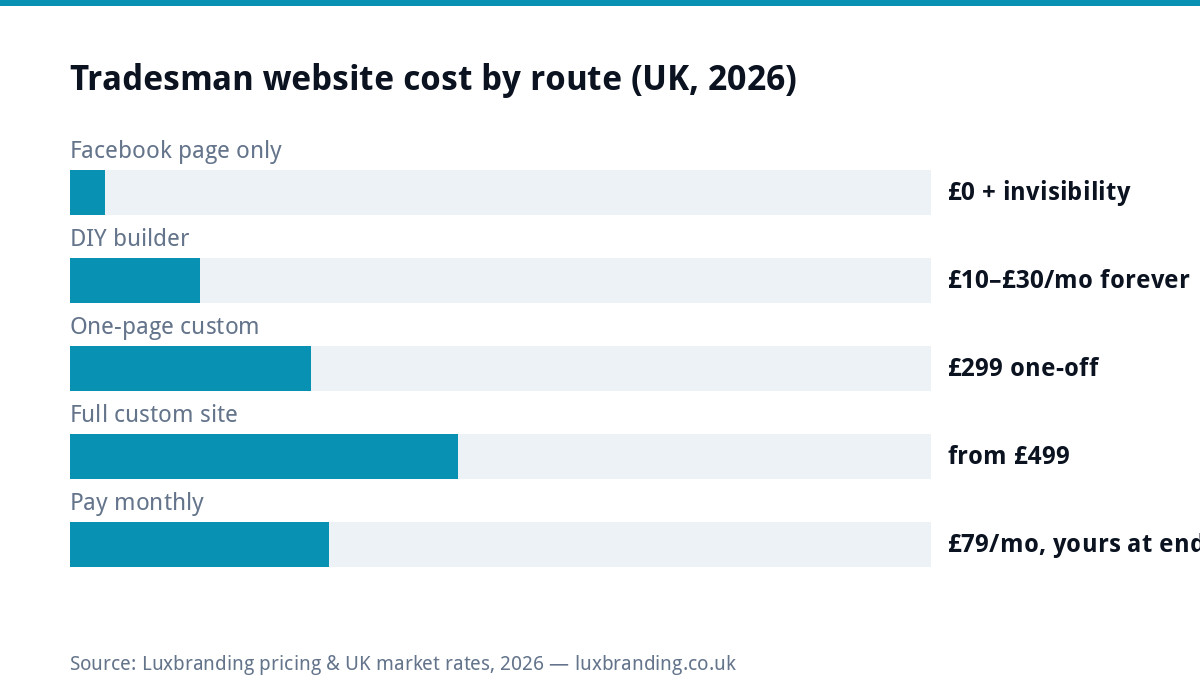
Route by route, trades edition
| Route | Cost | Right when | The catch |
|---|---|---|---|
| Facebook page only | £0 | Word-of-mouth genuinely fills your diary | Invisible to Google searches, the customers who don’t know you yet |
| DIY builder | £10–£30/mo | Testing whether you want an online presence at all | Evenings you don’t have; subscription outlives the savings |
| One-page custom | £299 flat | One core trade, local area, needs credibility + enquiries | Ranks for one thing well, fine until you want every service found |
| Full custom | from £499 | Multiple services that should EACH rank | Needs your photos and service details to build from |
| Pay monthly | £79/mo | Cashflow-shaped budgets; ownership at the end | 12-month minimum |
Why the page-per-service rule decides your tier
The single most useful thing a trade can know about websites: Google ranks PAGES, not businesses. One page listing “plumbing, heating, bathrooms, boilers” competes for none of those searches properly; a page each for boiler repair, bathroom fitting and emergency callouts can each rank for its own term in your area. That’s the entire case for the £499 build over the £299 one-pager when you genuinely offer multiple services, and the honest case FOR the one-pager when you do one thing: a specialist “oven cleaning [town]” one-pager with reviews and a booking form is complete as-is. (It’s the same limit our one-page cost guide spells out for every industry, trades just feel it faster because local search is where their work lives.)
The five mistakes trades make with their first site
Seen constantly, all avoidable at zero cost. The everything-page: ten services on one page, ranking for none (the page-per-service rule above exists because of this). Stock-photo syndrome: the smiling-model-with-spanner photo that customers have seen on four competitors’ sites this week, your muddy-boots real photos win precisely because they’re yours. The buried number: contact details only on a contact page, when the flooded-kitchen visitor gives you eight seconds on whatever page Google chose. Ghost-town signals: a “latest news” section last updated in 2023, or a copyright year two years stale, nothing says “maybe they’ve shut” louder; if you won’t update it, don’t include it. Vanity-first ordering: the site opens with the company’s story instead of the customer’s problem, “Established 2009” is a trust chip for further down the page, not a headline; “Emergency electrician covering [town], call now” is a headline. Every one of these is a content decision, not a budget one, which is why the £299 site that avoids them outperforms £2,000 sites that don’t.
A realistic year one (hypothetical, honest)
Sketch a one-van electrician in a mid-sized town, £499 site built in the spring lull plus the £199 profile setup. Months one to three: rankings for “name + town” and the Map Pack appearances start; enquiries are a trickle, two or three, mostly from the profile. Months four to eight: individual service pages (“EV charger installation [town]”, “fuse box replacement [town]”) begin placing for their long-tails; the trickle becomes steady, call it five to eight enquiries monthly across profile, site and reviews momentum. Months nine to twelve: the compounding shows; the site outdraws the directory listing he still runs, at zero marginal cost per lead. Now the honest arithmetic: if even ONE extra job a month lands at trade job values, year-one return runs to multiples of the £700 all-in spend, and unlike the directory fee, year two starts from the built position rather than zero. The numbers are illustrative, not promised, town size, competition and review velocity move them, but the SHAPE (slow, then compounding, then owned) is the reliable part, and it’s why the build-in-the-quiet-season advice above isn’t a platitude.
What actually converts on a trades site
The visitors are specific: locals with a problem, often on a phone, comparing three tabs. What wins them is specific too. Phone number top-right, tappable, on every page, the flooded-kitchen visitor doesn’t scroll. Real job photos: your scaffolding, your van, your finished bathrooms, stock photos actively repel (every competitor’s site has the same smiling model). Reviews visible, pulled from Google/Checkatrade where they already live. Areas covered, explicitly, it’s a top-three question and a local-SEO signal. A short quote form for evenings: name, number, job, photos-optional. Add the trust bits that cost nothing (insurance, certifications, years trading) and skip the bits that cost conversions (auto-playing anything, “we are a leading provider of solutions” copy). Design supports all this; it doesn’t replace it.
Gather this before the build (the trades edition)
Builds stall on materials, and trades materials are specific. Photos: fifteen-plus real jobs, before/after pairs where the trade shows transformation (decorating, landscaping, bathrooms), finished-work shots elsewhere, the van, and one of you or the team that isn’t a grimace; today’s phone photos in daylight beat everything stock. The facts customers filter by: exact services (the page-per-service list), postcode areas honestly covered, emergency availability yes/no and hours, insurance and certifications with numbers (Gas Safe, NICEIC, these are search terms as well as trust marks), years trading, payment methods. Proof: your best reviews copied verbatim with first names, and permission to use customer photos where jobs are recognisable. And the practical: your logo in vector (£39 conversion if it’s trapped in a JPG). An evening with a beer assembles the lot; it’s the difference between a five-day build and a five-week one.
When to build it (trades seasonality, used properly)
Every trade has a quiet season, and it’s the build window twice over: you have the evenings for the materials above, and, the underrated half, the site needs lead time before your busy season, because rankings age like concrete cures. A site live in the quiet quarter has indexed, gathered its first reviews and started ranking for name+town by the time demand spikes; one launched at the season’s peak spends your busiest months invisible. Practical calendar: heating trades build in spring, outdoor trades in late autumn, everyone else whenever the diary dips. The wrong answer is the perennial one, “after the busy period settles down”, which is how trades reach year five still renting every lead. If cashflow is the honest blocker rather than time, the £79/month pay-monthly route exists precisely for the trade whose quiet season is also the tight one.
The full trades stack, priced honestly
The website is the hub, not the whole machine. The stack that makes local trades findable: the site (£299–£499, above), a completed Google Business Profile (£199 done-for-you, or DIY, it’s the Map Pack, where huge amounts of trade work starts), reviews flowing (free, habit-powered), and a logo that works on the van tying it together. Ads and SEO layer on later, WHEN the diary needs more than the free channels fill. Whole stack, owned outright, for roughly what two quiet months of directory fees cost, and every element is a flat price on the price list.
Get the UK Website Project Brief Template (free)
A 2-page template for briefing any UK web designer — sitemap, integrations, audience, deliverables. Cuts revision rounds in half.
No spam. Unsubscribe any time. UK GDPR compliant — your email is only used to send this resource.
Frequently asked questions
How much does a website cost for a tradesman in the UK? +
A custom one-page site is £299 flat; a full multi-page site (page per service — the SEO-correct build) from £499; pay-monthly custom is £79/month with ownership at the end. DIY builders run £10–£30/month forever. Most sole traders need less site than they fear.
Do tradespeople actually need a website if they're on Checkatrade? +
Directories rent you leads; a website earns them free once ranked. The strongest position is both: directory presence for demand today, your own ranking site so "electrician [your town]" eventually finds YOU without a middleman's fee attached. Every year without a site extends the rent.
What pages does a trades website need? +
Homepage, one page PER service (that's how each service ranks — "boiler repair" and "bathroom fitting" can't share one page and both rank), an areas-covered page, photos of real jobs, reviews, and a contact page with the phone number everywhere. Ten pages covers most trades.
What makes a trades website actually generate work? +
Phone number visible without scrolling (mobile visitors are often standing in a flooded kitchen), real job photos rather than stock, your reviews pulled in, clear areas covered, and a quote form for the after-hours crowd. Design polish matters less than those five.
Website or more Checkatrade/ads budget — which first? +
If you have zero online presence: the £299 site plus a free Google Business Profile beats another month of directory fees — it's the asset everything else points at. If you have a decent site already: spend on what's missing (reviews, GBP, then ads).