Quick answer
Below is the full quote template: copy it, save it, fill it per job. One page, built to win work and prevent the two ways trades lose money on paper: scope disputes (“I thought that included…”) and quotes that read amateur next to a competitor’s. The wording that matters most is the exclusions line and the quote-versus-estimate declaration; both explained after the template. Cost £0, wins measurably more than verbal numbers and texts.
The template (copy from here)
| Section | What goes in it |
|---|---|
| Header | Business name + logo, phone, email, address, and the trust line: certifications with numbers (Gas Safe/NICEIC/etc.), insurance held |
| Quote for / job address | Customer name, the property, date of visit |
| QUOTE or ESTIMATE | Say which, in the title, bold. See below; this word is the dispute-killer |
| Scope of work | Numbered lines, plain English: “1. Remove existing radiator and cap off. 2. Supply and fit 600×1200 double panel…” Each line something the customer can picture |
| Not included | The line that saves relationships: “Excludes: making good decoration, disposal of old unit, any works found necessary once floor is lifted (priced separately if found)” |
| Price | Line totals if helpful, ONE clear total, VAT position stated (“includes VAT” / “no VAT applicable”), and materials-cost assumptions if volatile |
| Deposit & payment | “25% deposit to book, balance on completion, bank transfer/card.” Whatever YOUR terms are, in writing |
| Timing | Earliest start, expected duration, anything that could move it |
| Valid until | A real date, 14 to 30 days; materials prices move and open-ended quotes haunt you |
| Acceptance | “To accept, reply to this email or text YES to [number]. We’ll confirm your start date within 24 hours.” |
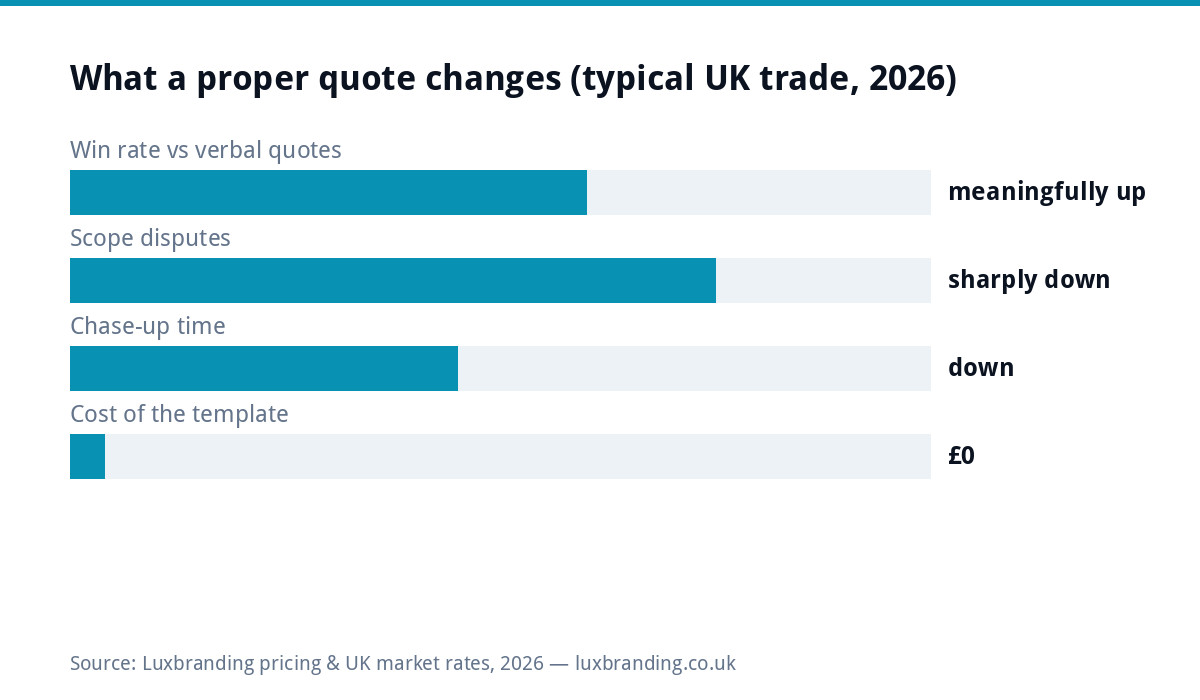
The two lines that do the heavy lifting
QUOTE vs ESTIMATE, declared. In consumer law and consumer minds these differ: a quote is a fixed price for the stated scope, an estimate can move. Most disputes are born in the gap, so the template makes you declare it in the title. Rule of thumb: quote what you can see, estimate what you cannot (“estimate; firm quote once floorboards are up”), and never let the word “quote” decorate a number you intend to change. The Not-Included line. Trades assume exclusions are obvious; customers assume the price covers everything they imagined. Writing the exclusions costs three lines and converts “you never said that” arguments into “as per the quote” sentences. Making-good, disposal, discovered works, and parking/permit costs are the four that pay for the whole habit.
Sending it fast (the phone workflow)
The template only wins if it goes out same-day, so wire the workflow once: save it as a note or document template on your phone, fill the scope lines in the van after the visit (voice-typing works fine for scope drafts), attach your logo’d version or paste into email, send before the next job. Trades using this rhythm report the quiet competitive truth: being FIRST with a professional-looking, clearly-scoped quote wins jobs at higher prices than being cheapest three days later, because the customer’s trust decision usually happens before the comparison one. If you are past ten quotes a week, this is the exact point where quoting automation earns its keep and where a simple CRM stops follow-ups slipping; until then, the template and a follow-up habit (“still interested? our [validity] date is coming up”) cover it.
Making it look the part (the ten-minute polish)
Presentation moves win rates more than trades expect, and the polish list is short: your logo at proper resolution in the header (the £79 fix applies if all you have is a blurry JPG), consistent fonts (one for headings, one for body, nothing comic), certifications displayed with numbers rather than claimed, and a PDF rather than raw email text for anything over small-job size, because PDFs read as documents and documents read as businesses. This is the same trust mechanics as your website and van: matching, professional, checkable. A customer holding your quote next to a competitor’s texted “£450 all in m8” experiences the difference as risk reduction, and pays for it.
Estimates, day rates and the jobs you cannot fix-price
Some work honestly cannot be quoted from a walkaround, and the template flexes rather than lies: title it ESTIMATE, state the assumption that changes it (“assumes joists sound; firm price after inspection”), and give the mechanism (“any additional works priced and agreed in writing before proceeding”), which keeps the customer’s control feeling intact, the exact fear that kills estimate acceptance. Day-rate work gets its own honest line: rate, what a day includes, materials billed at cost with receipts or marked up transparently, whichever is your practice. The one construction to retire forever is the fixed-sounding number with silent flex, because it converts like a quote and disputes like an estimate, collecting the worst of both. UK consumer-rights basics sit behind all of this for domestic work (cancellation rights on doorstep-agreed contracts, written terms), covered plainly on gov.uk, and one line in your footer (“full terms on request”) plus actually having terms puts you ahead of most of the trade.
The quote mistakes that cost jobs (a field list)
Seen weekly across trades: the mystery total with no scope (invites haggling, converts suspicion); “quote valid indefinitely” (materials moved, you honour a loss or break your word); certifications claimed nowhere (the customer is comparing you against someone whose Gas Safe number is in the header); the WhatsApp voice-note quote (unwritable, undisputable, unprofessional in one move); and silence after sending, which loses more accepted-in-principle jobs than price ever does. Each is free to fix and each is fixed by the template plus the follow-up rhythm, which is the entire pitch of this page: the money in quoting is in the boring parts done every time.
From quote to invoice (close the paperwork loop)
The quote’s accepted; the same professionalism should finish the job: an invoice matching the quote line-for-line (variations shown separately, as agreed in writing per the estimate mechanism), payment details prominent, terms restated, and sent the day the job completes while satisfaction is warm, which is also the exact moment for the review ask (scripts in our reviews guide). Trades running the full loop (professional quote, clean variations, same-day invoice, review ask) report the compounding nobody advertises: better customers referring better customers, because paperwork quality is how word-of-mouth describes “proper outfit”. When volume makes the loop heavy, that is the automation threshold our quoting automation guide prices; until then, templates and habit carry it free.
The follow-up rhythm (where quotes actually convert)
Most quotes die of silence, not rejection. The rhythm that converts without pestering: day 2 to 3, one message (“Any questions on the quote? Happy to walk through it”); a week before validity expires, one more (“Quote’s valid until the 15th; diary’s filling for the month, want me to pencil you in?”). Two touches, both giving reasons other than neediness, both easier because the quote stated a validity date and an acceptance route. Track the outcomes even crudely (won/lost/no-reply in a note) and your own numbers will tell you what to fix next; that habit, more than any template, is what the trades who win consistently share. The template just makes every touch look like a business worth choosing, and it is yours for the copy-paste; prices for everything we’d charge for live on the price list, this page deliberately not among them.
Get the UK SME Marketing Budget Worksheet (free)
A printable worksheet for setting a realistic UK marketing budget and splitting it across SEO, paid ads, content and email.
No spam. UK GDPR compliant. We only use your email to send this resource, unless you tick the box to hear from us.
Frequently asked questions
What should a trade quote include? +
Your business details (with certifications), the customer and job address, a clear scope broken into lines, what is EXCLUDED, the price with VAT position stated, deposit and payment terms, a validity date, and timing expectations. The template below covers all of it in one page.
Should a quote be itemised or one total? +
Broken into readable lines (labour, materials, distinct job parts) with one clear total. Line items build trust and make extras easier to price later; a single mystery number invites haggling and suspicion. Full parts-level breakdowns are optional and sometimes counterproductive.
What is the difference between a quote and an estimate? +
A quote is a fixed price for defined work; an estimate is an informed guess that may change. Say which yours is ON the document, because customers assume "quote" means fixed, and disputes live in that assumption. This template is built for quotes with an estimate variant noted.
Should I take a deposit, and how much? +
For jobs involving materials or booked days, yes: commonly 25 to 50% depending on trade and materials outlay. State it on the quote plainly. Deposits commit the customer, fund materials, and collapse no-start rates, the same psychology as booking deposits everywhere.
How quickly should I send a quote after seeing a job? +
Same day where possible, within 48 hours always. Speed signals reliability before the price is even read, and the first professional quote in the customer's inbox frames every later one. The template exists so speed does not cost accuracy.