Quick answer
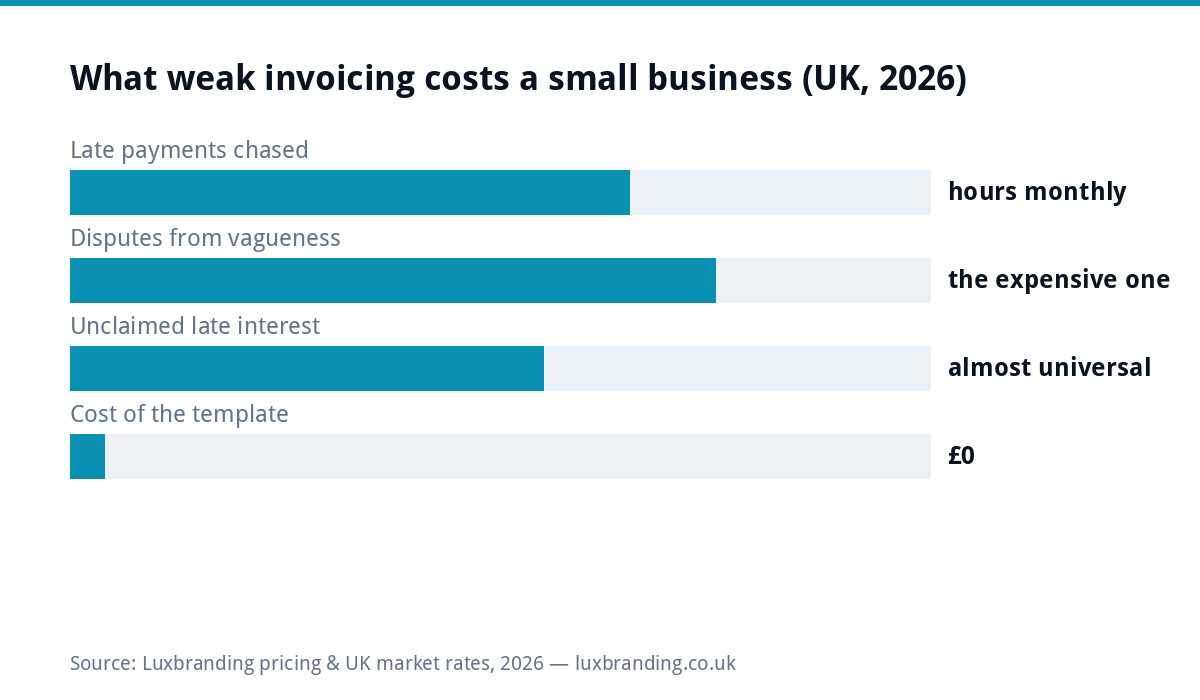
Below is the complete UK invoice template: copy it, fill in the brackets, send it, in the VAT or non-VAT variant that matches your registration. Every field required by UK invoicing rules is in it, the payment-terms wording is tuned to get you paid faster, and the whole thing costs £0. Weak invoices cost real money in three ways this page fixes: late payments that need chasing, disputes born of vague descriptions, and statutory late-payment interest almost nobody claims.
The template (copy from here)
| Section | What goes in it |
|---|---|
| Header | INVOICE in large type, your logo, invoice number (e.g. 2026-041), invoice date, supply date if different |
| From | Your business name, your own name if sole trading under a style, address, email, phone. Limited companies: registered name, company number and registered office. VAT-registered: your VAT number |
| To | Customer name (the legal entity paying), their address, a contact/reference if they gave one, their PO number if applicable |
| Lines | One row per item: plain-English description, quantity or hours, rate, line total. Describe so a stranger could match it to the work: “Boiler service, 3-bed semi, 12 Sept” beats “works as agreed” |
| Totals (non-VAT) | Subtotal and TOTAL DUE, with the words “Not VAT registered, no VAT charged” if customers may expect it |
| Totals (VAT) | Net subtotal, VAT at [rate]% shown as its own line, gross TOTAL DUE |
| Payment | “Payment due by [specific date].” Bank name, account name, sort code, account number, reference to use (the invoice number). Card/other options if offered |
| Footer | “We reserve the right to charge statutory interest and compensation on late commercial payments.” Thank-you line. Retention-of-title line for goods if relevant |
VAT or non-VAT: pick your variant and never mix them
The single most common invoicing error we see on client paperwork is variant confusion. If you are not VAT registered: never show a VAT number you don’t have, never write “VAT included”, never split out VAT, because charging VAT without registration is a genuine offence, and the safest wording where customers expect VAT is the explicit “not VAT registered, no VAT charged” line from the template. If you are registered: the full VAT invoice is mandatory for standard sales, with your number, the rate, and net/VAT/gross shown separately, and your invoice numbering feeding your VAT records cleanly. Cross the threshold mid-year and the switch date matters; your accountant’s the authority there, and our accountancy-sector guide explains what good ones publish about exactly this.
Sole trader vs limited company: the fields that differ
Sole traders invoice as themselves: your own name must appear (a trading name alone is not enough), plus an address where documents can be served. Limited companies must show the registered company name exactly as incorporated, and once you put any director names on invoices, rules require consistency, so most companies simply use the registered name plus company number plus registered office as a standing footer block. Partnerships name the partners or state where a list is available. None of this is decoration: get the identity block wrong and a determined non-payer’s solicitor will find the gap. The template’s From section carries each variant; delete the rows that are not you.
The payment-terms wording that actually gets you paid
Three template choices are doing quiet work. The specific due date: “due by 14 October” removes the maths and the ambiguity that “net 30” invites (30 days from invoice date? Receipt? Month end?), and dated obligations get diarised where vague ones get drifted. Bank details prominent, with the reference stated: every obstacle between intention and transfer costs days, and unreferenced payments cost you reconciliation time. The statutory-interest line: UK law gives businesses the right to interest and fixed compensation on late commercial payments (the gov.uk guidance sets the current rates), and simply stating the right, politely, moves your invoice up the payment queue. You will rarely need to claim it; the line works by existing.
Numbering: the tiny system that saves an inspection
Pick a sequence and never break it: 2026-001 onwards is perfect, one number per invoice, credit notes numbered in their own matching series. Why it matters beyond tidiness: HMRC expects an orderly sequence, and gaps read as deleted income in any inspection, VAT or otherwise. The template’s number sits in the header where their accounts-payable software looks for it, and your quote and invoice numbers should reference each other when a job had both, which is exactly the paperwork loop our quote template closes from the other end.
Descriptions: where disputes are born or prevented
The lines section earns the most craft. Write each line so the customer’s future self, or their bookkeeper, can match it to reality without a phone call: what, where, when, and any agreed variation shown as its own line referencing the agreement (“Additional socket as agreed by text 14 Sept”). Vague lines invite queries, queries pause payment runs, and paused invoices age into disputes. This mirrors the scope discipline from the quote side: the quote defined the work, the invoice mirrors the quote line-for-line, variations appear separately, and the customer signs off a story with no surprises in it. Businesses that run both templates report the same thing: arguments about money mostly stopped, because the paperwork stopped leaving room for them.
Sending, chasing, and the rhythm that keeps cash moving
The template is the artifact; the rhythm is the system. Send the invoice the day the work completes, while satisfaction is warm (it is also the natural moment for the review ask). Diary the due date. Chase the day after it passes, politely and by reference to the document (“just flagging invoice 2026-041 fell due yesterday, grateful if it could be scheduled”), then weekly, each message calm and referenced. Most late payment is disorganisation, not refusal, and referenced reminders slot into someone’s payment run where emotional ones start arguments. The statutory-interest line from the footer is your quiet escalation: mention it explicitly only when weeks pass, and involve the actual recovery process only when the relationship is already priced in.
Presentation: the ten-minute upgrade
An invoice is brand collateral that touches every single customer, so it should look like your business: your logo at proper size in the header, one clean font, your brand colour on the INVOICE header at most, and a PDF rather than editable document for anything that matters (Word invoices read as drafts and occasionally get edited by the wrong side). The same presentation rules as the quote template apply, because the customer experiences quote and invoice as chapters of one story, and consistency between them is precisely what “proper outfit” feels like from the paying side.
When templates stop being enough
The copy-paste version scales further than people expect, but three signals mark the graduation point: invoices above roughly ten a week (the numbering, sending and chasing admin becomes real hours), VAT registration (digital record-keeping expectations make software genuinely easier), or a growing gap between quoting, invoicing and knowing who owes what. That is when accounting software’s published tiers earn their fees, and when connecting the whole quote-to-cash loop becomes a build worth scoping: our quoting and invoicing automation guide runs the thresholds, and the custom business software service exists for the businesses whose loop no off-the-shelf tool fits. Until then, this page plus discipline is genuinely the whole system, priced at nothing, like every artifact in this series; the paid escapes live on the price list.
Get the UK SME Marketing Budget Worksheet (free)
A printable worksheet for setting a realistic UK marketing budget and splitting it across SEO, paid ads, content and email.
No spam. UK GDPR compliant. We only use your email to send this resource, unless you tick the box to hear from us.
Frequently asked questions
What must a UK invoice legally include? +
A unique identifying number, your business name and address, the customer's name and address, a clear description of goods or services, the supply date and invoice date, and the amount owed. VAT-registered businesses add their VAT number, the VAT rate and the VAT amount shown separately. Limited companies must also show the registered company name.
What is the difference between a VAT and non-VAT invoice? +
A non-VAT-registered business simply must not charge or show VAT at all. A VAT-registered business must issue full VAT invoices: VAT number displayed, the rate applied, net, VAT and gross amounts shown separately. Using the wrong variant is a compliance problem in both directions.
What payment terms should I put on an invoice? +
State a specific due date rather than vague wording: "Payment due by 14 October 2026" beats "net 30". Add accepted payment methods and your bank details prominently. UK businesses can also charge statutory interest on late commercial payments, and a line noting this measurably speeds payment.
How should I number my invoices? +
Sequentially and uniquely, with no gaps in the record: a simple format like 2026-001 works. HMRC expects an orderly sequence; restarting at 1 each year with a year prefix keeps it tidy, and gaps look like deleted invoices in an inspection.
Can I invoice without being a registered company? +
Yes. Sole traders invoice under their own name (plus a trading name if used) with their own address. You do not need a company number, but you do need every other required field, and you must include your own name on the invoice, not just a trading style.