

Quick answer
An accountancy practice website costs £299 as a custom one-pager or from £499 with a page per service line in 2026. The sector’s conversion levers are distinctive: qualification display clients can verify, fee transparency in a profession that resists it, a switching-is-easy page (the decisive one, and almost nobody has it), and January-proof timing. All four travel with whichever tier you buy.
How clients actually choose an accountant
Two entry paths dominate: referrals (“who does your books?”) that still Google the name before calling, and cold searches (“accountant for small business [town]”, “self assessment help”) that peak violently around deadlines. Both paths end at the same twenty-minute comparison: does this practice look competent, do they handle businesses like mine, roughly what will it cost, and will changing accountants be painful? A site that answers all four wins referrals it never met and searchers it never advertised to; a brochure that answers none leaks both to the practice up the road. That comparison moment is what £299–£499 buys entry to, alongside the Business Profile that catches the “near me” half.
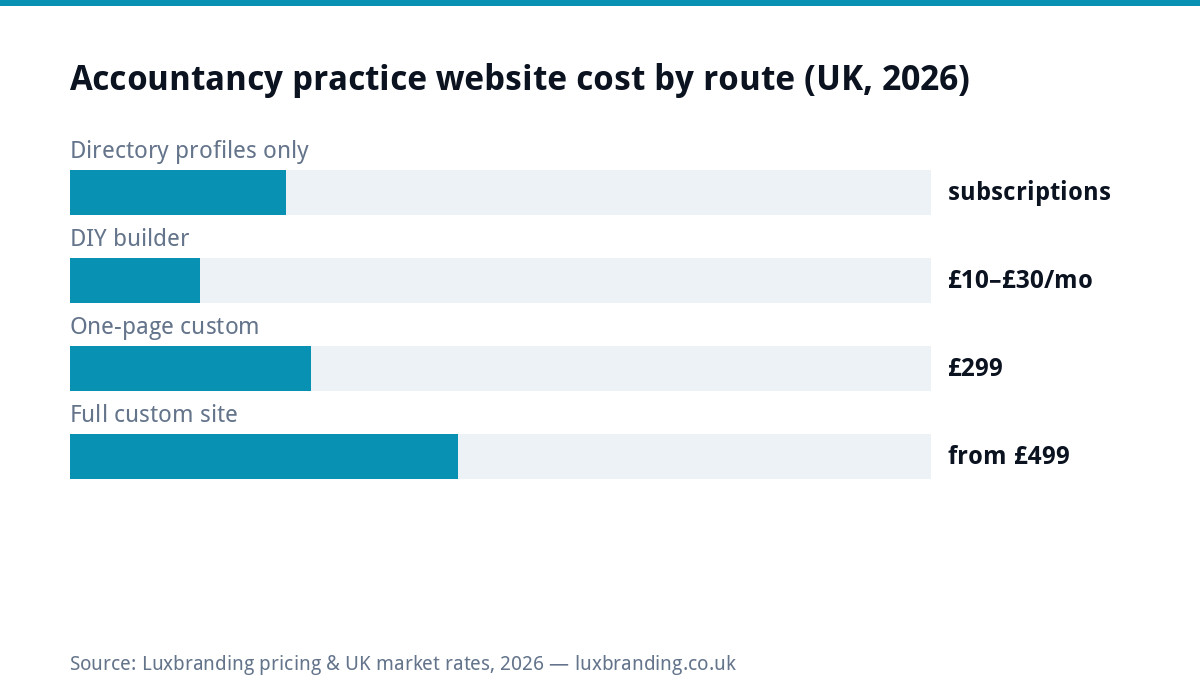
Route by route for practices
| Route | What you pay | Right for | The catch |
|---|---|---|---|
| Directories only | Subscriptions | Interim visibility | Generic listing, rented, your specialisms invisible |
| DIY builder | £10–£30/mo | Brand-new sole practitioners | Template look in a trust profession; fees usually left half-configured |
| One-page custom | £299 | Sole practitioners, niche specialists | One ranking theme; right when your niche IS one theme |
| Full custom | from £499 | Practices with 3+ service lines worth ranking separately | You supply the service detail; an afternoon of partner time |
The switching page: the highest-converting URL almost no practice has
The biggest brake on new-client flow is not competitors; it is inertia. Businesses stay with mediocre accountants for years because switching feels like surgery, and most practice websites never address it. One page changes the economics: “Switching to us takes one email. We contact your current accountant, request professional clearance, transfer the records, and time it around your deadlines. You do almost nothing.” Explain professional clearance in a sentence, state that it is normal and civil, give the timeline honestly. This single page converts the largest pool in the market (the dissatisfied-but-settled) and nearly every practice leaves it unwritten. In the from-£499 build it is a standard inclusion; even on the £299 one-pager it earns its section.
Trust, fees and the qualification layer
Accountancy is bought on trust signals that are checkable, so make checking effortless: body membership (ICAEW, ACCA, AAT) with logos used per their rules and registration details as text, practising certificate status, professional indemnity insurance stated, and real faces with names, because clients are choosing a relationship with a person, not a brand. On fees: the profession’s “it depends” instinct is costing it clients in a fixed-fee era; publishing from-prices per service (“self-assessment from £150”, “limited company packages from £95/month”) converts the comparison window and pre-qualifies budgets, the same published-price mechanics working for dentists and gyms in this series, and for our own price list. Specialisms deserve equal prominence: “accountants for contractors”, “e-commerce sellers”, “landlords” are both conversion hooks and their own search families.
Worked example: a sole practitioner’s launch quarter
Composite but typical: a newly-independent accountant, spring launch, £700 all-in (one-page site at £299 initially, profile setup £199, and the switching page added when the site graduated to the full build). Months one and two: name searches and the profile carry referral traffic; two switchers arrive from the switching page’s reassurance alone. Month three: “accountant for [niche] [town]” begins placing, the answer-pages start pulling long-tail, and the practice’s first entirely-cold client arrives having read the fees page and the switching page in one sitting, pre-sold. The shape to notice: every converting element was WORDS (fees, switching, niche, answers), none was decoration, and the whole owned stack cost less than one client’s annual fee. That is the economics this vertical enjoys more than almost any other: high client lifetime value against a three-figure digital stack.
Content that compounds for practices (without becoming a content mill)
Practices do not need a blog treadmill; they need a handful of evergreen answer-pages matching what clients and prospects actually search: “what can I claim as a limited company director”, “VAT registration threshold explained”, “sole trader vs limited company”, each ending with the honest line that generic guidance is not advice and a fee to get it properly. Six such pages, kept current at Budget time, out-earn years of news-regurgitation posts, pull the exact long-tail this whole series is built on, and give referrals something substantial to forward. The compliance note for the profession: keep guidance general, date it, and let the HMRC source carry the technical weight via links, which is both safer and better SEO than paraphrasing it thinly.
The tech-stack signal clients now check
A quiet differentiator worth a page section: which software you actually work in (Xero, QuickBooks, FreeAgent, and your certification tiers with them) and how digital your onboarding is. Post-MTD, businesses shortlist accountants partly by stack compatibility (“do they do Xero?” is a real search), and stating integrations plainly wins those matches while filtering the shoebox-of-receipts clients you may or may not want. Badge rules apply as ever: use the partner logos per their programmes, as text-plus-logo, checkable. It is the professional-services version of the certification display that wins work for electricians, and it costs a paragraph.
Timing and the deadline calendar
Practice demand spikes are legislated: October’s paper deadline, the January 31st panic, year-ends clustering at March/April, MTD milestones. Rankings need weeks to mature, so the build window is spring and summer: live, indexed and reviewed before autumn, so the January wave (when switching intent peaks alongside panic-searches) lands on a site already ranking. A practice building in December spends the busiest fortnight invisible. Content-wise, each deadline is also a page: “self assessment deadline help” and “just missed the VAT deadline” searches are the profession’s rescue-intent equivalents, and the practice whose site answers them at 11pm on January 30th earns clients for life. Total launch-grade stack: site from £299–£499, profile £199, a quiet afternoon of partner input; everything on the public price list.
The referral-conversion detail practices miss
Because referrals arrive pre-sold on trust, practices assume the website barely matters for them; the data says otherwise, since nearly every referred prospect still visits before calling, and what they are checking is different: not “is this practice good” but “is this practice for someone like me”. That makes the specialisms section and the faces page the referral-converters, and it makes one line valuable beyond its size: “clients typically like ours” phrasing on each service page (contractor day-rates, e-commerce VAT, landlord portfolios), which lets the referred visitor self-recognise in seconds. The cold-search machinery above wins strangers; this small mirror wins the warm ones, and both run on the same from-£499 pages. It also compounds referrals themselves: the partner who forwards your link is implicitly vouching, and a page that converts their contact cleanly makes referring you feel safe to do again, which is how practice growth loops actually close.
Get the UK Website Project Brief Template (free)
A 2-page template for briefing any UK web designer — sitemap, integrations, audience, deliverables. Cuts revision rounds in half.
No spam. Unsubscribe any time. UK GDPR compliant — your email is only used to send this resource.
Frequently asked questions
How much does an accountant's website cost in the UK? +
A custom one-page site is £299 flat; a full practice site from £499 with pages per service (self-assessment, limited company accounts, VAT, payroll, bookkeeping) so each ranks for its own searches. Add ~£20/month managed hosting.
Should accountants publish fees on their website? +
At least from-prices, yes. "Self-assessment from £150, limited company packages from £95/month" converts comparison shoppers that "contact us for a quote" loses, filters the wrong-budget enquiries, and signals the fixed-fee modernity clients increasingly expect.
What do clients check on an accountancy website? +
Qualifications and body membership (ICAEW, ACCA, AAT displayed and checkable), who they would actually deal with (faces and names), what you specialise in (their industry mentioned beats generic), fees or fee approach, and how switching accountants works, which deserves its own reassuring paragraph.
Do accountants need a page per service? +
For rankings, yes: "payroll services [town]" and "self assessment accountant [town]" are separate searches with separate intent. One services page ranks for neither properly. The from-£499 build exists for exactly this structure.
When is the best time for an accountancy practice to launch a new site? +
Spring and summer, the quiet season, so rankings settle before the autumn self-assessment surge and January deadline panic, which is when "accountant near me" demand peaks and switching decisions actually happen.

