

Quick answer
Estimate where your project lands with the free website cost calculator.
A website redesign in the UK costs £300–£1,500 with freelancers, £1,500–£5,000+ through agencies, or from £499 flat as a specialist-studio custom rebuild (a one-page site is £299) in 2026. One reframe before any spend: at small-business scale a “redesign” is really a rebuild with your content, and one diagnostic decides whether it’s worth anything at all: does your site have visitors who don’t enquire (redesign fixes that), or no visitors (it won’t)? Our redesign guide covers the how; this page is the money.
Why “redesign” means “rebuild” at these prices
Genuine redesign-in-place, new visuals on existing machinery, assumes machinery worth keeping. Most small-business sites carry the opposite: an ageing theme, a page builder adding megabytes, a plugin stack nobody remembers installing, and speed problems baked into all three (the usual suspects from our speed guide). Reskinning that costs designer hours while preserving every underlying problem. Rebuilding takes your content and brand onto clean foundations for similar money, which is why honest quotes at this scale are rebuild quotes, and why “from £499” here buys the same thing a fresh custom build costs: it IS one, with your existing content as the head start.
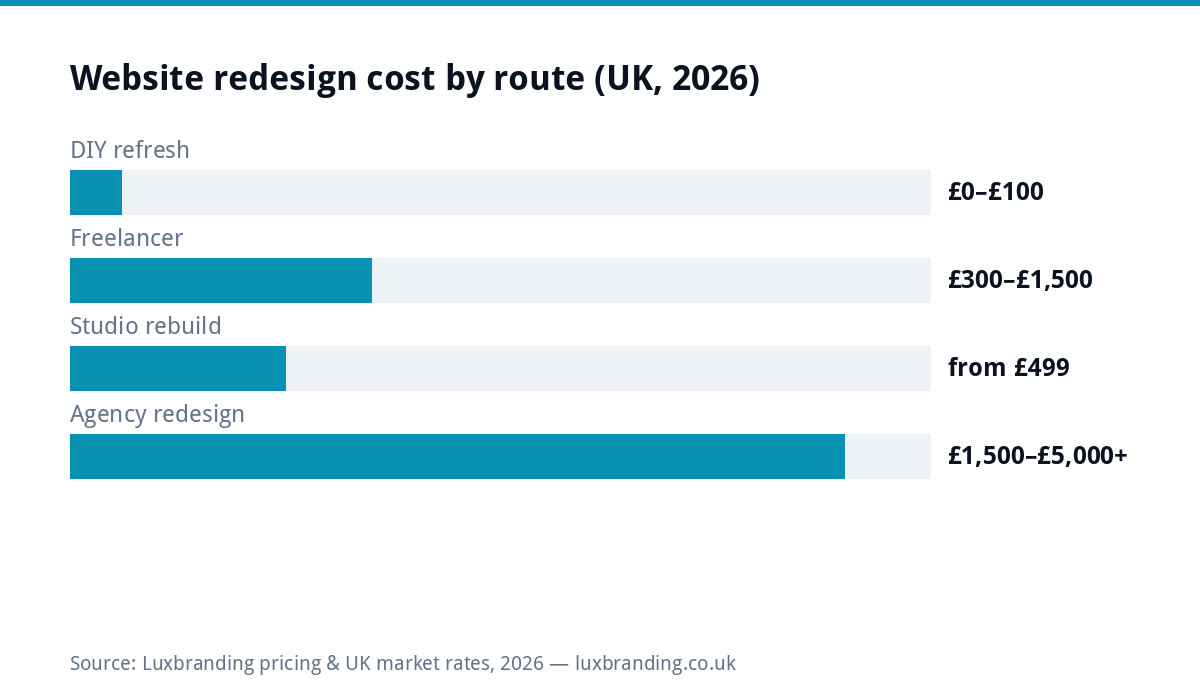
Route by route
| Route | Published cost | What you get | Watch out for |
|---|---|---|---|
| DIY refresh | £0–£100 | New theme/template, your evenings | Same machinery, same speed, same problems in new clothes |
| Freelancer | £300–£1,500 | Redesign or rebuild to your brief | Ask which one you’re buying, and who handles the redirects |
| Specialist studio | from £499 flat | Full custom rebuild, content migrated, redirects mapped, mobile-first | Confirm redirect mapping is included (it’s the SEO-safety step) |
| Agency | £1,500–£5,000+ | Same plus strategy workshops and process | Right for rebrands-with-research; heavy for “our site looks dated” |
The SEO-safety checklist (where redesigns go wrong)
Redesign horror stories are almost never about design, they’re about launches that quietly deleted what Google knew. The non-negotiables for any provider at any price: an inventory of current URLs and which pages earn traffic (five minutes in Search Console); 301 redirects from every old URL to its successor where structure changes; ranking content preserved, not “freshened” into oblivion (rewrite around what works, don’t replace it); and a post-launch Search Console check for 404s and coverage drops. Ask a prospective provider “how do you handle redirects and existing rankings?”, a fluent answer is the cheapest quality filter in this market, and a blank look prices the SEO recovery you’d be buying next.
What’s worth paying extra for (and what isn’t)
Redesign quotes attract add-ons; here’s the honest sort. Worth real money: content updates during the build (prices, services, proof, the rebuild is the natural moment, and stale content in a new frame wastes the frame); conversion plumbing, forms that route properly, click-to-call, the enquiry path tested on a phone; speed as a deliverable with before/after numbers (see our speed cost guide for the benchmarks to demand); and redirects done properly per the checklist above. Usually NOT worth it at small-business scale: animation packages, bespoke iconography, “brand workshops” bolted to a site job (if the brand needs work, price a rebrand honestly instead), and stock-photo subscriptions when your camera roll holds real jobs, real premises, real people, the photography customers actually believe.
What you’ll be asked for (gather it now, save a fortnight)
Rebuild timelines slip on client materials, not design. The pack any builder needs: your logo in vector (a £39 conversion if all you have is a JPG); current text per page, marked keep/update/kill; ten-plus real photos worth showing; login or export access to the old site for content migration; your Search Console access (for the URL inventory and post-launch checks); and the practical facts, services, areas, hours, accreditations, verified current. Half a rainy afternoon assembles it; without it, week one of the build is emails asking for it. And schedule the switch for your quiet season: launches surface small issues for a fortnight, and February forgives what December doesn’t.
Redesign vs the money’s better homes
Because a redesign is the most satisfying purchase in web (before/after screenshots!), it gets bought when other spends would earn more. The honest triage: no traffic? The £499 belongs in SEO or ads, a beautiful site nobody visits converts nobody. Traffic but slow? Try the £99 speed fix first; speed is a redesign-sized win at a tenth the price when the design itself is passable. Traffic, speed fine, no enquiries? Now you’re the redesign case, layout, message and trust signals are the failure, and a rebuild pays. Everything works but it embarrasses you? Legitimate too, credibility is a conversion factor, just buy it knowingly as brand investment. The same honesty applies to timing: mid-campaign or peak-season launches add risk for no return; rebuild in your quiet quarter.
Can’t do it all at once? The phased route that doesn’t backfire
Budget sometimes forces sequencing, and there’s a right order. Phase one: the money pages, home, your top two service pages, contact, rebuilt properly on the new foundations, everything else 301’d sensibly or carried as-is behind consistent navigation. Phase two: remaining service pages as cashflow allows (each one starts earning its rankings on arrival). Phase three: the nice-to-haves, galleries, history, extras. What makes phasing work is doing phase one on the REAL new foundations rather than patching the old ones (“we’ll just refresh the homepage in the old builder” is how businesses pay twice); what makes it fail is stalling after phase one with half the site in each era for years, set phase two’s date before phase one ships. And note the honest alternative when phasing feels forced: the £79/month pay-monthly build delivers the whole rebuild at cashflow-shaped pricing, which for many businesses beats living in two eras at once.
A worked before/after (the economics, not the screenshots)
Typical case from the small-business trenches: a 2019-era builder site, dated look, eight seconds on mobile, services buried, no analytics anyone reads. Traffic exists (the business ranks for its name and a couple of terms) but enquiries dribble. The £499 rebuild ships: clean design, sub-two-second loads, page-per-service structure, phone number where thumbs are, forms that route, redirects mapped. What changes measurably: bounce rate drops (speed + relevance), the service pages start ranking individually within a quarter (structure), and enquiry rate per hundred visitors climbs, which is the number that matters, because it multiplies against every visitor marketing ever buys. That last mechanic is the honest ROI story: a redesign doesn’t create demand, it stops wasting the demand you have, which is why the diagnostic at the top of this guide insists on traffic-first triage. Where it holds, the rebuild is the highest-leverage £499 on the menu; where it doesn’t, the same money in visibility comes first and the redesign meets it halfway next quarter.
What carries over, what shouldn’t
Bring: your content (edited, not embalmed, the rebuild is the natural moment to update prices and services), your images worth keeping, your brand (unless that’s part of the problem, a rebrand is a different project layered on top), and your URLs-or-redirects per the checklist. Leave behind: the theme, the builder, the plugin museum, and any “we might need it” pages with zero visits, pruning is free speed and focus. Rebuilds land on managed hosting (£20/month) so the next redesign conversation is years away and optional. Flat prices, as ever, on the price list.
Further reading: Core Web Vitals (Google) · PageSpeed Insights.
Get the UK Website Project Brief Template (free)
A 2-page template for briefing any UK web designer — sitemap, integrations, audience, deliverables. Cuts revision rounds in half.
No spam. Unsubscribe any time. UK GDPR compliant — your email is only used to send this resource.
Frequently asked questions
How much does a website redesign cost in the UK? +
Freelancers charge £300–£1,500 at public rates, agencies £1,500–£5,000+, and a specialist studio rebuilds from £499 flat for a custom multi-page site (£299 for a one-pager). "Redesign" usually means rebuild — reskinning an old site is rarely cheaper than rebuilding it properly.
Is a redesign just a new look, or a rebuild? +
Almost always a rebuild in practice. Old themes, page builders and plugin stacks mean a genuine redesign on the same foundations costs as much as starting clean — without fixing the speed and structure problems underneath. Content carries over; the machinery shouldn't.
Will a redesign hurt my Google rankings? +
Done properly, no — and often it helps. The must-dos: keep URLs the same or 301-redirect every old URL to its successor, preserve page content that ranks, and check Search Console after launch. Rankings drop when redesigns silently delete or rename pages Google knew.
How often should a website be redesigned? +
When it stops doing its job, not on a calendar. Signals: it embarrasses you against competitors, it's slow on phones, enquiries dropped, or updating it is so painful nobody does. Absent those, a well-built site runs for years with content updates.
When is a redesign the wrong spend? +
When the real problem is traffic, not conversion. A redesign fixes "visitors don't enquire"; it does nothing for "nobody visits". Check your analytics first: decent traffic + no enquiries = redesign territory; no traffic = the money belongs in SEO or ads, not pixels.


