
Quick answer
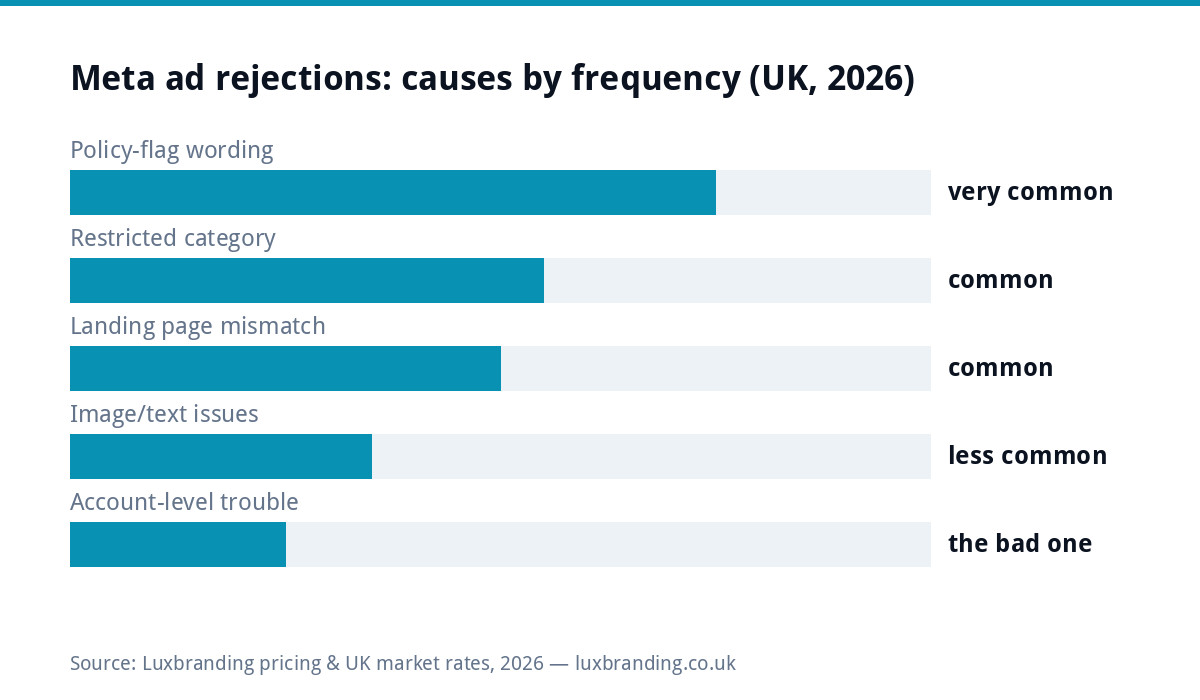
Meta rejections are pattern-matching, not persecution: an automated scan flagged your ad against a policy, the notice names which, and the fix is usually a rewrite of one sentence, occasionally a proper appeal, and only rarely the account-level problem everyone fears. The five real causes below cover nearly every UK small-business rejection, with the edits that clear them. The one universal rule: fix and resubmit ONCE properly, never re-roll duplicates hoping the bot blinks.
Cause 1: the personal-attributes tripwire (the big one)
Meta’s most-hit policy bars ads that imply you know things about the reader: their health, money troubles, age, situation. The tripwire is second-person framing of a problem: “Struggling with debt?”, “Losing your hair?”, “Is YOUR business failing?” all pattern-match, however kind the intent. The rewrite is mechanical once you see it: describe the situation or your service, not the reader’s state. “Struggling with your bookkeeping?” becomes “We handle bookkeeping for UK small businesses.” “Overweight and fed up?” becomes “Personal training programmes in [town].” Same offer, zero flag. Audit every “you/your + problem” construction in rejected copy first; it clears more UK rejections than everything else combined, and Meta’s policy pages confirm the pattern in their own examples.
Causes 2 to 4: categories, landings and creative
| Cause | The trip | The clear |
|---|---|---|
| Restricted categories | Finance, health/wellness, employment, housing and credit carry special rules; some need declared categorisation | Declare the special category where required; strip claims (earnings, cures, guarantees); expect stricter wording rules as the cost of the vertical |
| Landing page mismatch | Ad promises one thing, page shows another; or the page itself trips policy (pop-up walls, missing business info) | Say the same thing both sides of the click; ensure the page loads, names the business and matches the offer, which is conversion hygiene anyway per our ads audit guide |
| Image/creative flags | Before/after bodies, implied nudity, sensational imagery, misleading buttons drawn into images | Real work photos beat edgy stock everywhere; for fitness and beauty, show activity and results-context rather than body close-ups |
Cause 5: when it is the account, not the ad
Different animal, different response. If ads that previously ran now blanket-reject, or you see advertising-access restricted: complete any identity/business verification Meta requests, open the case via Business Support Home (the request-review route, politely, once), and pause borderline creatives while it resolves, because pending reviews plus fresh flags read as pattern confirmation. Days-to-weeks timelines are normal. The two responses that make it permanent: creating workaround accounts (explicitly against policy, links the accounts, deepens the hole) and arguing in resubmissions. If ads are mission-critical meanwhile, this is where diversification earns its keep: the Google Ads channel and the organic local stack do not share Meta’s weather.
The compliant-ad template (steal this shape)
For UK service businesses, this shape approves almost universally: [We/Business name] + [service] + [for whom, stated as a group not “you”] + [place] + [concrete offer] + [plain call to action]. “Luxbranding designs fixed-price logos for UK trades. £129 flat, first concepts in 48 hours. See examples and order online.” No reader-state implied, no claims to substantiate, offer and price doing the persuasion. It also happens to be better advertising: our Meta ads cost guide makes the case that creative specificity beats cleverness, and policy-safe copy is specificity by force. Managed accounts get this discipline included (£199/month flat, rejections handled as part of the service); DIY accounts just need the template and the one-resubmission rule. Prices, as ever, on the price list.
Worked example: one rejected ad, rewritten live
Before, rejected: “Struggling to lose weight? Tired of diets that don’t work for YOU? Our 12-week programme changes everything, guaranteed results!” Three flags in one breath: second-person health state, implied personal knowledge, and an outcome guarantee. After, approved, same offer: “Bodywork Fitness runs 12-week strength and habit programmes for beginners in Stockport. Small groups, evening sessions, first week free. See the timetable and book online.” The rewrite mechanics visible: the reader’s state vanished (the programme is described, not their body), the guarantee became a concrete offer (first week free persuades harder anyway), and specificity replaced hype. It also reads more credible to an actual human, which is the recurring secret of policy-safe copy: the robot’s rules and the customer’s trust point the same direction.
Special-category verticals: the stricter lane, navigated
If you advertise anything touching credit, employment, housing, health or social issues, Meta routes you into declared special-category handling with reduced targeting and stricter copy scrutiny; fighting it loses, working within it is routine. The moves that keep restricted-vertical ads flowing: declare the category honestly at campaign setup (undeclared-but-detected is how accounts earn flags), strip outcome claims entirely (“get out of debt” becomes “debt advice services”), let the landing page carry the detail your ad cannot, and expect broader targeting as the trade-off the category imposes on everyone equally. UK finance and health advertisers layer their own regulators’ rules on top (FCA promotions rules, ASA codes), which is beyond this guide but inside the same principle: the wording disciplines that clear Meta’s bots are usually the ones your regulator wanted anyway.
Read the rejection notice properly (it names the fix)
The rejection email and the ad’s status detail name the specific policy tripped, and that name is the repair manual: personal-attributes flags mean rewrite the second-person framing; restricted-category flags mean declare or de-claim; landing-page flags mean the click destination, not the ad. The common mistake is reading “rejected” and guessing, then editing the wrong element and burning a review cycle. Thirty seconds with the actual notice, matched against the causes above, turns most rejections into one targeted edit, and keeps your account’s history clean for the day you need a human reviewer to take your side.
Prevention: the pre-flight minute
Before every future submission: scan for second-person problem framing, check whether your vertical is restricted and declare accordingly, click your own landing link on a phone, and glance at the image for anything a cautious robot might misread. Sixty seconds against days of review queues is the best trade in paid social. Keep a note of what got rejected and what cleared it; your own history becomes the house style guide, and rejection rates drop toward zero within a month of writing to it.
When to stop fighting and change channel
Occasionally the honest audit conclusion is that your offer sits in a category Meta polices so tightly that compliant copy cannot carry it persuasively; some finance, health and recovery niches live here permanently. The graceful exit is not account roulette but channel fit: search advertising handles intent-led versions of the same offers under different rules (our Google Ads guide covers the economics), and the organic local stack has no copy police at all. Businesses that burn months fighting the policy wall usually needed one week of that reallocation instead; The ad platform is a tool, not a verdict on the business, and the businesses that internalise this diversify calmly instead of doom-scrolling appeal forums. Budget follows evidence across channels the way the audit order follows leaks: wherever the next pound demonstrably converts, unemotionally.
Get the UK SEO DIY Audit Checklist (free)
A 32-point checklist UK SMEs can run against their own website in an afternoon. Surfaces the quick wins before paying for a paid audit.
No spam. UK GDPR compliant. We only use your email to send this resource, unless you tick the box to hear from us.
Frequently asked questions
Why does Facebook keep rejecting my ads? +
Automated policy scanning flags patterns, not intent: wording that resembles personal attributes ("are YOU struggling with debt?"), restricted categories (finance, health, employment, housing have special rules), landing pages that mismatch the ad, or image issues. The rejection notice names a policy; the fix is usually a rewrite, not an argument.
What is the personal attributes policy that rejects so many ads? +
Meta bars ads implying knowledge of a user's characteristics: health, finances, age, condition. "Struggling with your accounts?" pattern-matches it; "We help small businesses with their accounts" passes. Address the situation, never the reader's implied state.
Should I appeal a rejected Facebook ad or just edit it? +
Edit first when you can see the trip (usually wording); appeal via the official request-review route when the ad genuinely complies, since automated flags do err and human review overturns them regularly. Never spin up duplicate ads to dodge a rejection; repeated identical rejections escalate toward account trouble.
My whole ad account got restricted, not just one ad. What now? +
Account-level restriction is a different severity: verify your identity/business if asked, request review through Business Support Home, and stop running borderline creatives meanwhile. Recovery takes days to weeks; new sneaky accounts violate policy and make it permanent.
Do rejected ads affect my account's standing? +
Occasional rejections happen to everyone and are fine once fixed. Patterns hurt: repeatedly resubmitting near-identical rejected ads, or racking rejections in restricted categories, feeds account-quality scoring toward restrictions. Fix properly rather than re-rolling the dice.