
Quick answer
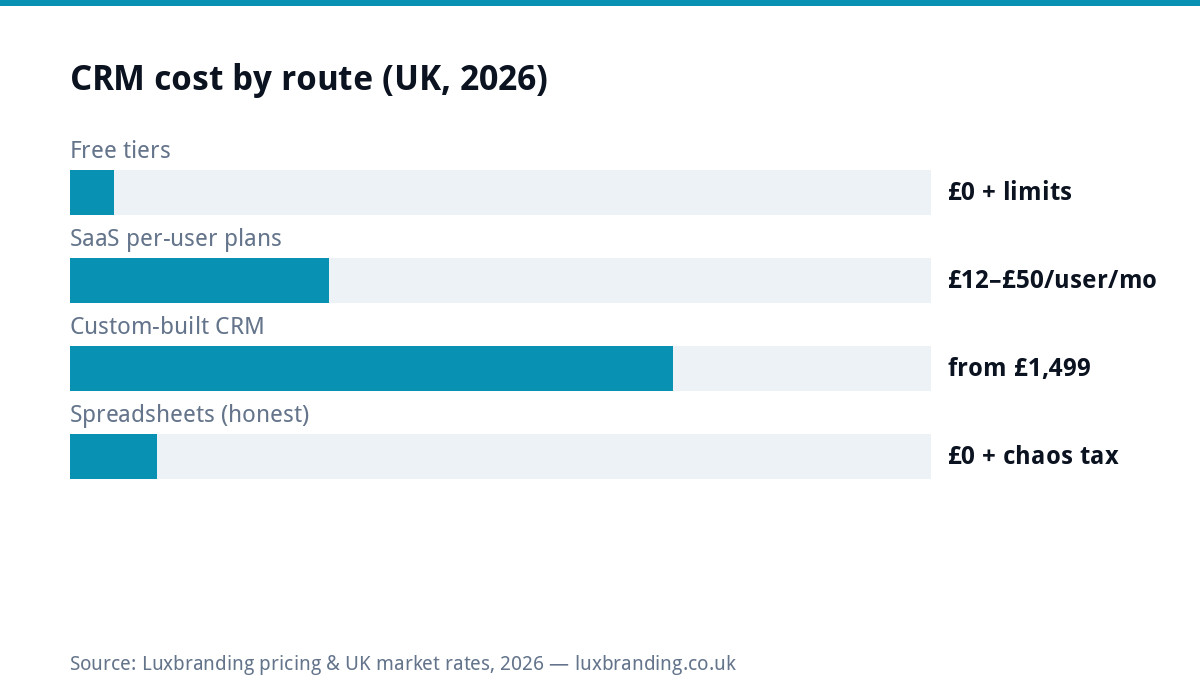
CRM pricing for UK small businesses in 2026: free tiers (real but designed to outgrow), SaaS at £12 to £50 per user per month at published rates, which is the headline that hides the real number: a five-person team pays £720 to £3,000 a year, every year, and custom-built CRMs from £1,499 one-off, which end per-seat maths and template-fit compromises at once. The spreadsheet you’re probably using now is the fourth option, priced in missed follow-ups. Which route wins is arithmetic plus fit, both below, and our CRM guide covers choosing and rolling one out.
The per-user trap, computed
SaaS pricing anchors on the per-user monthly figure because it sounds like lunch money. Multiply honestly: mid-tier at £25/user × 5 staff × 12 months = £1,500/year; over three years £4,500, for software that still calls your pipeline stages by its names, plus the tier-upgrade moments when the feature you need sits one plan up. None of this makes SaaS wrong (below the thresholds it’s clearly right); it makes the comparison against a £1,499 one-off build worth thirty seconds of your calculator: at 5+ users with a 3-year horizon, the custom build is usually the cheaper option before fit even enters the conversation. It’s the same subscription-vs-asset arithmetic as websites and spreadsheets vs software, with per-seat pricing sharpening the curve.
Route by route
| Route | Real cost (5 users, 3 years) | Best for | The catch |
|---|---|---|---|
| Spreadsheet | “£0” + missed follow-ups | One person, few leads | Breaks at two users; history scattered across inboxes |
| Free CRM tier | £0 until the limits bite | Trying the habit before paying | Caps and gates placed exactly where growth happens |
| SaaS paid plans | £2,000 to £4,500 published | Standard sales pipelines, small teams | Per-seat forever; your process bends to the template |
| Custom build | from £1,499 one-off | 5+ users, non-standard process, integration needs | Upfront cost; needs your process articulated (that’s a feature) |
Fit: the cost that never appears on pricing pages
The quieter argument for custom isn’t money, it’s that generic CRMs are built for a business that sells like a software company: pipeline, deal value, close date. A trades firm runs enquiry → survey → quote → chase → job → invoice → review-request; a clinic runs bookings and recalls; a wholesaler runs accounts and reorders. Forcing those into the template means fields nobody fills, stages nobody trusts, and eventually a CRM nobody opens, the most common CRM outcome in small business and a 100% waste at any price. A custom build starts from your actual process (articulating it is half the value of the project), automates YOUR follow-ups, and integrates with the quoting and invoicing you already run. That’s the scope of our custom business software service (from £1,499), and the broader build-vs-buy question is covered in off-the-shelf vs custom.
Signs you’ve outgrown your current setup (whatever it is)
Upgrade triggers, from the field: a follow-up you KNOW was promised can’t be found by anyone; a customer’s history takes assembling from three inboxes and a memory; two people update the spreadsheet and one overwrites the other (the classic); quotes go out and their fate is genuinely unknown a month later; someone leaves and their pipeline leaves in their head; or, the SaaS-specific one, you’re paying for seats and tiers whose features exist to solve problems you don’t have, while the problem you DO have (that survey-scheduling step, that trade-account structure) sits in the “ideas” forum since 2023. The first five say “get A system”; the last says “get YOUR system”. Either way the trigger to act is the same: the moment tracking customers by memory costs one real job, the tooling has stopped being optional, and one lost £400 job funds most of a year of SaaS or a meaningful chunk of the build that fits.
What goes IN the CRM (and the discipline of leaving things out)
CRM failure is usually over-ambition at setup: forty fields, every historical contact, integrations to everything, then nobody fills any of it and the tool dies of emptiness. The minimum viable CRM discipline: every LEAD goes in on day one with four facts (who, contact, what they want, next action + date); every conversation gets one line; and the daily view is simply “whose next-action date is today?” That’s the whole engine, follow-ups stop being memory-dependent, which is the entire point. Resist importing ten years of dead contacts (start from live leads and let history stay in email), resist fields “we might report on someday”, and resist connecting every tool before the habit exists. A CRM that tracks five things reliably beats one configured to track fifty theoretically, and if your process needs the fifty, that’s precisely the custom-build conversation.
Adoption is the product
The dirty secret of CRM procurement: the tool matters less than whether humans use it, and usage is designable. What works in small teams: the CRM is where work happens (quotes generated from it, follow-up reminders arrive from it) rather than an extra chore after work happens; one person owns hygiene for the first month; leads that arrive by phone get entered in the moment, not “later”; and the Monday question becomes “what’s in the pipeline?” answered from the screen, so the CRM is how you’re seen as well as how you sell. Custom builds get an unfair adoption advantage here, when the stages are YOUR stages and the fields are YOUR words, there’s nothing to translate, but even SaaS succeeds under this regime and dies without it. Budget the habit, not just the licence.
The migration nobody budgets
Whichever direction you move, data migration is the forgotten line item: contacts, histories and open deals rarely transfer cleanly between systems, and SaaS-to-SaaS moves cost real hours (or per-record migration fees from specialists). Two implications. Choose slower, once, the second CRM migration is the one that kills team buy-in. And when comparing costs, add migration to the SaaS side of the ledger too: the “cheap monthly” route usually involves one or two platform hops as you outgrow tiers, each with its own moving day. A custom build does this once, importing your spreadsheet-era history as part of the project.
Three worked examples
The two-person plumbing firm. Twenty enquiries a month, quotes chased from a van. A free tier, or honestly a disciplined shared spreadsheet, covers it TODAY; the upgrade trigger is the first month two quotes go unchased. When it comes, cheap SaaS first; custom only if the quoting integration itch becomes real. The six-person marketing agency. Per-seat maths bites (£25 × 6 × 12 = £1,800/year), the sales process is genuinely pipeline-shaped, and proposals/retainers fit templates, a textbook SaaS-fits case where the custom argument is purely financial: three-year SaaS ≈ £5,400 vs £1,499 once. At that spread, custom wins unless the team’s SaaS muscle-memory is worth £4k of switching pain, a legitimate answer either way. The kitchen showroom. Enquiry → home survey → design → quote → install → aftercare, with deposits and photos at every stage: the template pipeline mangles this, staff stop using it, and the “CRM nobody opens” outcome is pre-written. Fit case, custom, no arithmetic needed. Find yourself in one of the three and you’ve done the procurement.
Decide in three questions
How many people touch customer data? One: spreadsheet or free tier, honestly. Two to four: paid SaaS is your rational default. Five-plus: run the arithmetic above before renewing anything. Does your process fit a standard pipeline? Yes: SaaS templates serve you. No, surveys, recalls, job scheduling, trade accounts: fit is worth paying for once. What must it connect to? Nothing: any route. Your quoting/booking/accounts stack: integrations are where custom earns its keep and SaaS earns its add-on fees. Whatever the answers, the follow-up habit matters more than the software, the best CRM is the one your team actually opens. Build prices are flat and public on the price list.
Further reading: Zoho CRM published pricing · HubSpot CRM published pricing · Pipedrive published pricing.
Get the UK Software Project Brief Template (free)
A two-page template for scoping any custom software project: user roles, features, integrations, timeline and success criteria.
No spam. UK GDPR compliant. We only use your email to send this resource, unless you tick the box to hear from us.
Frequently asked questions
How much does a CRM cost for a UK small business? +
Published SaaS pricing runs £12 to £50 per user per month (Zoho, Pipedrive, HubSpot paid tiers). A five-person team lands at £720 to £3,000/year, forever. Custom-built CRMs cost from £1,499 one-off and remove per-seat pricing entirely. Free tiers exist with real limits.
Are free CRMs good enough? +
Often, at first: a free tier beats the spreadsheet it replaces. The limits are designed to bite as you grow: user caps, feature gates on automation and reporting, and upsell pressure. Treat free tiers as a trial of the paid product, because that's what they are.
When does a custom CRM beat SaaS? +
Two triggers: the per-user arithmetic (5+ users for 3+ years usually exceeds a build), and fit, meaning when your sales process doesn't match the pipeline template, when SaaS fields multiply into chaos, or when the CRM needs to talk to your quoting/job systems in ways integrations won't.
What does a custom CRM from £1,499 include? +
Your actual process as the design: your stages, your fields, your automations (follow-up reminders, quote chasing), your reports, connected to your email, and no per-user fees ever. It's scoped from how your business actually sells, not adapted from a template.
Isn't a spreadsheet fine for now? +
Until roughly the point where two people update it, follow-ups get missed, or a customer's history takes minutes to piece together. The spreadsheet isn't free. It's paid in missed follow-ups, which for most businesses is the single most expensive line nobody accounts for.