
Quick answer
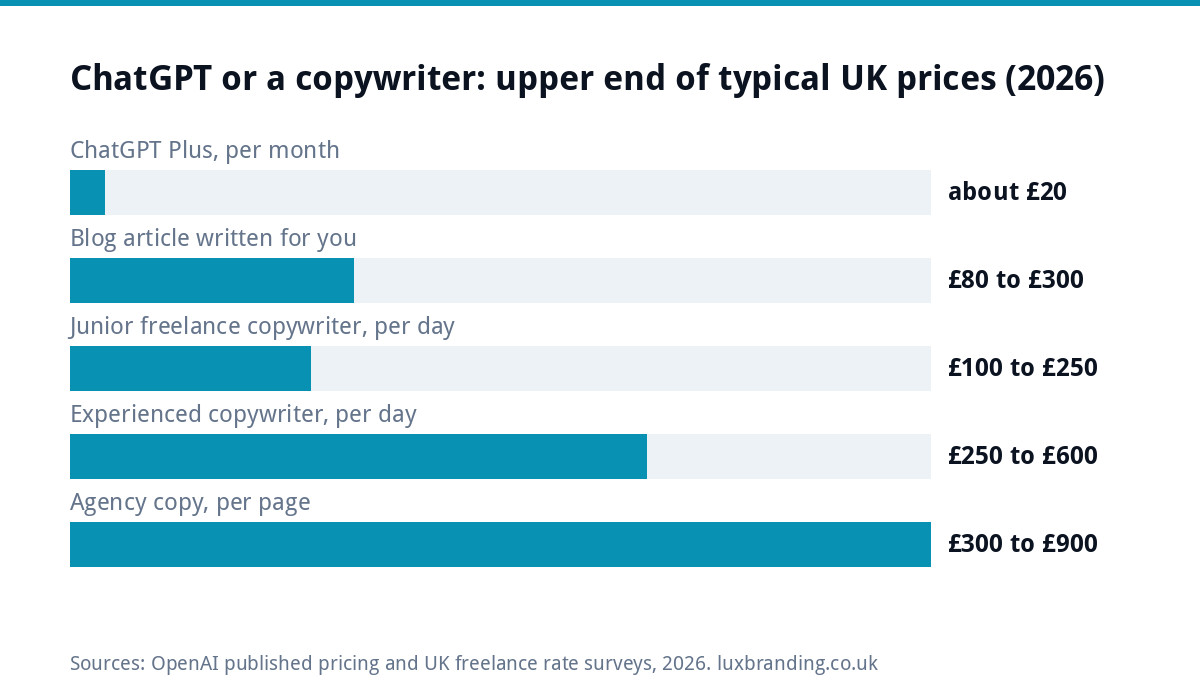
ChatGPT costs £0 to £20 a month and produces competent, average copy in seconds. A UK copywriter costs £250 to £600 a day, or roughly £150 to £400 for a single web page, and produces something a competitor cannot generate in thirty seconds. Use the model for volume, structure and first drafts. Use a person for the handful of pages that have to persuade somebody to part with money. Most businesses need both, and get the split backwards.
What the model is genuinely good at
Getting past a blank page. Turning notes into structure. Producing the twelfth variation of a product description when you have run out of ways to say the same thing. Summarising, reformatting, adapting one piece for three channels. Technical explanation where accuracy matters more than voice.
It is also very good at the writing nobody wants to do: the shipping policy, the alt text, the meta descriptions, the FAQ nobody reads until they need it. Refusing to use it for that is stubbornness, not craft.
What it is reliably bad at
Knowing what is actually true about your business. It will invent a plausible detail without hesitating and it will sound exactly as confident doing that as when it is right.
Sounding like anyone. The default register is smooth, agreeable and forgettable. Readers may not identify why, but they recognise it, and the volume of it online is rising fast enough that it now reads as a signal in itself.
Deciding what matters. The hard part of a sales page is choosing the one thing to lead with. That comes from knowing which objection loses you the most deals, which is information the model does not have and cannot guess.
Saying something risky. Good copy commits. Models hedge, because hedging is safer on average, and the average is exactly what you are trying to escape.
What each costs in the UK
| Route | Typical price | Turnaround | Best for |
|---|---|---|---|
| ChatGPT free tier | £0 | Seconds | Drafts, reformatting, ideas |
| ChatGPT Plus | about £16 to £20 a month | Seconds | Volume work, longer context |
| Freelance copywriter, junior | £100 to £250 a day | 2 to 5 days | Blog volume with a human pass |
| Freelance copywriter, experienced | £250 to £600 a day | 3 to 10 days | Home page, sales pages, brand voice |
| Agency copy, per page | £300 to £900 | 1 to 3 weeks | Launches, regulated sectors |
| Blog article, written for you | £80 to £300 | 3 to 7 days | Ongoing content with research |
The split that actually works
Rank your pages by how much money each one is responsible for. Nearly every business finds the answer is four or five pages: the home page, the two or three service pages that sell the thing, and the page people land on from advertising.
Those get a person. Everything else, and there may be two hundred of them, gets a model and an editor. That is the whole method. Spending copywriter money on your privacy policy while your home page was generated is the backwards version, and it is extremely common.
Does AI-written content hurt your search rankings?
Not because it is AI-written. Search engines reward useful content and penalise mass-produced pages that add nothing, and those two things are separable. A generated page that genuinely answers a question can rank. Two hundred generated pages that restate each other will not, and may drag the rest of the site down with them.
The practical risk is not detection. It is that generated content tends towards the average of what already exists, and average does not outrank anything. If you want the detail, our guide to SEO content writing covers what actually earns a position.
How to get more out of the model
Give it the facts it cannot know: your prices, your guarantee, the objection you hear most, the sentence a customer said last week. Ask for the argument before the prose. Make it write three openings and pick one rather than accepting the first. Then rewrite the first and last lines yourself, because those are the two that carry the page.
Where a person is not optional
Anything regulated. Anything where a wrong claim costs you money or a licence. Anything that has to sound like a specific human being, which includes most founder-led brands. And your home page, because it is the one page where being forgettable is expensive.
If you would rather hand the ongoing volume to somebody, our content and blog writing service is £249 a month, and the research is the part you are paying for.
Task by task, an honest verdict
| Task | Model | Person | Verdict |
|---|---|---|---|
| Home page | Average | Strong | Person, every time |
| Main service pages | Adequate | Strong | Person, then reuse the voice |
| Blog volume | Strong | Expensive | Model, edited |
| Product descriptions at scale | Strong | Not worth it | Model |
| Meta descriptions and alt text | Strong | Waste of a person | Model |
| Policies and terms | Adequate | Needed if regulated | Model unless regulated |
| Email sequences | Fair | Strong | Person for the first, model for variants |
| Case studies | Weak | Strong | Person, the detail is the point |
The editing pass that makes generated copy usable
Most people either publish the output or throw it away. The useful middle is a short, repeatable edit.
Cut the first paragraph, which is almost always throat-clearing. Replace every generic claim with a specific one: not “fast turnaround” but “first drafts in 48 hours”. Delete any sentence that would be equally true of a competitor. Put one real detail in that only you could know, a price, a deadline, something a customer actually said. Then read the first and last lines aloud, because those are the two that decide whether the rest gets read.
That takes about ten minutes per page and is the difference between content that fills a site and content that sells from it.
Why so much AI copy reads the same
Not a mystery, and worth understanding if you are going to use it well. A language model produces the most probable continuation, and the most probable phrasing is by definition the one that appears most often already. Ask a hundred businesses to describe their service and the model will reach for the same constructions each time, because those constructions are what the training data contains.
The practical consequence: the model cannot give you differentiation, because differentiation is by definition improbable. It can execute a difference you have already decided on. Deciding it is the job that remains yours.
What this means if you are hiring
The rate card has not collapsed and probably will not, but what you are buying has shifted. Paying somebody by the word for volume content is now poor value. Paying for judgement, the decision about what to lead with, which objection to answer, what to leave out, is worth more than it was, because that is the part the tools cannot supply.
Brief a writer accordingly. Ask for the argument and the structure, not a word count.
A realistic monthly budget for content
Putting numbers on the split makes the decision concrete. Three shapes cover most UK small businesses.
Under £100 a month. One subscription and your own editing time. Generated drafts, edited properly, for everything except the home page. Get the home page written once by a person and leave it alone for two years. This is the right answer for most businesses turning over under a quarter of a million.
£250 to £500 a month. Ongoing articles written and researched for you, plus the model for product descriptions and the incidental writing. The research is what you are buying here, not the prose: knowing what to write about is harder than writing it.
£1,000 and up. A writer on retainer who learns the business properly, plus the model for volume. Worth it when content is genuinely a channel rather than a box being ticked, which usually means you already know your cost per lead from it.
Below all of these sits the option nobody sells you: writing it yourself badly but honestly. A founder writing plainly about work they understand routinely outperforms polished copy about nothing in particular, and it costs an hour a week.
We publish what everything costs rather than quoting per project, and content marketing for small businesses covers whether you should be doing this at all before you decide how.
Related reading
See also what blog writing costs in the UK for the full rate picture, the AI tools worth paying for for the wider stack, and how to plan website content before you commission any of it.
Model pricing is published by OpenAI, UK freelance rate benchmarks are collected by the ProCopywriters association, and search guidance on AI content is set out by Google Search Central.
Get the UK SEO DIY Audit Checklist (free)
A 32-point checklist UK SMEs can run against their own website in an afternoon. Surfaces the quick wins before paying for a paid audit.
No spam. UK GDPR compliant. We only use your email to send this resource, unless you tick the box to hear from us.
Frequently asked questions
How much does a copywriter cost in the UK? +
Experienced freelancers charge £250 to £600 a day, or roughly £150 to £400 for a single web page. Agency copy runs £300 to £900 per page. A researched blog article is typically £80 to £300.
Does AI-written content hurt SEO? +
Not because it is AI-written. Search engines penalise mass-produced pages that add nothing, which is a separate problem. A generated page that genuinely answers a question can rank perfectly well.
Which pages should a human write? +
The four or five responsible for the money: the home page, the two or three service pages that sell, and any page you send paid traffic to. Everything else can be drafted by a model and edited.
What is ChatGPT genuinely good at for business writing? +
Structure, first drafts, reformatting one piece for several channels, and the writing nobody wants to do such as policies, alt text and meta descriptions.
How do I get better copy out of ChatGPT? +
Give it what it cannot know: your prices, your guarantee, the objection you hear most. Ask for the argument before the prose, generate several openings, and rewrite the first and last lines yourself.