Quick answer: what a suspension means and what it costs
A suspended Google Ads account stops every campaign instantly, and the appeal costs £0. Most UK small-business suspensions fall into one of three policy families, and most are recoverable if you fix the underlying issue before appealing. The one move that reliably makes things permanent is opening a second account to route around the ban. This guide decodes the suspension email, walks the appeal step by step, and covers what to do with your marketing while you wait.
The three suspension families, decoded
Google’s suspension emails cite a policy name that sounds abstract but maps to something specific. Almost every UK case lands in one of these three buckets.
| Policy cited | What it usually means in practice | Recoverable? |
|---|---|---|
| Circumventing systems | Multiple accounts, repeated policy violations after warnings, cloaked or redirecting landing pages, or a new account linked to a previously suspended one | Hardest. Requires demonstrating the behaviour has genuinely stopped |
| Unacceptable business practices / untrustworthy promotions | Landing page claims Google cannot verify, missing contact details or terms, prices on the ad that do not match the site, thin or template sites | Yes, once the site is fixed |
| Billing and payment issues | Card declined repeatedly, payment name or address not matching the advertiser, chargebacks, unpaid balances | Usually the fastest to clear |
Read the email carefully and click through to the exact policy page it references. Appealing against the wrong policy is the most common self-inflicted delay: Google’s reviewer sees an appeal that does not address the violation and rejects it in minutes.
Why small UK accounts get flagged
Automated enforcement leans on signals, and small accounts trip several at once without knowing. A new account spending aggressively in week one looks like a churn-and-burn advertiser. A personal card paying for a limited company’s ads creates a name mismatch. A landing page promising “the cheapest in the UK” or guaranteed results makes claims no crawler can verify. None of these is fatal individually, but stacked together they push an account over the automated threshold, which is why brand-new accounts are suspended at far higher rates than aged ones.
Step 1: fix before you appeal
The appeal form asks what changed. If the honest answer is nothing, do not appeal yet. Work through the cited policy on your actual assets: align billing name, address and VAT details with the business; complete advertiser identity verification if prompted; add a real contact page, terms, privacy policy and returns information to the site; remove superlative claims you cannot evidence; make sure the phone number and prices on the site match the ads. For payment suspensions, clear any outstanding balance first, because no appeal succeeds with money owing.
Step 2: write the appeal properly
The appeal is a short free-text box, not a courtroom. The structure that works: name the policy, state plainly what was wrong, list exactly what you changed with dates, and confirm it will not recur. Three or four sentences of specifics beat three paragraphs of protest. A worked example for an unacceptable business practices case: “Our landing page displayed a guarantee we could not substantiate and lacked a terms page. We have removed the guarantee claim, published terms and a complaints procedure, and added full company details including our Companies House number. The site now accurately reflects the service we sell.”
Step 3: wait properly
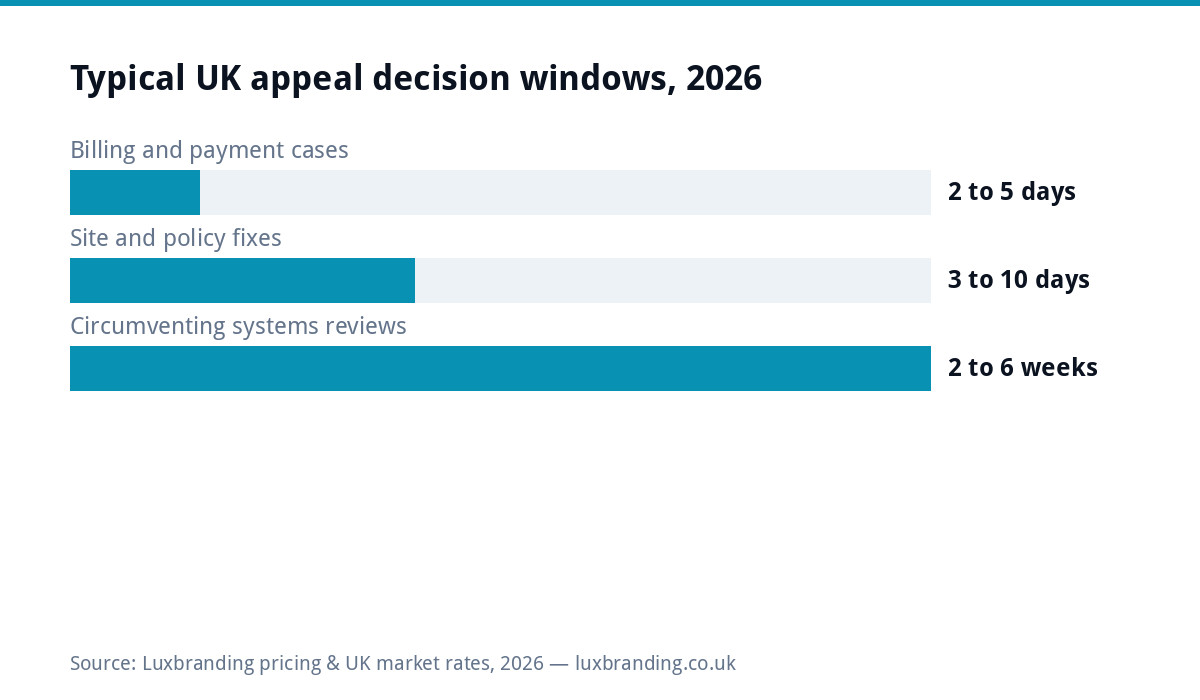
Google’s published guidance says appeals are typically reviewed within a few business days. Real UK experience runs from 48 hours for billing cases to several weeks for circumventing systems reviews. During that window, resist the urge to submit again: duplicate appeals reset nothing and mark the account as noisy. You get limited credible attempts, so spend them carefully.
The mistake that makes it permanent
Opening a fresh account, on a new email, with the same business details and the same site, feels like a workaround. To Google it is the textbook definition of circumventing systems, the exact behaviour the policy exists to catch. Accounts get fingerprinted by payment method, domain, address and device, the new account is suspended, and the original one now carries a genuine circumvention violation that is dramatically harder to appeal. However tempting, do not do it.
While you wait: the traffic does not have to stop
A suspension pauses paid search, not your business. Push the channels that keep working: your Google Business Profile keeps generating map-pack calls, organic rankings are unaffected, and printed media still lands. If ads were your only lead source, that fragility is worth fixing permanently: our guide to SEO versus Google Ads covers building the channel that cannot be suspended.
Prevention: the checks that keep accounts clean
| Check | Why it matters |
|---|---|
| Complete advertiser verification early | Verified accounts survive automated sweeps far better |
| Billing details match the legal business | Name and address mismatches are a top new-account trigger |
| Landing pages carry contact, terms and privacy pages | Trust signals the policy crawler explicitly looks for |
| No claims you cannot evidence | Guarantees, “number one” and cure-style claims trip untrustworthy promotions |
| One account per business, forever | Multiple accounts is the fastest route to circumventing systems |
| Keep the card funded | Repeated declines read as payment abuse, not admin slip |
A worked UK example
A Midlands plumbing firm had campaigns suspended two days after launch, citing unacceptable business practices. The diagnosis: ads promising “guaranteed same-day repair” while the site had no terms page and a mobile number only. The fix took an afternoon: claim softened to “same-day call-outs available”, terms and complaints pages published, landline and company number added to the footer. The appeal stated exactly that, and the account was reinstated in six days. Nothing exotic, just the policy taken literally.
If ads keep misfiring after reinstatement
Reinstatement restores delivery, not performance. Suspended accounts often return to the same wasteful structure that made spend feel desperate in the first place. Run the numbers with our guide to what Google Ads costs in the UK, check the diagnosis order in spending but getting no leads, and if you sell trade services, weigh the channel against directories in Checkatrade versus Google Ads. If you would rather hand the whole thing to someone accountable, our Google Ads campaign service builds clean, policy-safe accounts, and every price we charge is on the public price list.
Agencies, manager accounts and inherited suspensions
If an agency ran your ads through their manager account, establish immediately whose account is suspended: yours, or theirs with you inside it. Agency-level suspensions can take every client down with them, and the recovery is out of your hands. Insist on owning your own account with the agency granted access, never the reverse; that single structural choice means a supplier’s problems can be unlinked from your business in one click. If you inherited a suspension from a previous marketer, say exactly that in the appeal, describe the access change, and show the cleanup you did.
Verification: the step that prevents most of this
Google’s advertiser verification asks for business documents and identity confirmation, and accounts that complete it early get suspended less and reinstated faster: a verified UK limited company with matching billing simply looks like what it is. If the verification prompt is sitting unanswered in your account, treat it as urgent rather than optional admin, because ignoring the deadline is itself a suspension trigger. Sole traders can verify too; the documents differ but the trust effect is the same.
Sources and further reading
Google’s own policy pages are the canonical reference: the suspended account policy overview and the circumventing systems policy. For UK advertising claims generally, the ASA CAP Code sets the standard your landing pages should already meet: substantiate every claim, or do not make it.
Get the UK SEO DIY Audit Checklist (free)
A 32-point checklist UK SMEs can run against their own website in an afternoon. Surfaces the quick wins before paying for a paid audit.
No spam. UK GDPR compliant. We only use your email to send this resource, unless you tick the box to hear from us.
Frequently asked questions
How long does a Google Ads suspension appeal take? +
Google states most appeals are reviewed within a few business days, but UK advertisers routinely report one to four weeks for complex cases. One thorough appeal beats three rushed ones: repeated weak appeals slow everything down.
Can I just open a new Google Ads account instead? +
No. Opening a new account to bypass a suspension is itself a violation of the circumventing systems policy, and it usually converts a recoverable suspension into a permanent ban across accounts. Fix and appeal the original account.
Does a Google Ads suspension cost anything to appeal? +
Nothing. Appeals are free and made from inside the account. Be wary of anyone selling guaranteed reinstatement: nobody outside Google can guarantee an outcome, and paid shortcuts that involve new accounts make things worse.
Why was my brand new Google Ads account suspended immediately? +
New UK accounts are suspended most often for payment mismatches (card name or address not matching the business), unverified identity, or landing pages making claims Google cannot verify. Complete advertiser verification and align billing details before appealing.
Will my Google Business Profile or Analytics be affected? +
A standard Ads suspension does not remove your Business Profile or Analytics, but serious violations can cascade across linked accounts. Treat the appeal seriously and do not create duplicate assets while it is in review.