Quick answer: the fix and what it costs
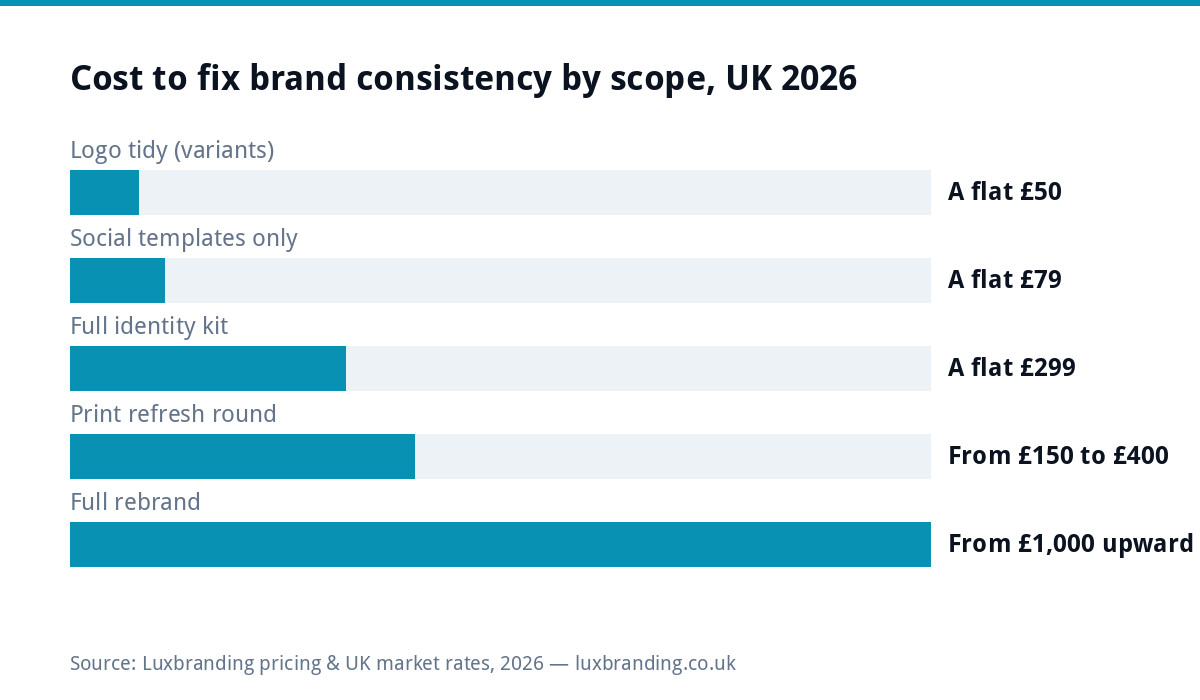
When your brand looks different everywhere, the fix costs between £50 and £299 in most UK cases, not the £1,000+ rebrand you might fear. The method is audit-then-kit: score every touchpoint against your best version, pick one master identity, then rebuild the kit, logo files, colours, fonts and templates, around it. A full brand identity with guidelines is £299 at our fixed rate; a simple logo tidy is £50. The expensive path is drifting on: research collated by Marq’s brand consistency reporting has long linked consistent presentation to measurable revenue uplift, and the mirror image is what inconsistency quietly costs.
How brands drift apart
Nobody decides to be inconsistent; it accumulates. Five causes explain most of it: the logo exists in six file versions and nobody knows which is current; colours were never written down, so every supplier eyedroppers a slightly different blue; fonts default to whatever each tool had; each new platform got a fresh improvised header; and multiple hands, printers, van sign shops, a nephew with Canva, each made reasonable local choices with no master to follow. Drift is a systems failure, not a design failure.
What looking different everywhere costs
Customers rarely say your branding is inconsistent; they say weaker things they cannot articulate: the van did not look like the website, the invoice felt off, is this the same company? Recognition is repetition, and every variant resets the counter. Inconsistency also leaks money operationally: files rebuilt because nobody can find the right one, print jobs redone because the blue came out purple, and social templates remade from scratch each time. Our guide to brand consistency in social graphics shows the most visible surface of the problem.
Step 1: audit and score the damage
Lay everything side by side, website, social profiles, van, signage, invoices, business cards, uniforms, email signature, and score each against your best touchpoint. Same logo version? Same colours? Same fonts? Same tone? Our free brand audit checklist structures this as a scored worksheet; most drifted brands land between 20 and 35 out of 50, and the score tells you whether you need a tidy, a kit or a rethink.
Step 2: choose the master version
Somewhere in your materials is the version you would keep: usually the most recent professional piece. That becomes law. Resist the urge to redesign while consolidating; changing the logo now means every touchpoint needs updating anyway, so first make everything match, then judge whether the matched brand needs evolving. If the honest answer is that no version is worth keeping, that is a different project, and our guide on signs your logo needs a redesign helps you tell tidy from replace.
Step 3: rebuild the kit around it (£299)
A consistency kit is: the logo in every needed format, print vector, web, white-out, favicon; a written palette with exact colour codes for screen and print; named fonts with where to get them; and a one-page guideline sheet any supplier can follow. That is precisely what our £299 brand identity service produces, guidelines included, and what our brand guidelines cost guide benchmarks across the market. If the logo itself just needs its variants regenerated, a £50 logo edit is the smaller door in.
Step 4: roll it out in the order that pays
| Priority | Touchpoint | Why this order |
|---|---|---|
| 1 | Website and Google profile | Where strangers check you exist |
| 2 | Social profiles and templates | Highest posting frequency |
| 3 | Email signature and invoices | Every customer sees them |
| 4 | Print: cards, flyers | Replace at next print run |
| 5 | Van, signage, uniforms | Costly: schedule, do not rush |
The first three cost almost nothing beyond the kit and fix the surfaces seen most often. Vehicles and signage are real money, so book them into the replacement cycle rather than repainting on principle; a consistent digital presence buys patience for the van.
Templates are what lock it in
Guidelines describe consistency; templates enforce it. Social post templates, a document header, an email signature block: once they exist, the path of least resistance produces on-brand output even when the busiest person in the company is posting at 9pm. This is why the kit matters more than the lecture, and why every rollout we do ships editable templates rather than a PDF sermon.
What the consistency kit contains
| Component | Format | Who uses it |
|---|---|---|
| Logo master set | Vector, web, white-out, favicon | Every supplier, forever |
| Colour codes | Screen and print values written down | Printers, sign shops, web tools |
| Font specification | Names, weights, where to obtain | Anyone making documents |
| One-page guidelines | PDF any supplier can follow | The nephew with Canva included |
| Editable templates | Social posts, documents, signature | Whoever posts at 9pm |
Keeping it consistent: the five-minute quarterly check
Consistency decays without maintenance, so diarise a five-minute quarterly pass: open the website, your three most active social profiles, the last invoice sent and the newest printed piece, and eyeball them against the guideline sheet. Anything drifting gets fixed from the kit, not improvised. When a new supplier joins, the one-page guidelines go in the first email before any artwork conversation starts. This tiny ritual is the difference between a brand that stays fixed and one that needs this article again in eighteen months.
Worked example: the electrician who looked like three companies
An electrical firm had a 2014 logo on the vans, a 2019 variant on the website, and a Facebook page using neither, three colour blues across surfaces. Score on the audit: 24/50. The fix: master version chosen from the website mark, £299 identity kit with exact codes and templates, then rollout, digital surfaces in week one, invoices and signature in week two, print at the next order, vans left until their scheduled rewrap eight months later. Total spend before the vans: under £400. Enquiry quality shifted noticeably, fewer is-this-the-same-firm questions, and the office stopped rebuilding artwork for every print order.
Briefing suppliers from the kit
The kit only works if suppliers receive it before they improvise. The rule: guidelines and logo pack go in the first email, ahead of any artwork conversation, to every printer, sign shop, embroiderer and web tool operator. Ask each to confirm which logo version and colour values they will use; a one-line reply catches the wrong-blue problem while it is free to fix. For embroidery and workwear specifically, send the simplified white-out version and say so, because stitched gradients are how good logos die. Suppliers overwhelmingly prefer this; guessing is work, and the ones who resist a one-page guideline sheet are auditioning to cause your next drift.
By situation
Solo trade with drift: £50 logo tidy plus the free checklist may be enough. Small firm across web, social and print: the £299 kit is the standard fix. Renamed, repositioned or merged business: that is genuine rebrand territory, budget accordingly with our rebranding checklist and when-to-rebrand guide. If the mark you consolidate around might deserve trade mark protection, the IPO’s registration guidance is the official route. Everything we charge is on the public price list.
When it is actually a rebrand
Consolidation assumes the brand underneath is right. If the name no longer describes the business, the market has moved, or the mark fails at small sizes and on embroidery, matching everything to it just makes the wrong thing consistent. The tell: if you flinch at putting the master version on a new van, do not roll it out; rebrand first, then run this exact playbook for the launch.
Get the UK Branding Budget Worksheet (free)
A printable worksheet: decide what your brand needs now and price it against fixed published prices and the IPO trademark fee.
No spam. UK GDPR compliant. We only use your email to send this resource, unless you tick the box to hear from us.
Frequently asked questions
How much does it cost to fix an inconsistent brand? +
Usually £50 to £299. A logo tidy regenerating correct variants costs £50; a full identity kit with exact colour codes, fonts, templates and a guideline sheet is £299. A true rebrand only becomes necessary when the brand underneath is wrong.
Why does my brand look different everywhere? +
Drift, not decisions: multiple logo file versions, colours never written down, default fonts per tool, improvised headers per platform, and different suppliers each making reasonable local choices with no master to follow.
Does brand consistency actually affect revenue? +
Industry research, including the long-running Marq brand consistency reports, links consistent presentation to measurable revenue uplift. Practically: recognition is repetition, and every variant resets the counter.
What order should I fix touchpoints in? +
Website and Google profile first, then social profiles and templates, then email signature and invoices. Replace print at the next run and schedule vehicles and signage into their normal replacement cycle.
When is it a rebrand rather than a consistency fix? +
When no existing version is worth keeping: the name misdescribes the business, the market has moved, or the mark fails at small sizes. Making the wrong thing consistent helps nothing; rebrand first, then roll out.