
Quick answer: what to do and what cover costs
When your social media manager quits, secure the accounts within 48 hours, then bridge content before choosing a replacement route. Cover costs range from £0 for a planned pause to £150 to £400 a month for a freelancer, £300 to £800 a month for agency management, and £2,000+ a month for an in-house hire. The urgent part costs nothing but discipline: an access audit and password rotation done today prevents the expensive version of this story, where a departed contractor still holds your ad account.
The first 48 hours, in order
One: list every platform you exist on, including the ones nobody posts to. Two: establish who owns each account, the business or the person who just left. Three: rotate passwords and remove their access everywhere, roles first, shared logins second. Four: check connected apps and schedulers, because access often survives through tools. Five: pull any scheduled posts and read them before they publish unsupervised. Six: note what was mid-flight, campaigns, ads, influencer conversations, so nothing dies silently.
The account access audit
| Check | Where | Risk if skipped |
|---|---|---|
| Page and profile roles | Each platform’s settings | Ex-manager retains admin |
| Business Manager / ad accounts | Meta Business settings | Ad spend access survives |
| Scheduler tools | Buffer, Hootsuite, Later etc. | Posting access via the tool |
| Email addresses on accounts | Account settings | Recovery goes to their inbox |
| Two-factor devices | Security settings | Their phone gates your login |
| Connected apps | Authorised apps lists | Zombie integrations keep tokens |
Meta’s own Business Help Centre documents role removal step by step, and it is the platform where orphaned admin rights bite hardest. If an account was created under the manager’s personal email, recovery gets harder; our guide to a locked business social account covers those recovery routes.
Change passwords like you mean it
Rotation means new, unique passwords in a password manager the business controls, two-factor moved to a business phone or authenticator, and recovery email pointing at a business inbox. Shared spreadsheet passwords are how this crisis repeats with the next person. Ten minutes per platform, done once, properly.
Bridge two weeks of content fast
You do not need to match their output on day three; you need presence, not silence. Pull together: three pieces of proven past content worth reposting, two customer photos or jobs from this month, one simple offer or reminder post, and a things-people-ask post answering your most common question. That is a fortnight at three posts a week. Our free social media calendar template gives the slots; fill a fortnight, not a quarter.
What to tell followers
Nothing. Audiences do not notice a staffing change unless you announce it. No farewell posts, no new-era posts. Keep the feed normal and boring while you reorganise backstage; the only visible failure mode is silence stretching past a couple of weeks.
The cover options, priced honestly
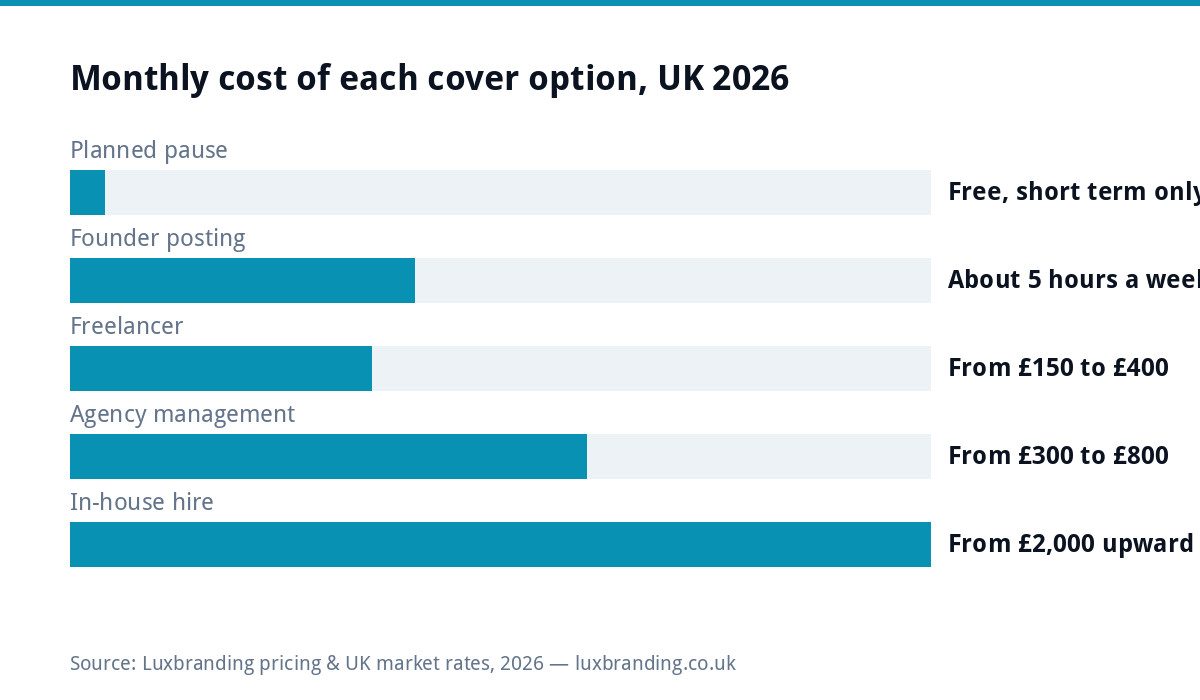
DIY founder posting costs no cash and roughly five hours a week you were spending elsewhere, sustainable as a bridge, corrosive as a permanent plan. Freelancers at £150 to £400 a month suit steady content without strategy. Agency management at £300 to £800 a month adds planning, design and reporting; our social media management cost guide breaks down what each band buys. In-house makes sense when social genuinely drives revenue daily and there is a wider marketing role to fill.
The handover you are owed
Whether the exit is friendly or not, request in writing: all account credentials and role transfers, the content calendar and any drafts, performance reports or at least screenshots of insights, supplier and influencer contact threads, and brand assets, templates, fonts, photo libraries. If they were an employee, notice-period cooperation on handover is a reasonable instruction; ACAS guidance covers what you can expect during notice. Contractors owe what the contract says, which is why the next contract should say it.
Outsource or rehire?
Rehire in-house when social is a revenue channel needing daily judgement, community management and fast response. Outsource when what you actually need is consistent, on-brand presence: it is cheaper, it does not resign, and quality is contractual. Many businesses land on a hybrid, an owner voice for authenticity plus managed scheduling and design, using templates from a social media design pack so anyone posting stays on brand.
What belongs in the handover document
| Item | Why it matters |
|---|---|
| Credential list and role map | Proves every account is transferred |
| Content calendar and drafts | Your next fortnight already half-exists |
| Insights snapshots | Baseline to judge any successor against |
| Supplier and influencer threads | Relationships are assets, not memories |
| Templates, fonts, photo library | Brand consistency survives the exit |
| Ad account status and billing | No orphaned spend running unwatched |
Five questions for the replacement
Whether freelancer or agency, ask: who owns the accounts and assets they create for you, and get it in the contract this time? What happens when they are on holiday or leave? What does a monthly report contain, and can you see a redacted example? How do they handle access, roles on business-owned accounts or logins of their own? And what would they post for you in week one, which reveals whether they researched your business or run one playbook for everyone. The answers separate professionals from the drift that created this crisis.
Worked example: the cafe that gained from the exit
A cafe’s part-time social manager left with four days’ notice. The owner ran the 48-hour audit, found the Instagram recovery email was the ex-manager’s personal address, fixed it, and bridged with reposted bestsellers and daily specials shot on a phone. After three weeks she moved scheduling and design to a managed plan at a third of the old part-time salary and kept posting the specials herself. Engagement dipped 15% for a fortnight, then recovered above the old baseline, and the recovered salary funded the quarter’s print run.
Rebuild the system so the next exit is boring
The deeper fix is separating the system from the person. Document the posting rhythm: which days, which content types, which hashtags and tone rules. Keep templates in a shared brand folder so design does not walk out of the door. Batch content monthly rather than improvising daily, because a fortnight of scheduled posts is a fortnight of cover whenever anyone leaves. Keep the calendar in a tool the business owns, not the manager’s personal account. When the system lives in documents and templates, a manager leaving costs you a person, not a function, and hiring their replacement becomes a choice made calmly rather than a rescue conducted in a weekend.
One last piece of perspective: this happens to almost every small business eventually, and the ones who come through it strongest treat the exit as the audit they never got round to. Access tightened, system documented, cover chosen deliberately rather than inherited. Done that way, the departure ends up improving the function it briefly threatened.
Prevention: access hygiene rules
Business owns every account, on business email addresses. Roles, never shared logins. A password manager with an offboarding checklist. Two-factor on business devices. Quarterly access review, five minutes in the diary. Write it down once and the next departure is an afternoon’s admin, not a crisis. If you are rebuilding the wider function, our guide to management costs and the managed service show what handled looks like; all prices are on the public list.
Get the UK SEO DIY Audit Checklist (free)
A 32-point checklist UK SMEs can run against their own website in an afternoon. Surfaces the quick wins before paying for a paid audit.
No spam. UK GDPR compliant. We only use your email to send this resource, unless you tick the box to hear from us.
Frequently asked questions
What should I do first when my social media manager leaves? +
Secure access within 48 hours: list every platform, rotate passwords, remove their roles, check schedulers and connected apps, move two-factor and recovery emails to business-controlled addresses, and read any scheduled posts.
How much does social media cover cost? +
A freelancer runs £150 to £400 a month, agency management £300 to £800, and an in-house hire £2,000+ monthly. Founder-posting costs no cash but about five hours a week, workable as a bridge rather than a plan.
Should I tell followers the manager left? +
No. Audiences only notice silence, not staffing. Keep the feed normal with reposted proven content and simple current posts while you reorganise; announcements create questions nobody was asking.
What handover materials should I ask for? +
In writing: credentials and role transfers, the content calendar and drafts, performance reports, supplier and influencer threads, and all brand assets including templates and photo libraries.
Should I rehire in-house or outsource? +
Outsource when you need consistent on-brand presence; it costs less and does not resign. Rehire when social drives revenue daily and needs live judgement. Many settle on owner voice plus managed scheduling.