
Quick answer
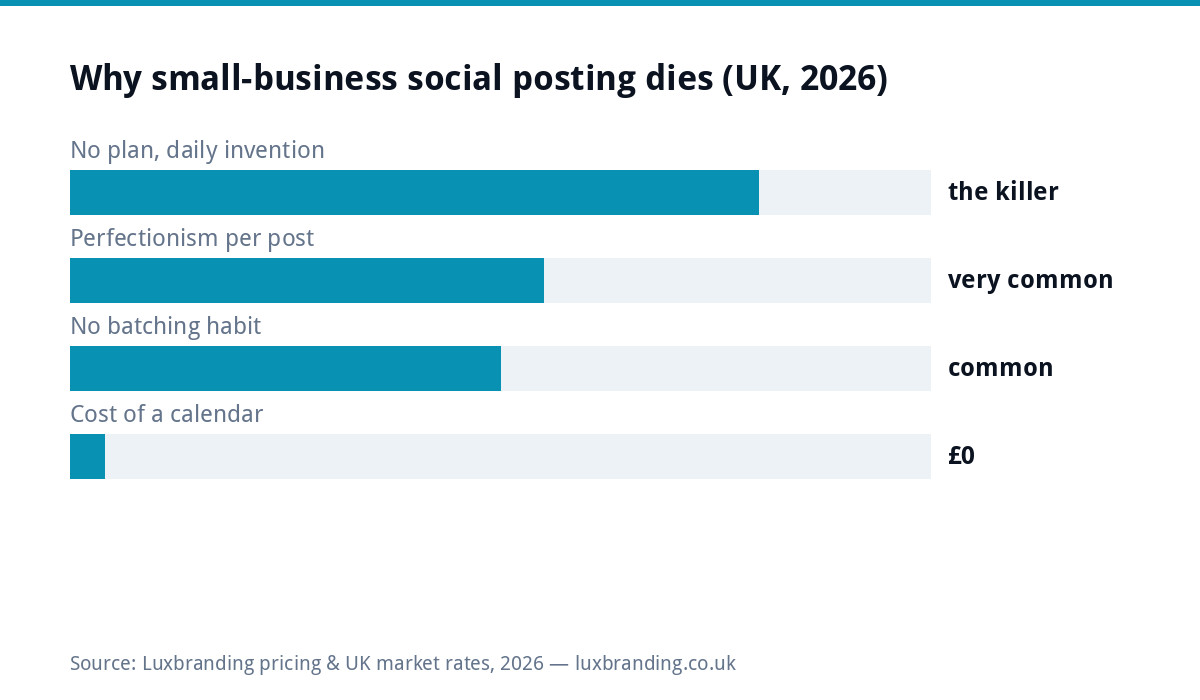
Small-business social dies of daily invention, not lack of ideas, so the fix is a calendar that makes every post a fill-in rather than a blank page. Below: the 12-month UK themes table, the weekly rhythm sized to survive your busy season (3 to 4 posts, not daily heroics), and the 90-minute batching method that produces a fortnight at a sitting. Copy both tables, adapt the bracketed bits to your trade, and the “what do I post?” question retires for £0.
The weekly rhythm (copy this first)
| Slot | Post type | The fill-in formula |
|---|---|---|
| Monday or Tuesday | Work post | One job/product photographed properly + two lines: what it was, where (area not address), one detail you’re proud of |
| Midweek | Useful tip | One thing customers ask you constantly, answered plainly. Your FAQ list is a year of these |
| Thursday or Friday | Proof post | A review screenshot with a thank-you, a milestone, a behind-the-scenes, or the team being human |
| Flexible (optional) | Seasonal/offer | This month’s theme from the table below, or an offer, used sparingly so it stays news |
The 12-month UK themes table
| Month | Theme to ride | Post ideas for a local business |
|---|---|---|
| January | Fresh starts, planning | New year offers, “book early for spring” for seasonal trades, year-ahead availability |
| February | Quiet season value | Maintenance tips, Valentine’s angles for food/retail/florists, “winter checks” content |
| March | Spring prep | Garden/exterior trades wake up; spring cleaning; Mother’s Day for retail/food; end-of-tax-year for B2B |
| April | Easter + outdoor season | Bank holiday hours (post them!), outdoor work showcases, spring before/afters |
| May | Peak season proof | Two bank holidays: hours again; busy-season work stream; “book summer slots now” |
| June | Summer visibility | Father’s Day, weddings season for relevant trades, longest-day light for photography |
| July | Holiday mode | Your holiday dates announced early, summer job showcases, school-holiday angles |
| August | Quiet B2B, busy leisure | Hospitality peaks; B2B posts lighter; “September book-ahead” seeds |
| September | Back to routine | The second January: new-term energy, autumn prep for trades, project restarts |
| October | Pre-winter urgency | Heating/roofing/gutter season, Halloween for retail/food, “before Christmas” booking cutoffs |
| November | Christmas run-up | Christmas orders/bookings open, gift angles, last-date-for-X announcements |
| December | Hours + gratitude | Holiday hours everywhere, year-in-review favourite jobs, thank-you post, January availability |
The 90-minute batching method
Fortnightly, calendar-protected, phone plus a cuppa: minutes 0 to 20, gather photos (camera roll from recent jobs, one walk round the premises, screenshots of new reviews); minutes 20 to 60, write eight captions against the rhythm table’s formulas, voice-typing allowed, perfection banned; minutes 60 to 90, schedule the lot in Meta Business Suite (free, native, covers Facebook and Instagram) or your platform’s scheduler. The psychology is the entire method: starting is the expensive part of content, so start once per fortnight instead of fourteen times, and the calendar means zero decisions during the sitting. Businesses running this loop report the same shape: posting stops being a guilt item and becomes admin, which is precisely the ambition.
Captions that work (the three-line formula)
Local-business captions need three lines, not essays: what/where (“Full rewire finished in Sale this week”), the human detail (“customer’s 1970s fuse box was a museum piece, new board in a day”), and a soft action (“booking September now, link in bio / call us”). Write like you talk, name the area for local reach, skip hashtag walls (two or three relevant ones outperform twenty), and let the photo carry the persuasion. The tip posts borrow their content from questions you already answer weekly, which is why they cost nothing to write and quietly build the “helpful expert” position that converts lurkers years later.
What this calendar deliberately is not
It is not a growth-hacking scheme, a reels production schedule, or a promise that social replaces search: for most local businesses, social nurtures people who already know you while Google captures the strangers, and budget priorities should reflect that split (our management cost guide and the website-vs-social comparison run the numbers). It is also not daily: the rhythm is sized so August-you can sustain what January-you starts, because a feed that dies in March signals more loudly than one that never sprinted. Consistency at three posts a week for a year beats fourteen brilliant days, everywhere, always.
Make it yours in twenty minutes
Adaptation pass: replace the bracketed examples with your trade’s equivalents, strike the months’ themes that don’t apply, add YOUR dates (local events you attend, your holiday closures, your industry’s seasons: boiler-service autumn, wedding-fair January, whatever yours are), and note your three most-asked questions as the first three tip posts. If your visuals need the consistency layer under the calendar, that is exactly what the £79 template kit provides (on-brand frames the batching session drops photos into), and the calendar plus kit together are the whole system our social design service sets businesses up with. The calendar itself: free, like every artifact in this series; the paid layers live on the price list.
Worked fortnight: a plumber runs the system
Concrete beats abstract: Monday week one, a batching session from the van (photos of last week’s bathroom job, the tidy pipe run he’s proud of, a new five-star review screenshot); captions voice-typed against the formulas; eight posts scheduled in fifteen minutes inside Business Suite. What publishes over the fortnight: two job posts naming Sale and Altrincham, two tips (“why your radiator’s cold at the bottom”, his most-asked question), two proof posts (the review, a “300th boiler serviced this year” milestone), one October theme post (“book your boiler service before the rush”) and one flexible slot he skipped without guilt. Total effort: ninety minutes. Total output: a fortnight of presence that looks like a business that’s alive, which is the entire brief social has for a local trade.
When the calendar earns an upgrade
Three signals say the free system has done its job and the next layer would pay: enquiries traceable to posts arriving monthly (time to make the visuals consistent with the £79 kit), the batching habit holding for a quarter (time to consider whether paid boosts on the proven post types earn), or the honest realisation that nobody will ever sustain it internally (the done-for-you conversation, priced in the management guide, becomes cheaper than the guilt). The calendar stays the spine in all three cases; the upgrades just change who fills it and how far each post travels.
The monthly ten-minute review (keep it honest)
Once a month, three questions against your platform’s own insights: which post type earned the most reach and saves (do more of it), did anything convert to an enquiry or visit you can trace (screenshot it for the proof pile), and is the rhythm still sustainable (if a slot keeps slipping, delete the slot, not the habit)? That last permission matters most: the calendar serves the business, and a trimmed rhythm that runs beats a full one that guilt-trips. Social’s compounding is slow and real, and it compounds on whatever cadence actually happens, which this template exists to protect.
And the permission slip some owners need in writing: it is fine to post three times a week, fine to skip the flexible slot, fine to repeat a great post from six months ago, and fine for the feed to be helpful rather than viral. The calendar’s job is presence a real business can sustain, and sustained modest presence beats abandoned ambition on every platform, every year, without exception.
Get the UK Print-Ready Artwork Checklist (free)
A one-page checklist for any UK designer or printer covering CMYK, bleed, fonts and resolution. Saves you the pre-press fix-up fees.
No spam. UK GDPR compliant. We only use your email to send this resource, unless you tick the box to hear from us.
Frequently asked questions
How often should a small business post on social media? +
Three to four sustainable posts a week beat daily posting that collapses by February. The weekly rhythm in the template (job/work post, useful tip, proof post, plus one flexible slot) is deliberately sized to survive busy months, and consistency outranks volume on every platform.
What should a small business actually post? +
Four evergreen types carry local businesses: real work (before/afters, jobs done, products made), useful tips in your trade, proof (reviews, milestones, behind-the-scenes), and offers used sparingly. The calendar rotates them so you never invent from nothing.
What is content batching and why does it work? +
Making a fortnight's posts in one 90-minute sitting: photos gathered, captions written, everything scheduled. Batching works because starting is the expensive part of content, and doing it once per fortnight instead of daily cuts the willpower cost by ninety percent.
Which platform should a local business post on? +
Where your customers actually are: trades and local services lean Facebook, visual businesses (food, beauty, design) lean Instagram, B2B leans LinkedIn. Pick one primary platform and do it properly; cross-post to the second with the same assets rather than running two strategies.
Do I need scheduling tools for social media? +
Free ones cover small businesses: Meta's own Business Suite schedules Facebook and Instagram natively, and most others have native scheduling now. Paid tools earn their fees at multi-platform volume, not at four posts a week.