
Quick answer
A leaflet drop that “did nothing” almost always failed for one of five fixable reasons: no measurement (so nobody actually knows what it did), a weak offer, wrong targeting, a design that got binned in the hallway triage, or distribution that never fully happened. Usually it is two or three stacked. This guide diagnoses each in order and ends with a retry plan that costs less than the failed drop did, because the frustrating truth about leaflets is that the channel works for radius-bound local businesses; campaigns fail on execution, not on the letterbox.
First, the maths you should have been sold
Run the numbers before diagnosing anything, because expectations cause half the disappointment. Unaddressed door-drop response rates in industry-published data run in the fractions-of-a-percent to low-single-digit range depending on sector, offer and frequency; the industry body JICMAIL publishes audited door-drop engagement data if you want the channel’s real figures rather than a printer’s brochure. Now your side: 5,000 leaflets at, say, £50-£90 print (see our flyer cost guide for the full print-and-design market) plus distribution per thousand rates from our leaflet distribution cost breakdown. Against a £250 average job, a mere 0.3% response with modest conversion can turn profit; against a £15 product it almost never can. If your maths never worked at realistic response rates, the campaign did not fail: it was never structured to succeed, and the retry plan below changes the structure, not just the leaflet.
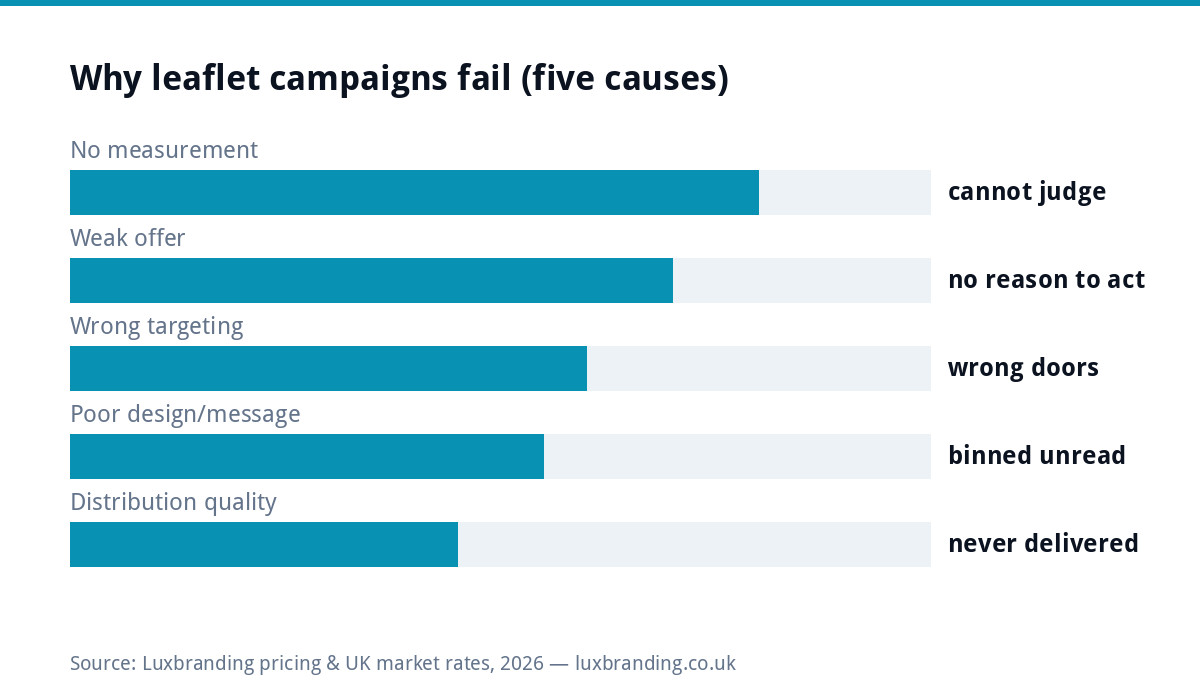
Cause 1: you measured nothing (fix this before anything)
“We got no calls from it” is usually a guess wearing a suit. Leaflet responses arrive late (physical mail lingers on fridges and hallway tables for weeks), arrive sideways (the recipient Googles your name instead of dialling the printed number, and looks like “organic search” in your notebook), and arrive unlabelled unless you built labels in. The fix kit for the next drop: a unique offer code (“quote LEAFLET10”), a QR to a dedicated landing page that exists nowhere else, ideally a distinct phone number, and a six-week window of asking every single enquirer “how did you hear about us?” and writing it down. None of that costs more than an hour. Without it, you are not running campaigns; you are donating paper to the borough. With it, the other four causes become diagnosable from data instead of vibes.
Causes 2 and 3: the offer and the doors
| Symptom | Likely cause | Fix |
|---|---|---|
| People kept it but nobody acted | No offer, or no deadline | One concrete offer + expiry (“£20 off gutter cleans booked by 30th”) |
| Calls from people who cannot afford you | Wrong areas | Match drops to streets where your best past customers actually live |
| Right area, wrong needs | Wrong housing stock | Flats do not need gutter cleaning; audit the round before booking it |
| Zero response AND zero code redemptions | Suspect distribution | See cause 5 |
The offer failure is the commonest: a leaflet that is a business card with delusions (name, list of services, “no job too small”) gives the reader nothing to DO. One service, one offer, one deadline, one action beats seven services and a montage every time. The targeting failure is quieter: distribution rounds are sold by volume, and 5,000 doors in the wrong postcodes is worth less than 1,500 in the right ones. Map your last 20 good customers before buying the next round; the cluster on that map IS your route plan.
Cause 4: the design failed the hallway triage
Every leaflet faces a two-second sort above the recycling bin. What survives: a clear headline naming the reader’s problem (“Gutters overflowing?”), one strong image, prices or from-prices (the same transparency argument as our price list template makes for websites), the offer with its deadline, and contact routes big enough for the reader’s parent to use. What gets binned: clip-art, six fonts, paragraph text, and anything that looks like every other leaflet in the pile. Paper matters more than digital people expect: flimsy stock reads as flimsy business. If the current design came free with the printing, that is likely a cause; a professionally designed flyer at £89 amortised over three drops adds pennies per door, and the brief that makes it convert is a fifteen-minute exercise with our free design brief template.
Cause 5: the leaflets never all arrived
The channel’s awkward secret: distribution quality varies wildly, and undelivered leaflets look identical to unresponsive ones in your results. The reliable end of the market: Royal Mail’s door-to-door service delivers with the post itself, and reputable independents offer GPS-tracked walkers and backchecking. The unreliable end pays casual walkers per thousand and hopes. Questions that sort them, drawn from the checklist in our distribution cost guide: GPS tracking as standard? Solus or shared drops (your leaflet alone, or bundled with four takeaway menus)? Backchecking calls to households? References from repeat clients? If your failed campaign used the cheapest quote you could find and produced literally zero code redemptions across thousands of doors, weight this cause heavily, and pay the reliable rate next time; undelivered is the most expensive price per delivered leaflet there is.
By business type: is the channel even right?
Radius trades (gutters, windows, drives, gardens): leaflets remain among the best-fit channels in print; persistent, local, no ad auction. Salons, cafés, takeaways: strong for openings and offers within walking distance; pair with the direct-order push if you are commission-squeezed. Appointment professionals (accountants, clinics): weaker; trust builds poorly from letterboxes, and search plus reviews usually out-earns print. Anyone whose customers are not geographically clustered: wrong channel entirely; the same budget in search visibility compounds instead, which is the standing argument of our SEO cost guide. The test: if you cannot draw your customer base on a map of your town, stop posting paper at it.
The leak nobody audits: what happens to the leads you DO get
Before blaming the paper, audit the catch. Door-drop enquiries behave like all local enquiries: they go to whoever answers. A leaflet that generates eight calls of which three ring out, two reach a voicemail nobody returns and one gets a quote emailed five days later has not failed as marketing; the business failed as a receiver, and no amount of design fixes that. The receiving checklist for the next drop: the printed number answered by a human during the hours the leaflet promises (or a callback within the hour), the QR landing page carrying the same offer the paper made rather than dumping visitors on a generic homepage, quotes out within 48 hours while the leaflet is still on the fridge, and one follow-up a week later, which is where an outsized share of trades work is actually won because most competitors never send it. None of this costs money; all of it multiplies whatever response rate the drop achieves, and the source-logging habit from cause one tells you exactly how many catches you fumbled. Fix the receiver before re-judging the channel: it is the only part of the system you control completely.
The retry plan (one drop, done properly)
Composite worked example to steal: a gutter-cleaning firm’s 10,000-leaflet blast produced “nothing” (untracked, offer-free, cheapest distributor). The retry: 2,000 leaflets, three drops six weeks apart, to the 12 streets where its best customers cluster; one offer with a deadline; code + QR + source-logging; Royal Mail door-to-door for delivery certainty; £89 design against a proper brief. Cost: under half the original blast. Result pattern typical of the structure: single-digit jobs per drop, rising with repetition as the name becomes familiar, at an acquisition cost the job value supports, plus the unmeasurable-but-real lift in brand searches the tracking now catches. That is what “leaflets working” actually looks like: unglamorous, repeatable arithmetic. Run the retry once; if honestly-measured results still fail YOUR maths, retire the channel with a clear conscience and move the budget to search, where every price is equally public on the price list.
Get the UK Print-Ready Artwork Checklist (free)
A one-page checklist for any UK designer or printer covering CMYK, bleed, fonts and resolution. Saves you the pre-press fix-up fees.
No spam. UK GDPR compliant. We only use your email to send this resource, unless you tick the box to hear from us.
Frequently asked questions
What is a realistic response rate for leaflet drops in the UK? +
Industry-published figures for unaddressed door drops typically sit around fractions of a percent to low single digits depending on sector, offer and repetition. At a £45-£300 average job value, even 0.5% on 5,000 leaflets can pay handsomely, which is why the maths must be run per business, not by feel.
Why did my leaflet campaign get zero calls? +
Usually more than one cause stacked: no tracking (so "zero" may be wrong), no offer worth acting on, the wrong areas, a design that got binned in the hallway triage, or a distributor who never delivered them all. Diagnose in that order; each has a cheap fix.
How do I track whether leaflets actually work? +
Give the leaflet its own trackable routes: a unique offer code, a QR to a dedicated page, and ideally a separate phone number. Then log every enquiry source for the following six weeks. Without this, a campaign cannot fail OR succeed; it can only be guessed about.
How many times should I leaflet the same area? +
Door-drop media rewards repetition: one drop is an introduction, not a campaign. Industry practice favours the same households several times across months over one big blast everywhere. Budget for three drops to a tighter area rather than one drop to a wide one.
Are leaflets still worth it compared with online ads? +
For local, radius-bound trades and services with decent job values, often yes: letterboxes have no ad blockers and physical mail lingers in the home. For businesses whose customers are not geographically clustered, search and social usually beat print. The channel must match the catchment.