

Quick answer: UK flyer design + print costs in 2026
Flyers split into two costs: design (one-off) and print (per run). Real UK ranges:
Hospitality businesses budgeting print usually price the menu at the same time: see UK menu design costs.
| Item | Cost | Notes |
|---|---|---|
| Single-sided A5/A4 flyer design | £49-£149 | One side, basic layout, brand-consistent |
| Double-sided A5/A4 flyer design | £79-£199 | Front + back, more design work, higher impact |
| Tri-fold leaflet design (A4 → DL) | £149-£299 | 6 panels, structured information flow |
| 500 prints A5 double-sided 130gsm | £30-£50 | UK trade printer mid-tier |
| 1,000 prints A5 double-sided 130gsm | £40-£70 | Best per-unit value for most UK SMEs |
| 2,500 prints A4 tri-fold 150gsm | £90-£150 | Common quantity for direct mail campaigns |
Average UK SME total spend on a flyer campaign: £130-£250 (design + 1,000 prints). Distribution costs are separate.
Five fold types and what each costs
Single sheet (no fold)
Cheapest option. £49-£99 to design A5; £30-£60 to print 500 mid-tier. Best for short messaging, one offer, one CTA. Common UK use case: gym membership offer, restaurant opening, builder discount.
Bi-fold (A4 folded once → A5)
£79-£149 to design (4 panels). £40-£80 for 500 prints. Useful for two-step information: cover/teaser + inside detail.
Tri-fold (A4 folded twice → DL/long)
£149-£299 to design (6 panels). £60-£120 for 500 prints. The standard for service businesses: cover + 3 service panels + back panel with contact + CTA panel.
Gate-fold (premium presentation)
£199-£399 to design (6 panels). £80-£150 for 500 prints. Used for premium event invites, hospitality menus, real estate listings. Distinctive but tactile cost is high.
Z-fold (concertina)
£199-£349 to design. Useful for sequential information (step-by-step process, timeline). Slightly fiddly to design well; commonly used for service workflows.
Paper weight: what each gsm feels like
| GSM | Feel | UK common use | Cost vs 130gsm |
|---|---|---|---|
| 90gsm | Thin, nearly newsprint | Throwaway mass distribution | -30% |
| 130gsm | Standard flyer weight | Most UK promotional flyers | Baseline |
| 170gsm | Slightly premium | Service businesses, mid-market | +15-25% |
| 250gsm | Card-like, premium | Premium offers, real estate | +40-60% |
| 350gsm | Stiff like business card | Postcards, premium DM | +80-120% |
For most UK SMEs, 130gsm (for cheap mass distribution) or 170gsm (for service businesses where perceived quality matters) is the sweet spot. Going above 170gsm rarely justifies the cost unless you’re using the flyer as a tactile premium piece.
How many to print, and when each quantity works
250 flyers
Right for highly targeted: networking events, one shop window, a single street. Cost per flyer is high (£0.12-£0.20) but waste is zero.
500 flyers
UK small business sweet spot for first run. Tests the design and offer before committing larger budget. Per-flyer cost £0.08-£0.14.
1,000 flyers
Best per-unit pricing for most UK SMEs (£0.05-£0.09). Right when you’ve validated the offer and want to scale a single campaign.
2,500-5,000 flyers
Direct mail campaigns, area-saturation marketing, larger local events. Per-flyer cost £0.04-£0.07.
10,000+ flyers
Only worth it for very large UK distribution campaigns where you’ve proved conversion at smaller scale. Per-flyer cost can drop to £0.02-£0.04.
Distribution costs: what to budget
Leaflet drop services (UK)
Door-to-door leaflet distribution costs £30-£60 per 1,000 in most UK cities (Letterbox Marketing, dor2dor, Royal Mail Door-to-Door). Royal Mail’s Door-to-Door service offers more reliable delivery but at £80-£120 per 1,000.
In-store / community placement
Free if you can negotiate counter placement at local cafes, salons, gyms. Volume per location is low (5-20 flyers/week) but cost is zero and trust transfers from the host venue.
Hand-distribution at events
Free if you’re attending the event yourself. Conversion rate is 5-10x higher than passive distribution because there’s a conversation attached.
Royal Mail business mailing
Cheapest at £0.30-£0.65 per address depending on quantity and class. Worth it for targeted lists (existing customers, postcode targeting).
UK flyer compliance: the ASA and CAP code
UK flyer copy is regulated by the Advertising Standards Authority and the CAP Code. Common compliance issues:
- Price claims must include all mandatory charges (VAT, delivery, booking fees)
- “From £X” pricing must have a meaningful number of items at that price
- Health and slimming claims need substantiation
- “Limited time” offers must have a genuine end date
- Comparative claims (cheaper than X competitor) must be verifiable
Non-compliance risk is real, UK ASA rulings appear in search results when someone Googles your brand. The cost of compliance is zero if you brief your designer properly; the cost of a ruling is reputation damage that lasts years.
Measuring flyer ROI: what actually works
Unique URL or short link
Use a memorable short URL (yourdomain.com/march) that only appears on the flyer. Track visits in Google Analytics. Most accurate measurement method.
QR code with UTM tracking
QR code linking to a UTM-tagged URL. Modern smartphone cameras read QR codes natively (no app required). Increasingly the default measurement method in 2026.
Mention-this-flyer offer
Bold call-to-action: “Show this flyer for 10% off.” Customer-led attribution; lower precision but works in venues where digital tracking isn’t possible.
Phone number with unique extension
Track which phone number was dialled (works with call-tracking services like Mediahawk or CallRail UK). High accuracy for service businesses where the conversion is a phone call.
Where UK SMEs typically waste flyer money
- Ordering 5,000+ flyers without testing the design at 500 first
- Designing flyers in DIY tools (Canva) that produce non-print-ready files, requiring printer re-work fees
- Premium finishes (foil, spot UV) on flyers that get discarded within 5 seconds
- No measurement mechanism (no QR code, no URL, no tracking number), so ROI can never be calculated
- Distributing to wrong geographic area (typical leaflet drop spans 4-6 postcodes; if your service area is one postcode, 80% of the cost is wasted)
UK flyer print processes and what they cost
Digital print (most common for small UK runs)
Used for runs under 5,000 units. Faster setup (no plates), more flexible (variable data possible). Cost per unit slightly higher than offset but no setup fees. Most UK SME flyer runs go this route.
Offset print
Used for runs over 5,000-10,000 units. Lower per-unit cost at scale but high setup fees (£40-£150 per plate). Sharper image quality. Used by UK chains running national flyer drops.
Risograph / silk-screen (specialty)
Niche options for premium brands wanting tactile, handmade feel. UK risograph studios in London, Bristol, Manchester. Cost: 2-5x standard digital print. Used by craft brands, art events, design-led businesses.
Design considerations for UK leaflet drop campaigns
The 3-second test
Most leaflets get 1-3 seconds of attention before the bin. Design accordingly:
- One headline message (not three)
- One call-to-action (not multiple)
- One offer (not several)
- Strong visual hierarchy: eye lands on the key info first
Front vs back strategy
Front: hook + offer + CTA. Back: details, multiple service options, supporting content. People scan the front; only interested prospects read the back.
Localisation
Generic flyers underperform. Mentioning the specific UK area (“Manchester homeowners, save £200 on your boiler service”) doubles response rate vs national wording.
UK leaflet drop services and rates
| Service | UK rate per 1,000 | Notes |
|---|---|---|
| Local independent distributor | £25-£45 | Cheapest but verify delivery via GPS tracking |
| Letterbox Marketing (UK national) | £40-£70 | Reliable, GPS tracked |
| dor2dor | £45-£75 | Professional, tracked |
| Royal Mail Door-to-Door | £80-£120 | Most reliable, postcode-targeted |
| Targeted demographic drop | £90-£200 | Filtered by household income, age, etc. |
Tracking and measurement: getting real ROI data
Code-on-flyer methods
- Promo code: “Quote FLYER10 for £10 off”
- Unique URL: yourdomain.com/march
- QR code with UTM parameters (modern default)
- Unique phone number with call tracking
Typical UK response rates
- Direct mail (Royal Mail addressed): 1-5%
- Leaflet drop (unaddressed door-to-door): 0.5-2%
- Event handouts: 5-15%
- In-venue placement (cafes, salons): 2-8%
UK businesses that measure consistently typically discover their actual conversion rate is 30-50% below what they assumed. Always measure.
A6 vs A5 vs DL vs A4: picking the flat size
Fold types are covered above, but the flat-size decision comes first, and it changes both the print bill and the design brief:
| Size | 1,000 double-sided, 130gsm | Choose it when |
|---|---|---|
| A6 (postcard) | £30 to £50 | One offer, one CTA; cheap area-saturation drops where volume beats detail |
| DL (a third of A4) | £35 to £60 | Rack displays, envelope mailings, takeaway menus: the letterbox-friendly shape |
| A5 | £40 to £70 | The default: room for offer plus proof without inviting clutter |
| A4 | £60 to £100 | Information-heavy pieces (price lists, event programmes) or anything that will be folded anyway |
The under-rated point: size is a design constraint, not just a cost line. A6 physically forces the one-message discipline the 3-second test asks for, for a first campaign, picking the small size is often the cheapest way to buy focus.
Designing for the fridge, not just the letterbox
Everything above optimises the three seconds between doormat and bin. But the highest-ROI flyers play a longer game: they earn a place on the fridge or the noticeboard, where they keep advertising for months. What earns that place:
- A reason to keep it. A plain price list, a “what we do” checklist, or a seasonal maintenance calendar (gutters in autumn, boiler service before winter) turns an advert into a reference.
- A phone number legible from across the kitchen. If the number needs picking up to read, it won’t get called.
- An offer without a same-week expiry. “10% off your first clean” survives on a fridge; “this Saturday only” is in the bin by Sunday either way.
- Restraint on the keeper side. The hook side can shout; the reference side should look like something worth pinning up, which mostly means white space, clear type and your logo, not a second sales pitch.
For emergency trades (plumbers, locksmiths, electricians), this is the whole strategy: nobody plans a burst pipe, so the flyer’s job is to be findable the day it happens. That’s also the one case where magnetic backing, at several times standard print cost, can pay for itself on a single call-out.
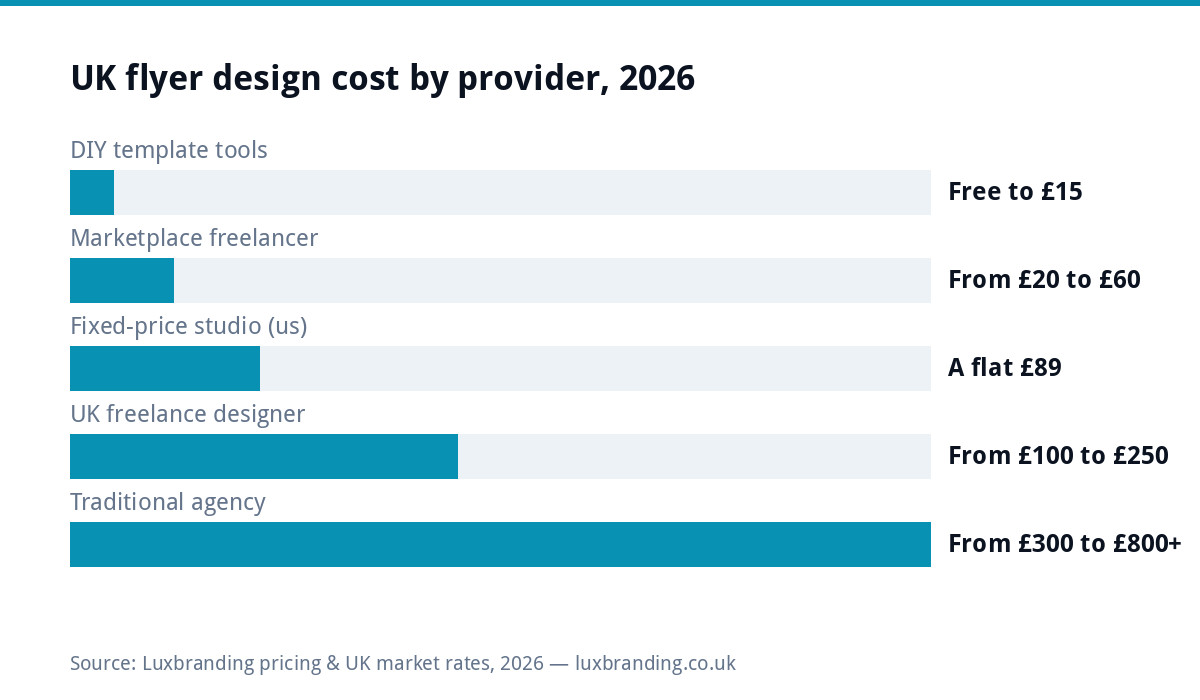
A double-sided piece designed this way costs no more to print than one designed to be binned. Our fixed-fee flyer design is £89 with print-ready files included, and if the logo going on it needs work first, start with the logo, because every flyer you ever print inherits it.
Get the UK Print-Ready Artwork Checklist (free)
A one-page checklist for any UK designer or printer covering CMYK, bleed, fonts and resolution. Saves you the pre-press fix-up fees.
No spam. UK GDPR compliant. We only use your email to send this resource, unless you tick the box to hear from us.
What to send a designer for an accurate flyer quote
Half the price variation between flyer quotes is designers pricing in the unknowns. Send these six things and quotes come back tighter and lower: your logo in vector format (or say you only have a JPEG, which is fixable for £79), the exact wording you want on the flyer rather than “we will sort copy later”, the finished size and whether it folds, the print quantity and who is printing it, one or two example flyers you like, and your deadline. A designer who receives that brief can quote the actual job instead of padding for surprises. If gathering it feels like work, that is what a design brief template is for, and it is exactly the information our own £89 flyer service collects at order.
Sources & Further Reading
- CAP Code, UK advertising rules, Advertising Standards Authority
- Royal Mail Door-to-Door distribution, Royal Mail
- The Design Economy 2026, Design Council
- Federation of Small Businesses, FSB
Frequently asked questions
How much does a UK flyer design cost in 2026? +
Single-sided A5 flyer design starts at £49-£149 in the UK. Double-sided £79-£199. Tri-fold leaflets £149-£299. Print is separate at £30-£70 for 500 mid-tier and £40-£90 for 1,000.
What's the best paper weight for UK flyers? +
130gsm is standard for mass distribution. 170gsm for service businesses where perceived quality matters. Going above 170gsm rarely justifies the cost unless using as a premium tactile piece.
How many flyers should I print? +
500 for first test, 1,000 once design and offer validated. UK best per-unit pricing kicks in at 1,000+. Avoid 5,000+ runs before testing the design; the design itself is often the limiting factor.
How do I measure UK flyer campaign ROI? +
Use a unique URL, QR code with UTM tracking, mention-this-flyer offer, or a tracking phone number. Without one of these, ROI is unmeasurable.
Are leaflet drops still effective in 2026? +
Yes for very local services (plumbers, gardeners, restaurants, gyms) where geographic targeting matters. Typical UK response rates are 0.5-2% for well-designed flyers in well-chosen areas, ROI-positive for businesses with £50+ customer lifetime values.


