Quick answer
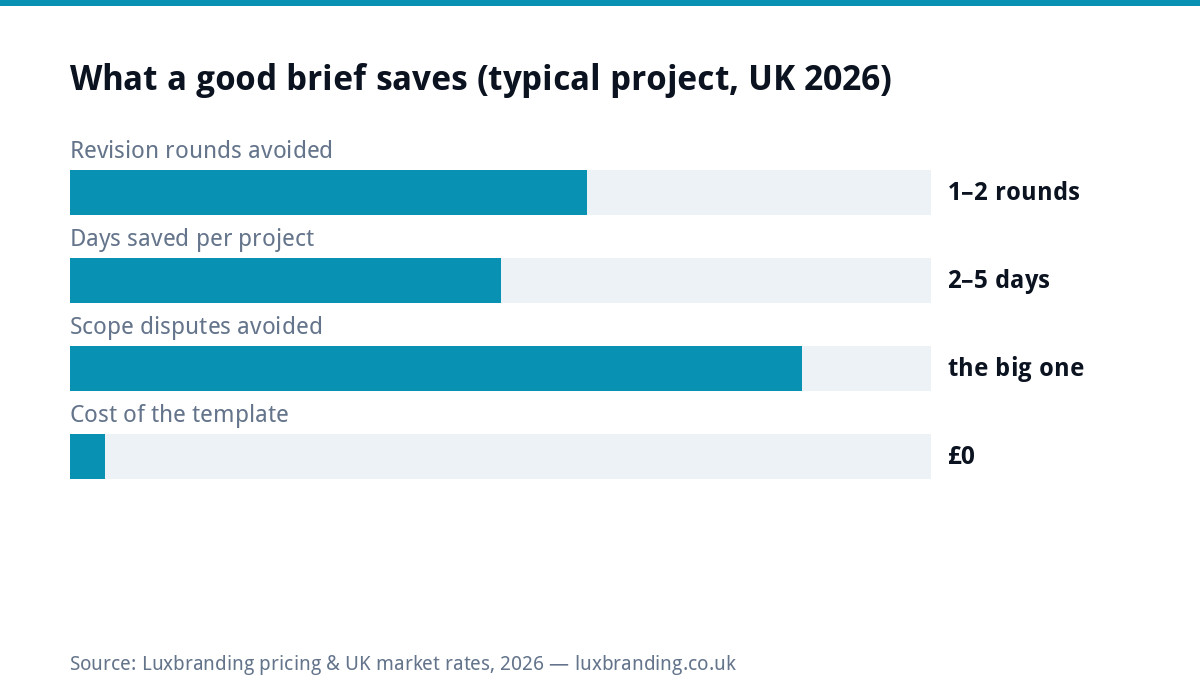
Below is the complete brief template: copy it, fill it in, send it with any design job (logo, flyer, van, website, anything). It is one page on purpose, every field prevents a specific failure we see weekly, and the guidance after it explains the three fields people fumble. Cost: £0. Typical saving: one to two revision rounds and the scope conversation nobody enjoys having mid-project.
The template (copy from here)
| Field | Your answer |
|---|---|
| Business: what you do, in one sentence, for whom | e.g. “Emergency and planned plumbing for homeowners across Stockport” |
| The job: exactly what is being made | e.g. “A5 double-sided flyer for spring boiler-service push” |
| Where it will live: every place this will be used | e.g. “Door drops, van magnet, Facebook posts” |
| The ONE message: what a stranger must remember | e.g. “£79 boiler service in March, book by phone” |
| Must include: the non-negotiables | Phone, logo, Gas Safe number, offer end date… |
| Must NOT include / avoid | e.g. “No clip-art tools, no red (competitor’s colour)” |
| Taste evidence: 2 to 3 examples you like, 1 to 2 you hate, each with WHY | Links or photos (Pinterest boards and Dribbble shots work well); the why matters more than the links |
| Assets attached | Logo (vector if you have it), photos you own, brand colours/fonts if defined |
| Deadline: when you need it, and the real drop-dead date | Both dates, honestly |
| Budget: the number or the band | Yes, write it down; see below |
| Sign-off: who approves, in one name | The committee field. One name. |
The three fields people fumble (and how to fill them)
The ONE message. The most-skipped field and the most decisive. If you cannot pick one message, the designer certainly cannot, and the piece will whisper five things instead of saying one. Test: what should a stranger repeat to their partner an hour later? Write that. Everything else is supporting cast. Taste evidence with WHY. “Make it modern” means nothing; “I like this one because it feels expensive without being cold” is steering. The hate-examples work even harder: one honest “never like this, because…” eliminates whole wrong directions before they cost a draft. Budget, written down. The superstition that hiding the budget gets better prices does the opposite: designers scope to budgets, and an unstated one gets you a guess. At a fixed-price studio the field is even easier; it is confirmation you have seen the number, which is its own dispute-prevention.
Why one page beats the twelve-page brand questionnaire
Agencies love long discovery documents, and for £20k rebrands they earn their keep. For the jobs most UK small businesses actually buy (logos, flyers, one-page sites), length is where truth goes to hide: page nine contradicts page three, nobody rereads it, and the designer privately re-derives a one-pager anyway. The single page forces the decisions that matter, takes fifteen minutes once you have done it twice, and becomes reusable: next job, copy the last brief and change four fields. That reuse is the quiet superpower; briefs compound like the file-handover habits do.
Using it with any designer (including us)
Send the filled template with your enquiry and watch what happens: good designers respond with sharper questions and faster, closer first drafts; weak ones ignore it, which is itself useful vetting (the same tell as our choosing-a-designer guide describes). With our flat-price jobs it plugs straight in: the 48-hour first drafts on logos and print assume exactly this information, and the unlimited-revisions promise works best when revisions refine a well-briefed direction rather than search for one. Print jobs: add the size/format from your printer’s spec. Web jobs: add the page list and who writes the words; our redesign guide’s gather-list is this template’s big sibling.
Worked example: the same job, briefed twice
The difference in practice. Unbriefed: “Need a flyer for the boiler service offer, something eye-catching, you know our style.” The designer guesses at sizes, invents an offer hierarchy, centres a headline you never approved, and round one returns polite disappointment; three revisions later everyone likes it less than the deadline does. Briefed with the template: A5 double-sided for door drops · one message: “£79 boiler service in March, book by phone” · must include Gas Safe number, phone twice, offer end date · avoid red, competitor owns it · two liked examples attached with whys · deadline the 20th, drafts by the 14th. Round one lands within touching distance, round two ships. Identical designer, identical £89 flyer price, entirely different week; the template is the difference, and it cost four minutes. That asymmetry, minutes against rounds, is the whole economics of briefing, the same trade a proper written quote makes on the other side of the transaction, as our briefing guide argues at length.
The same template, five different jobs
Proof it flexes: for a logo, “where it will live” becomes van/signage/embroidery and the taste evidence carries competitor logos to avoid; for a flyer, the one message rules and must-includes carry the offer’s end date; for a van wrap, add the vehicle model and photograph the actual van; for a website, the job field becomes the page list and two new lines appear (who writes the words, who supplies photos), the two answers that decide web timelines; for a menu or price list, the must-include field carries every price, checked twice, because a designed typo prints beautifully. One skeleton, five jobs, and the fields you skip are always the revisions you buy.
Where to keep it (so it actually gets used)
Templates die in downloads folders, so give this one a home with gravity: a note titled “DESIGN BRIEF, copy me” in whatever notes app the business already lives in, pre-filled with the fields and your standing details (business one-liner, brand assets location, sign-off name), so per-job filling is genuinely four minutes. Teams: pin it where jobs get requested, and make “send the brief” the standard reply to “can we get a flyer made?”, which converts the template from advice into workflow. The printable-checklist cousin for the files designers should HAND BACK lives in our handover checklist; run both and the design supply chain, in and out, stops leaking.
The two-minute version (for tiny jobs and busy weeks)
When even one page is friction, these five lines are the floor below which briefs should not go: what is being made · where it will be used · the one message · must-includes · deadline. Text-message length, prevents the worst failures, upgradeable to the full template when the job grows. Print this page, or copy the table into a note titled “brief template” and thank yourself every project from now on: the whole point of the artifact is that filling it is faster than one round of “not quite what I meant”.
Briefing on a deadline (the emergency variant)
When the job is due yesterday, brief tighter, not looser: the two-minute version above, plus one line of triage honesty (“this is urgent; I will accept your judgement calls on anything I have not specified”), which explicitly trades control for speed and prevents the deadline-plus-revisions collision that sinks rush jobs. Rush work without a brief is how expensive mistakes print overnight; rush work with the five-line version is routinely fine, because the designer knows which decisions are theirs. And if the emergency is a supplier needing files rather than design (the printer, the signwriter), that is usually a £79 file rescue wearing a design-emergency costume; check before commissioning artwork nobody needed.
Get the UK Branding Budget Worksheet (free)
A printable worksheet: decide what your brand needs now and price it against fixed published prices and the IPO trademark fee.
No spam. UK GDPR compliant. We only use your email to send this resource, unless you tick the box to hear from us.
Frequently asked questions
What should a design brief include? +
The business basics (what you do, for whom), the job (exactly what is being made and where it will be used), taste evidence (examples you like and hate, with why), the practical rails (deadline, budget, formats needed), and the single message the piece must carry. The template below structures all five.
How long should a design brief be? +
One page. Long briefs bury the decisions; the discipline of one page forces them. Every field in the template earns its place by preventing a specific, common project failure.
Do I need a brief for a small job like a flyer? +
Small jobs benefit most: there is no budget slack for a wasted round. The five-minute version of this template (job, message, must-includes, deadline, examples) turns a £89 flyer into a first-draft-approved £89 flyer.
What happens if I skip the brief? +
The designer designs the brief you didn't write: assumptions fill the gaps, the first draft misses, and revisions become the project. Most "the designer didn't get it" stories are unsent-brief stories; the template exists to end them.
Can I use this template for website projects too? +
Yes: the core sections travel. For sites, expand the "where it lives" field into a page list and add who supplies the text and photos, the two answers that decide web timelines more than design does.