Quick answer
Most small-business rebrands fail for boring reasons: the owner changed the logo without changing anything else, nobody checked the new name, the rollout dribbled out over six months, or the old brand kept turning up on the van. None of these are design problems. They are planning problems, and every one of them has a cheap fix. Below are the twelve mistakes we see most often on UK rebrands, why each one hurts, and what to do instead.
If you only fix three: audit every touchpoint before you start, pick one decision-maker, and set a launch date. Those three prevent more than half the trouble on the list.
The twelve mistakes at a glance
| # | Mistake | What it costs you | The fix |
|---|---|---|---|
| 1 | Changing the logo only | A new mark on an old-looking business | Identity system, not a badge |
| 2 | Not checking the new name | Legal letters, forced second rebrand | Register, domain, trade mark search |
| 3 | No touchpoint audit | Old brand survives for a year | List every asset first |
| 4 | Design by committee | Weeks of delay, a compromise mark | One decision-maker |
| 5 | No launch date | Two brands running side by side | Fixed Monday, work backwards |
| 6 | Throwing away recognition | Regulars do not recognise you | Keep a link to the old brand |
| 7 | Not telling customers | Confusion, suspected scam emails | Announcement plan |
| 8 | Losing reviews and rankings | Years of Google history gone | Edit profiles, never recreate |
| 9 | Following a trend | Dated in three years | Design for the next decade |
| 10 | No brand guidelines | Drift within months | Even a two-page guide |
| 11 | Skipping vector files | Blurry van, refused by embroiderer | Insist on SVG, AI or EPS |
| 12 | Rebranding to avoid a real problem | Same problem, new logo | Fix the service first |
1. Changing the logo and calling it a rebrand
A logo is one part of a brand. If the colours on the van, the tone of the quotes, the photography on the website and the way the phone is answered all stay the same, customers see a new badge on the same business, and the money spent on the mark produces nothing. A rebrand that works changes the system: mark, palette, type, templates, imagery and language together. The difference between the two is explained in our guide to brand identity vs logo design.
2. Falling for a name nobody checked
This is the expensive one. A business picks a new name, wraps the vans, and three months later receives a letter from a company with the same name and an earlier trade mark. The second rebrand costs more than the first. Before you commit, check the Companies House register, the domain, the social handles and the UK trade mark register. The Government’s rules on choosing a company name explain what is refused outright and what counts as too similar. Our free business name checker runs the register, domain and handle checks in one go, and this guide to logo copyright and trade marks explains why registering the mark early protects the investment.
3. Starting without a touchpoint audit
Owners routinely guess at ten places their brand appears and find thirty when they look. The ones you miss are the ones that stay old: the trailer, the PPE, the supplier portal, the email footer on the invoicing software, the sticker on the site cabin. A one-evening pass with our rebranding checklist turns the rollout from a treasure hunt into a list with lead times.
4. Design by committee
Three partners, a spouse, the office manager and a mate who “does a bit of design” will not agree on a mark, and every round of feedback adds a week. Appoint one decision-maker, give feedback in writing within 48 hours, and describe problems rather than prescribing solutions (“it feels too corporate” beats “make the blue lighter”). Two or three revision rounds is normal. Six means the brief was wrong.
5. Rebranding without a launch date
Without a fixed day, the new website goes live in March, the vans get done in May, the cards run out in August and the workwear is still the old colour at Christmas. Customers see two businesses. Pick a launch Monday four to six weeks out, book the sign-writer and embroiderer for the week before it, and switch the website, Google Business Profile and socials on the day. Our guide to how long a rebrand takes has a week-by-week plan.
6. Throwing away the recognition you paid for
If the old brand has ten years of vans on local roads, a completely unrelated new identity resets that recognition to zero. Where the old brand had equity, keep a thread: the name, a colour, a shape from the old mark, or a “formerly known as” line for the first year. Where the old brand was actively hurting you, a clean break is right. The decision is covered in when to rebrand a business.
7. Not telling customers, or telling them badly
A regular customer who receives an invoice from a company name they do not recognise assumes fraud. A rebrand needs an announcement: an email to your customer list, a note on quotes and invoices, a pinned social post, and a line on the website. Email announcements to existing customers are fine under the marketing rules, but the ICO’s PECR guidance is worth a read before you send to anyone who is not already a customer. We cover the sequence in how to announce a rebrand to customers.
8. Losing your Google reviews and rankings
Some owners create a new Google Business Profile for the new name and abandon the old one, along with every review and years of ranking history. Never do this. Edit the existing profile’s name, logo and website instead; Google reviews name changes, and it can take a few days, but the history stays. The process is in Google’s own guide to editing business information. The same applies to Checkatrade, Trustpilot and Facebook: edit, never recreate. Our Google Business Profile guide covers what else to update.
9. Following the trend of the year
Every year has a look that every new brand copies. Whatever it is now, it will date the business by the time the vans need re-wrapping. Ask the designer to show the mark as it would look in a decade, in one colour, at 20 millimetres on a pen and at two metres on a fascia. A brand that works in all four is not a trend.
10. Launching without brand guidelines
Without written rules, the printer picks a nearly-right blue, the sign-writer stretches the logo to fit the van, and a new starter makes a flyer in Word with a different font. Twelve months later you have five versions of the brand. Even a two-page guide (logo clear space, minimum size, exact colour values, typefaces, three do-not examples) prevents most of it. Use our free brand guidelines template or have a designed set produced as part of the identity.
11. Accepting the wrong files
A JPG is not a logo file. Sign-writers, embroiderers, printers and web developers all need vector formats (SVG, AI or EPS) plus transparent PNGs for screens. Owners who receive only a JPG discover the problem when the embroiderer refuses the job or the van decal comes out blurry. Get the full file set at handover and keep two copies. Every Luxbranding logo ships with every format; if a previous designer left you with a JPG, our Recreate & Vectorise service redraws it as a true vector file, £79 for one layout.
12. Rebranding instead of fixing the business
A new brand will not fix slow quotes, missed calls or bad reviews. If the reviews say “great work, impossible to get hold of”, spend the money on a phone system and a booking form first, then rebrand once the service matches the promise. A rebrand amplifies what the business already is.
What a rebrand that avoids all twelve looks like
| Stage | Done right | Typical cost (fixed price) |
|---|---|---|
| Name and legal checks | Register, domain, handles, trade mark search before design starts | Free tools, trade mark filing fee |
| Identity design | Mark, palette, type, stationery, social templates, guidelines | Brand identity from £299 |
| Website | Rebuilt to the new identity, launched on the day | Custom WordPress from £499 |
| Complete programme | Logo and identity, stationery, premium website, social refresh, Google Business Profile and vehicle design, one supplier, one timeline | Complete rebrand package £1,999 |
The full price list, including vehicle livery and signage design, is on our pricing page, and the rebranding cost guide shows how the numbers stack up for a typical small business. Get the planning right and the design takes care of itself.
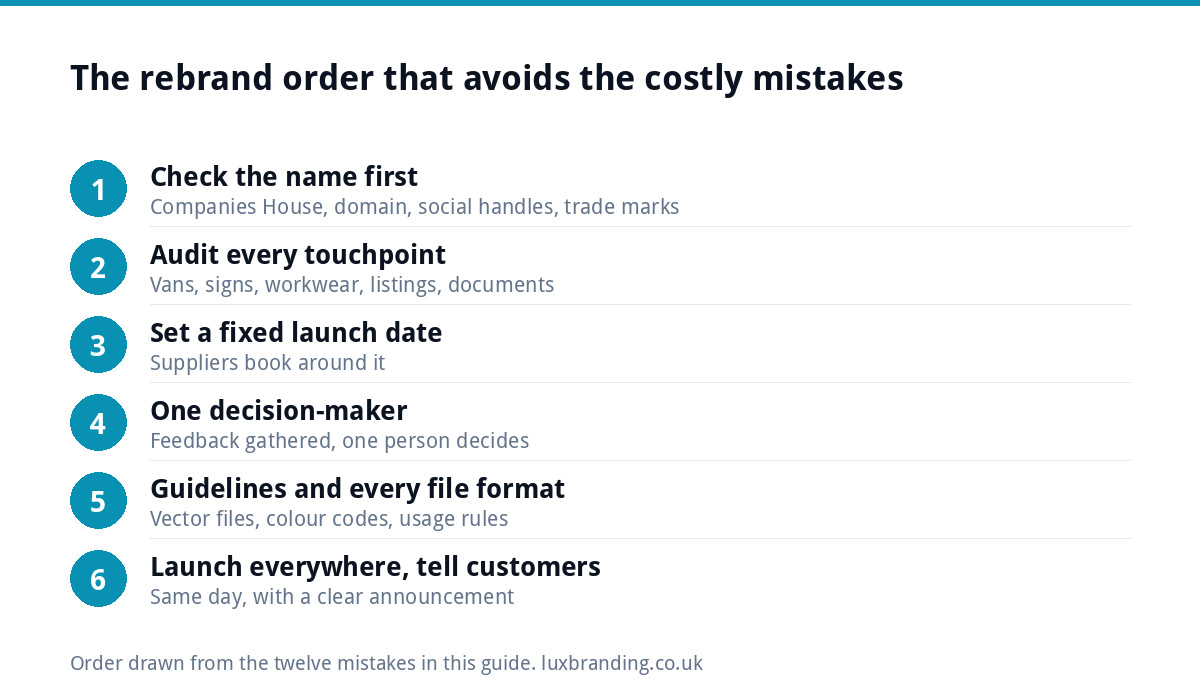
If you remember one thing from this list, make it the order: name checks before design, a touchpoint audit before quotes, and a fixed launch date before anyone prints anything. Almost every expensive mistake above is a step done out of sequence, and getting the sequence right costs nothing.
Get the UK Branding Budget Worksheet (free)
A printable worksheet: decide what your brand needs now and price it against fixed published prices and the IPO trademark fee.
No spam. UK GDPR compliant. We only use your email to send this resource, unless you tick the box to hear from us.
Frequently asked questions
What is the most expensive rebranding mistake? +
Choosing a name nobody checked. A trade mark or company-name clash discovered after the vans are wrapped forces a second rebrand that costs more than the first. Check the register, domain, handles and trade mark database before design starts.
Is changing the logo enough to count as a rebrand? +
No. A logo is one part of a brand. If colours, templates, imagery and tone stay the same, customers see a new badge on the same business. A rebrand changes the system together.
Will I lose my Google reviews if I rebrand? +
Only if you create a new Google Business Profile. Edit the existing profile's name, logo and website instead; Google reviews the change within days and your history stays.
Do I need brand guidelines for a small business? +
Yes, even two pages. Without written rules the printer, the sign-writer and new staff each produce a slightly different version and the brand drifts within a year.
Which logo files should I insist on? +
Vector files (SVG, AI or EPS) plus transparent PNGs. Sign-writers, embroiderers and printers need vector; a JPG on its own is not a logo file.