

Quick answer
Announce a rebrand to customers in this order: warn your regulars personally a week before, switch every channel on one launch day, send one clear email that says what changed and what has not, put a “formerly known as” line on quotes, invoices and the website for six to twelve months, and answer the same three questions everywhere (is it still you, has the price changed, is my booking still valid). Do that and nobody thinks the invoice is a scam, nobody rings a competitor by mistake, and the rebrand starts paying back on day one instead of costing you customers.
The announcement is not a marketing moment. It is a reassurance moment. Customers do not care about your new colours; they care that the plumber they trust is still the plumber they trust.
The seven-step announcement plan
| Step | When | Channel | Message |
|---|---|---|---|
| 1. Tell staff and regular trade partners | 2 weeks before | In person, phone | What is changing, what to say when asked |
| 2. Warn your best customers personally | 1 week before | Phone, text, short email | “You will see a new look from Monday. Same team, same numbers.” |
| 3. Switch everything on launch day | Launch Monday | Website, Google, directories, socials, email signatures | New brand everywhere at once |
| 4. Send the announcement email | Launch Monday, mid-morning | Email to your customer list | What changed, what did not, why |
| 5. Post once, pin it | Launch day | Facebook, Instagram, LinkedIn | Before-and-after, one sentence of why |
| 6. Add “formerly” everywhere money moves | Launch day, keep 6 to 12 months | Quotes, invoices, website footer, van (optional) | “[New name], formerly [Old name]” |
| 7. Answer the three questions in every channel | Ongoing | FAQ on site, auto-reply, front desk script | Same business, same prices, bookings unchanged |
Step 1: brief the people who speak for you
Staff, subcontractors, your accountant and the supplier who answers your trade counter will all be asked “have you changed hands?” Give them a two-line answer to use: what changed (name, look, website) and what did not (owners, team, prices, phone number). A rebrand announced by the receptionist as “oh, I think they’ve done something with the logo” undoes the work.
Step 2: warn your regulars before they see it
Your top twenty customers should hear it from you, not from a van they do not recognise. A call or a short personal text a week out: “From Monday you will see us as [New name]. Same team, same numbers, same prices. The new look is because [one honest sentence].” Regulars who hear it first feel like insiders and become the people who tell everyone else it is still you. Our guide to customer retention for small businesses covers why this personal contact matters more than any campaign.
Step 3: switch every channel on one day
The single most damaging mistake is a slow rollout: new website in March, old vans until June, old logo on Facebook until someone notices. Customers see two businesses and assume one is fake. Pick a launch Monday, stage the website, prepare the new Google Business Profile logo and cover, have the social images ready, and switch everything between 8am and 10am. On Google, edit the existing profile’s name and logo; do not create a new one, or your reviews stay with the old listing. Google’s guide to editing business information shows where. The full sequence is in our rebranding checklist.
Step 4: the announcement email
One email, sent to existing customers, on launch day. Keep it short and lead with reassurance.
| Section | What to write | Example |
|---|---|---|
| Subject | Old name first so it gets opened | “[Old name] has a new name: meet [New name]” |
| Line one | Same business, same people | “Same team, same phone number, same prices. Just a new name and look.” |
| The why | One honest sentence, no jargon | “We do far more than boilers these days, and the name needed to catch up.” |
| What changes for them | Email address, website, invoice name | “Invoices will now say [New name]. Our bank details have not changed.” |
| What does not | Bookings, guarantees, contacts | “Every booking and guarantee carries over exactly as it was.” |
| Sign-off | A named person | Owner’s name, direct number |
The line about bank details is not optional. Invoice fraud works by telling customers a supplier has “changed details”; a rebrand is exactly when a fraudster would strike. Say plainly that payment details are unchanged, and if they ever do change, tell customers to phone you on the number they already have. Existing customers can be emailed about your own business under the marketing rules; the ICO’s PECR guidance explains the limits if you are tempted to email a wider list.
Step 5: social media, once and pinned
One post per platform on launch day: the old logo and the new one side by side, the one-sentence why, and the reassurance line. Pin it. Update the profile image, cover image and bio at the same time. Resist a week of countdown posts; customers do not care about the reveal, and a teaser campaign reads as bigger than the business. If your social templates are part of the new identity, everything after that post is on-brand automatically. Our social media design service produces the profile set and post templates.
Step 6: “formerly known as” wherever money moves
For six to twelve months, every document that involves a payment should carry the old name in small type: “[New name], formerly [Old name]”. Quotes, invoices, statements, the website footer, the email signature. It costs nothing and it answers the “is this a scam?” question before it is asked. Some firms keep a small “formerly” line on the van for the first year too; for a trades business with a lot of local recognition that is worth the vinyl. If the rebrand involves a legal name change, remember that the Government’s rules on company changes you must report apply, and the registered name on invoices must be the legal one.
Step 7: answer the three questions everywhere
Every customer, in every channel, has the same three questions. Answer them before they ask, in the same words each time.
- Is it still you? “Yes. Same owners, same team, same phone number.”
- Have the prices changed? “No. The rebrand does not change what we charge.” (If prices are changing at the same time, separate the two announcements by at least a month; see raising prices without losing customers.)
- Is my booking or guarantee still valid? “Yes, everything carries over exactly as agreed.”
Put these on a short FAQ page on the website, in an email auto-reply for the first fortnight, and on a card by the phone.
What to say about why you rebranded
Customers are suspicious of vagueness. “Exciting new chapter” tells them nothing and sounds like a takeover. One plain sentence works: “We have grown from boilers into full bathrooms and the name needed to catch up.” “The old logo would not print properly on the new vans.” “Two businesses merged and we needed one name.” Honesty about a small reason builds more trust than grandeur about a big one. Our guide to when to rebrand a business lists the reasons that hold up.
What not to do
- Do not run a teaser campaign. “Something big is coming” makes a two-van firm look like it has been bought by a chain. Customers want reassurance, not suspense.
- Do not change bank details in the same email. Even if they genuinely have changed, do it in a separate message a month later, and tell customers to phone the number they already have to confirm.
- Do not bury the old name. The old name is the search term your customers still type and the word they still use to recommend you. Keep it visible for a year.
- Do not announce before the assets are ready. An email that says “new look” while the vans are still old creates exactly the confusion the email was meant to prevent.
- Do not go quiet afterwards. Answer every “is this still you?” reply personally in the first fortnight. Those replies are the people most likely to recommend you next.
Timeline for the announcement
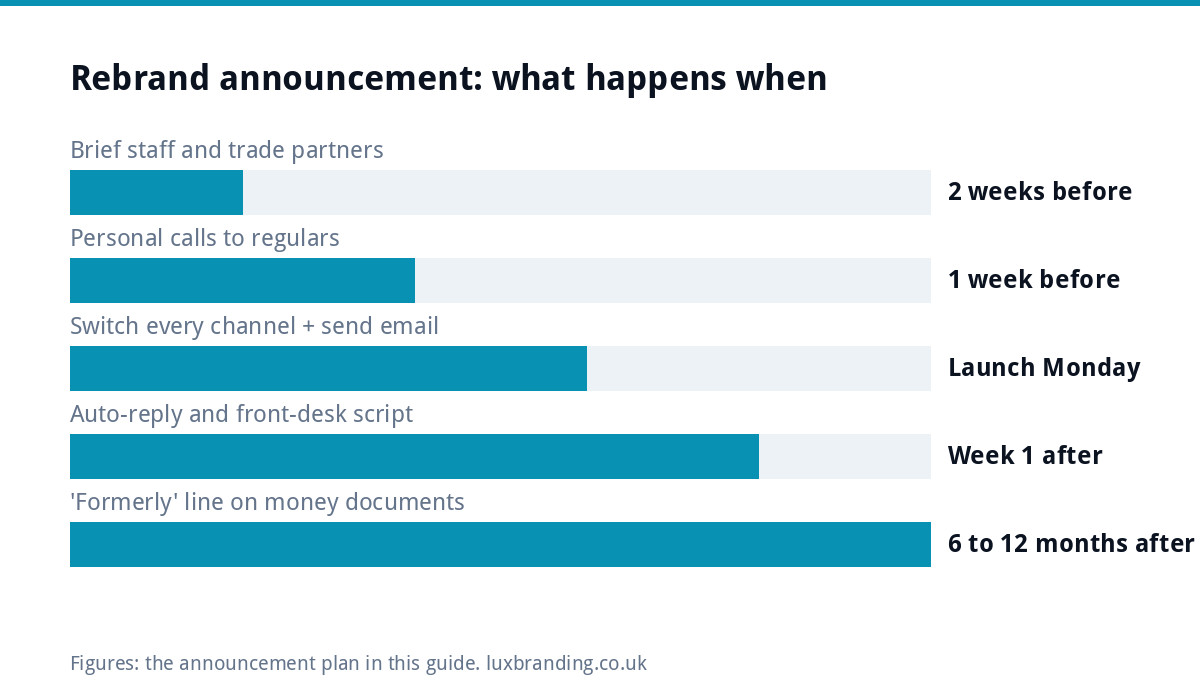
- Two weeks out: staff briefed, email drafted, social images ready, “formerly” line added to templates.
- One week out: personal calls and texts to regulars, trade partners told.
- Launch Monday, 8am to 10am: website live, Google profile edited, directories and socials updated, email signatures switched.
- Launch Monday, mid-morning: announcement email sent, social posts pinned.
- Week one: auto-reply with the three answers, front-desk script in use, watch reviews and messages for confusion.
- Months one to twelve: “formerly” line stays on money documents; drop it when nobody has asked in three months.
The whole rebrand timeline, with the announcement slotted into launch week, is in how long a rebrand takes. If the new identity itself is still to be designed, a complete rebrand package covers the new logo and identity, stationery, a premium website of up to 14 pages, a social media refresh, Google Business Profile setup and vehicle and signage design on one timeline, and the price list has every fixed price.
Get the UK Branding Budget Worksheet (free)
A printable worksheet: decide what your brand needs now and price it against fixed published prices and the IPO trademark fee.
No spam. UK GDPR compliant. We only use your email to send this resource, unless you tick the box to hear from us.
Frequently asked questions
How do I tell customers about a rebrand? +
Warn your best customers personally a week before, switch every channel on one launch day, send one short email that says what changed and what has not, and keep a 'formerly known as' line on quotes and invoices for six to twelve months.
What should a rebrand announcement email say? +
Lead with reassurance: same team, same phone number, same prices. Give one honest sentence on why, say what changes for them (invoice name, email address), state plainly that bank details have not changed, and sign it with a named person.
Will customers think a new business name is a scam? +
Some will, especially on invoices. Prevent it by announcing before they see it, keeping the old name visible on money documents, and never changing payment details in the same message.
Should I announce a rebrand on social media? +
Yes, once per platform on launch day with the old and new logos side by side, then pin it. Avoid teaser campaigns; customers want reassurance, not suspense.
How long should I keep the old business name visible? +
Six to twelve months on quotes, invoices, the website footer and email signatures. Drop it when nobody has asked about it for three months.


