
Quick answer
Below are two copy-paste price list templates (one for trades, one for salons and beauty) plus the from-price rules that let you publish rates like a £45 call-out or a £38 cut and finish without trapping yourself. Publishing prices is the highest-leverage page most small businesses refuse to build: it filters out the callers who were never going to pay your rate, and it wins the two-tab comparison against every competitor still hiding behind “call for a quote”. Cost of doing it: an hour with these templates. Fill them in honestly and the page earns from the day it goes live.
Why the silent majority is wrong about this
The standard objections: competitors will undercut me, every job is different, prices scare people away. In order: your serious competitors already know your rates within £10 (customers tell them); “every job is different” is what from-prices and ranges are FOR; and the customer scared off by your real price was a cost, not a prospect, because you were going to spend an evening quoting them anyway before losing them at the same number. Meanwhile the customer you want (busy, solvent, comparison-shopping three tabs at 9pm) books the business that answered the money question without a phone call. We wrote the vertical evidence into our trade guides: the plumber and salon playbooks both name the published price list as a conversion lever, and this template is that section made copy-paste-able. Regulator-side, the direction of travel is the same: UK advertising rules expect quoted prices to be honest about what is and is not included, per the CAP Code’s pricing provisions, and a well-written list satisfies that by design.
The trades price list template (copy, then fill)
| Item | Price | Notes |
|---|---|---|
| Call-out (first hour, local) | £45 | Includes diagnosis; deducted from the job if we do the work |
| Hourly rate thereafter | £38/hr | Billed in half-hours |
| Day rate | £280 | Booked jobs over 6 hours |
| [Common job 1, e.g. tap replacement] | from £75 | Plus parts at cost; typical total £90-£130 |
| [Common job 2] | from £120 | Exact price confirmed after seeing the job |
| [Common job 3] | from £180 | Includes materials up to £X |
| Emergency / out of hours | £85 call-out | Evenings, weekends, bank holidays |
Swap the bracketed rows for YOUR ten commonest jobs (pull them from the last three months of invoices, the same exercise the free quote template is built around). Footer lines that do the legal and expectation work: whether prices include VAT (if you are registered, state it either way; the standard rate surprises nobody, hidden VAT surprises everybody), the parts/materials policy, payment terms, and the master sentence: “From-prices reflect the simplest version of each job; your exact price is confirmed in writing before work starts.”
The salon and beauty variant
| Treatment | Duration | Price |
|---|---|---|
| Cut and finish | 45 min | £38 |
| Cut, colour and finish | 2 hrs | from £95 |
| Root tint | 75 min | £62 |
| Balayage / colour correction | consultation | from £140, patch test required |
| Blow dry | 30 min | £28 |
| [Treatment row: gels, brows, lashes…] | … | … |
Salon-specific rules: show durations (clients book time as much as treatments), name your senior/junior stylist tiers if you price them differently rather than leaving the gap to be discovered at the till, state the patch-test policy on colour rows, and put the deposit/no-show policy in the footer where it reads as housekeeping rather than accusation. This list doubles as your booking-system service menu, so keeping one master version synchronised matters twice.
The from-price rules (so honesty never traps you)
A from-price is a floor, not a promise, but only if you write it properly. The rules: set it at the genuine minimum for the simplest real version of the job (a fake-low £20 from-price is bait, reads as bait, and falls foul of the advertising rules above); pair every from-price with a typical range in the notes column, which manages expectations better than the floor alone; date nothing (a “2024 price list” still live in 2026 is a complaint generator); and repeat the master sentence anywhere the list appears. When costs rise, change the list the same day everywhere it lives: site, profile, counter, PDF. Price drift between your website and your invoice is the fastest trust-burner in local business, which is why our own price list carries its last-reviewed date and matches the checkout to the penny; it is the same discipline at a different scale.
Where to publish, by situation
Established trade, steady book: the list goes on your website as text (a page or a section, never a PDF-only, so phone users and Google can read it) plus from-prices in your Business Profile services section. New business, building trust: publish everything; transparency is the challenger’s best weapon against incumbents who quote high on discovery calls. Salon or clinic: full list online, printed version at the counter, and the booking system’s menu kept identical to both. Genuinely bespoke work (design, building projects, anything scoped): publish the STRUCTURE instead: call-out or consultation fee, day rate, and worked example ranges (“kitchen refits typically £4,000-£9,000”), which answers the budget question without pretending jobs are identical. Whatever the situation, the test is the same: can a stranger reach a rough number for their job in under a minute on your site? If yes, you outrank every silent rival in the only ranking that matters at 9pm.
The five mistakes that undo a good price list
The stale list. Prices rose in January; the website still says 2024. Every customer who catches the drift at invoice time becomes a complaint, and the fix is a diary rule: any price change propagates to every published copy the same day, no exceptions. The image-only list. A photographed A4 sheet or Canva JPEG cannot be read by Google, screen readers or half of phone users; the list lives as text on the page, with the pretty version as a bonus, never the only copy. The fantasy floor. A from-price nobody has ever actually paid is bait, and readers smell it; anchor every floor to a job you genuinely did at that number this year. The hidden asterisk. VAT added silently at invoice, materials “extra” without warning, weekend surcharges nobody mentioned: each is a trust invoice that costs more than the margin it hid. State the rules in the footer once, plainly. The orphaned list. A beautiful pricing page no other page links to earns nothing; link it from the homepage, every service page, your Business Profile and your quote emails, because a price list is a destination customers actively hunt for, and internal links are how they and Google find it. Avoid those five and the humble table above quietly becomes one of the hardest-working pages on the site.
Worked example, and the designed version
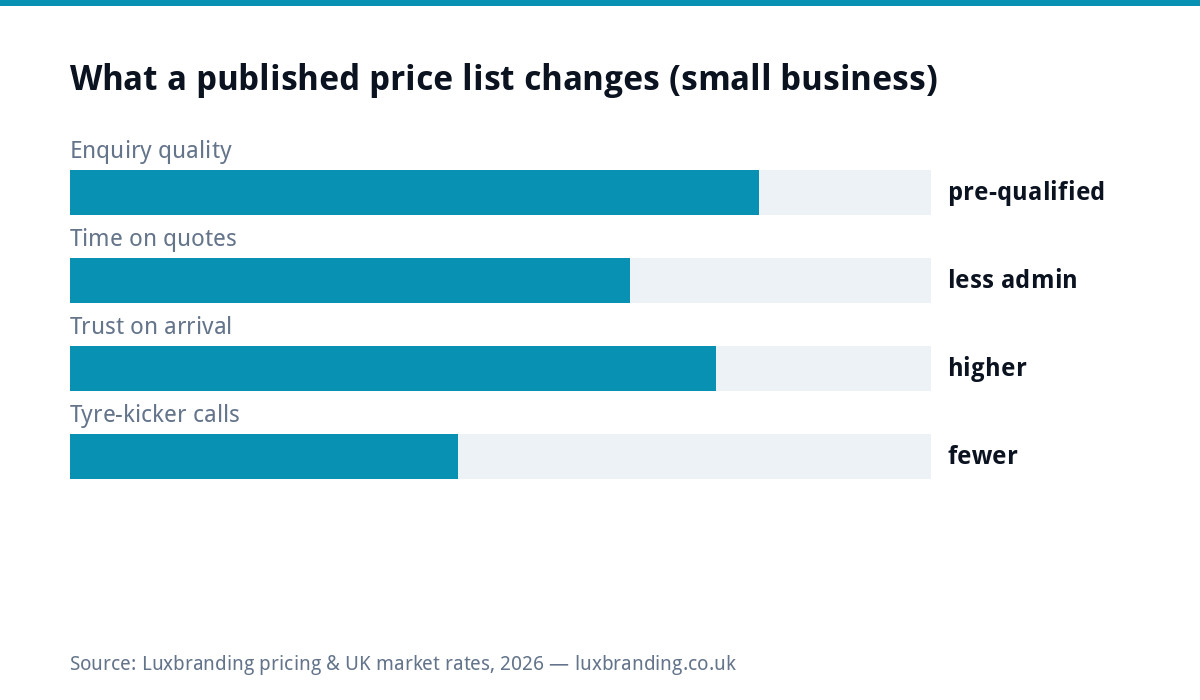
Composite: an electrician publishes the trades template with nine from-priced jobs. The next month’s enquiries drop slightly in number and jump in quality: fewer “how much just roughly” calls, more “can you do the £from-£120 consumer unit check next week” bookings, and the quoting evening shrinks because callers arrive pre-anchored. One competitor grumbles; two copy him within the quarter, which is the sincerest market research. The list itself took 50 minutes against last quarter’s invoices. When you outgrow the copy-paste version: a designed price list (matching your brand, print-ready for counters and van packs) falls under standard print design, £49-£89 depending on format, alongside the flyer design service it usually accompanies, and if the brand it needs to match does not exist yet, that is a different, earlier conversation. Either way: publish the honest text version TODAY; design is a coat of paint on a decision, and the decision is the part that earns.
Get the UK Print-Ready Artwork Checklist (free)
A one-page checklist for any UK designer or printer covering CMYK, bleed, fonts and resolution. Saves you the pre-press fix-up fees.
No spam. UK GDPR compliant. We only use your email to send this resource, unless you tick the box to hear from us.
Frequently asked questions
Should a small business publish its prices? +
For most trades and salons, yes. Published prices pre-qualify enquiries (people who cannot afford you stop calling), build trust before contact, and win the comparison against silent rivals. The exceptions are genuinely bespoke services where every job is scoped, and even those can publish from-prices.
What should a trades price list include? +
Call-out fee, hourly or day rate, from-prices for your ten commonest jobs, what is included (materials or not, VAT status), and payment terms. Ranges and from-prices are fine; the goal is honest expectation-setting, not a binding quote.
How do I write from-prices without underquoting myself? +
Set each from-price at the genuine minimum for the simplest version of that job, then add the one line that protects you: "exact price confirmed after seeing the job". A from-price is an entry ticket, not a ceiling; the site quote remains the contract.
Where should I publish my price list? +
As text on your website (never only a PDF or image, so Google and phone users can read it), on your Google Business Profile where relevant, printed at the counter for salons, and in quote follow-ups. One master version, updated everywhere on the same day prices change.
Do published prices put customers off? +
They put the WRONG customers off, which is the point. The customer who leaves at the sight of your £45 call-out was never paying it; the one who stays arrives pre-sold. Hiding prices mostly delays the same conversation to a costlier moment: after you have driven out.