
Quick answer
Seeing your logo on a competitor’s van is enraging, so here is the calm version: document first, escalate second, shout never. The ladder runs: evidence pack (free, today), firm polite letter (free, settles most incidents), platform takedowns (free), solicitor’s letter (£150-£500), and formal IPO or court routes for the rare stubborn case. What you can demand depends on what you actually own, so this guide starts there, and it ends with the prevention step this incident is probably talking you into: registering the trademark.
The first hour: build the evidence pack
Before any contact, capture the situation as it stands, because copied logos have a habit of quietly changing once letters arrive. Screenshot their website, social profiles and marketplace listings with visible dates and URLs. Save an archive copy via the Wayback Machine so a neutral third party holds the timestamp. Photograph physical uses: vans, signage, flyers. Then assemble YOUR side of the timeline: when your logo was designed, the designer’s invoice, files with creation dates, first public uses (the same archive helps here too). The whole pack is an hour’s work, costs nothing, and is the difference between “they said, we said” and a case. Do it before the adrenaline talks you into emailing them.
What you actually own (this decides everything)
Copyright arises automatically in an original logo design, no registration needed, as gov.uk explains. The catch that determines whether it is YOURS: the designer owns it by default until assigned in writing. If your logo came with proper copyright assignment (ours do; many cheap sources do not), you own the design itself. The full detail lives in our logo copyright and trademark guide. A registered trademark is the heavyweight: registration with the Intellectual Property Office gives you a public, dated, enforceable right that turns disputes from arguments into paperwork. Unregistered rights (passing-off) protect established goodwill: if you have traded under the mark long enough that customers associate it with you, English law can restrain a rival whose imitation misleads them, though proving it is heavier work than waving a registration certificate. Inventory which of the three you hold before choosing your tone.
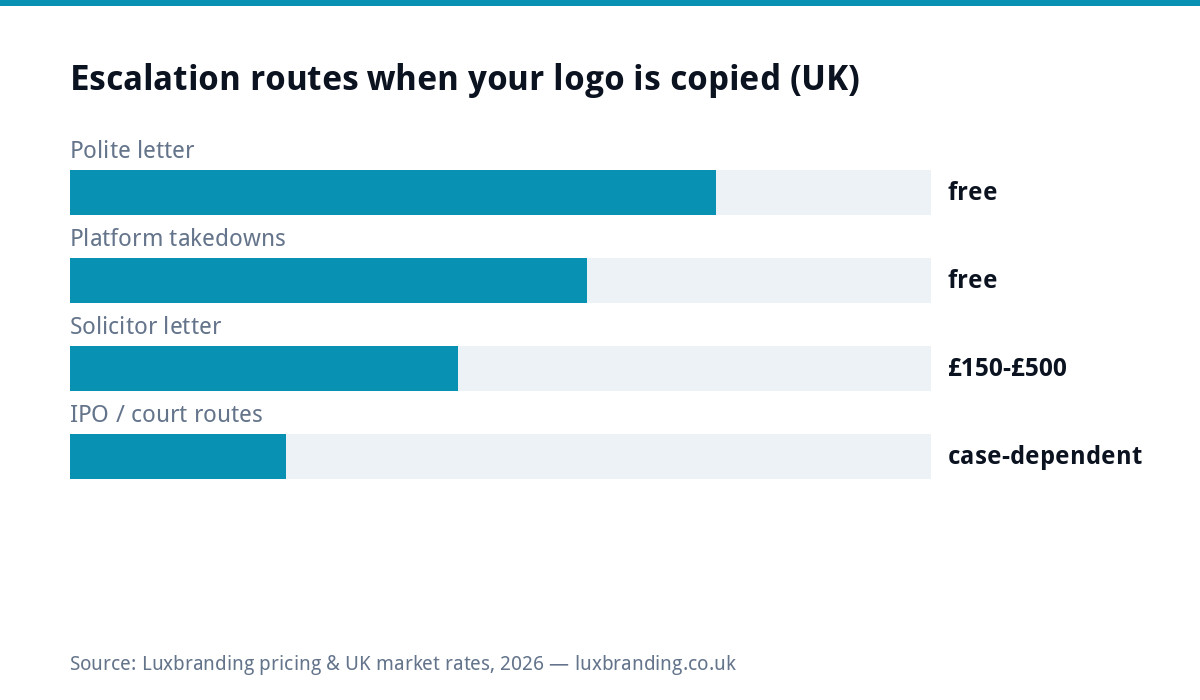
The escalation ladder
| Step | Cost | When | Resolves |
|---|---|---|---|
| Firm polite letter | £0 | Always first | The majority: most copiers fold on contact |
| Platform reports | £0 | Marketplace, social, ad copies | The specific listing or profile |
| Solicitor’s letter | £150-£500 | Ignored or hostile replies | Most of the remainder |
| IPO opposition / invalidation | fees + advice | They try to REGISTER your mark | Their registration attempt |
| Court (IPEC small claims track) | case-dependent | Genuine damages, dug-in infringer | Rare; get advice first |
The letter that settles most of these (template)
Adapt freely; the tone is firm, factual and exit-friendly: “Dear [name], it has been brought to our attention that [business] is using a logo at [locations] which is substantially identical to the logo we have used in trade since [year], in which we own copyright [and/or which is registered trademark no. X]. We assume this arises from your designer rather than any deliberate act. We require that you cease using the mark and remove it from your website, profiles and materials within 14 days, and confirm in writing when done. If we do not hear from you we will escalate, including reports to the relevant platforms and instruction of our solicitors. Enclosed: evidence of our prior use.” The give-them-an-out sentence is load-bearing: most copies really do come via a lazy or larcenous designer, and a face-saving exit gets faster compliance than accusations. Send by email AND recorded post; calm silence beats replying to any bluster.
If a competitor has also copied your website, our guide sets out four routes, most of them free.
Platform takedowns, and the two-sided rules
Copies living on marketplaces, social platforms or search ads have a shortcut: every major platform operates IP-report processes that action clear-cut logo copies without anyone’s solicitor, and your evidence pack slots straight into their forms. File against the specific listings and profiles, cite your registration number if you hold one, attach the dated evidence. Two cautions. First, these forms are declarations with legal weight, so claim only what you own. Second, the machinery is two-sided: bad-faith or overreaching reports rebound, and if you are ever on the RECEIVING end of an accusation (it happens to honest businesses whose cheap logo turned out to be a template someone else also bought), the same evidence-first, calm-letter playbook applies in mirror image, and our trademark objection guide covers the registration-stage version of that fight.
The honesty section: when it is not really a copy
Two logos sharing a concept is not infringement, and this page would be dishonest without saying so. Copyright bites on copied EXPRESSION (your actual drawing), not on ideas: nobody owns leaves for landscapers, roofs for roofers or two initials in a circle. The confusion tests ask whether a real customer would mix the businesses up, and generic concepts executed differently usually clear that bar comfortably. Ask a blunt friend to view both cold: “same company, or just same industry clichés?” If the honest answer is clichés, spend the anger on differentiation instead; a distinctive mark is both better protection and better marketing, which is half the argument in our cheap-vs-expensive teardown. And if your own logo came from a £15 template, the uncomfortable possibility is that the “copy” is the same template, legally bought twice, which is a reason to upgrade the logo, not to write letters.
The nightmare inversion: they registered YOUR mark first
Rarer but real: you have traded under the logo for years, never registered, and the copier (or a squatter) files a trademark application for it. Do not panic and do not concede; the UK system anticipates exactly this. Applications are published before registration, and there is a formal window to oppose; earlier still, you can file observations. Your years of genuine trading are the ammunition: UK law protects established unregistered goodwill through passing-off, bad-faith filings are a ground for refusal and invalidation, and the evidence pack from the first hour of this guide (dated uses, archives, invoices) is precisely what those proceedings want to see. The moves, in order: search the IPO register today to see what exists around your name and mark, set up monitoring so future applications touching your mark alert you, take an hour of professional advice if an application is already live (opposition deadlines are unforgiving, and this corner of the fight genuinely rewards a specialist), and file your own application in parallel, because the fastest way to end an argument about who owns a mark is to become the person who registered it with provable prior use behind them. The costs stay modest at this stage: monitoring is free, IPO fees are fixed and published, and an early opposition is dramatically cheaper than unpicking a granted registration later. The lesson is the same one this whole page keeps arriving at: registration is cheap, disputes are not, and whichever side files first sets the terrain.
Worked example, and the prevention purchase
Composite: a Midlands cleaning firm finds a new rival using its swoosh-and-initials mark in the same teal, same layout, on a leafleted estate. Evidence pack: one evening. Polite letter citing copyright assignment from the original design invoice: sent Tuesday. The rival’s designer, it transpires, “found the logo on Google”; the rival, mortified, swaps it within the fortnight for a paid redesign. Total cost £0, resolved in 16 days. The postscript is the useful part: the firm files its trademark application the same month (IPO fees around £205 for one class), so the next incident, if it comes, is a registration-number letter instead of an evidence essay. That is the general lesson: this article is the expensive version of a problem whose cheap version is own your copyright in writing, register the mark you trade on, keep your files. If your logo’s ownership paperwork is the weak link, a £129 original design with assigned copyright (prices public on the price list) costs less than one solicitor’s letter.
Get the UK Branding Budget Worksheet (free)
A printable worksheet: decide what your brand needs now and price it against fixed published prices and the IPO trademark fee.
No spam. UK GDPR compliant. We only use your email to send this resource, unless you tick the box to hear from us.
Frequently asked questions
What can I do if a competitor copied my logo in the UK? +
Document everything first (screenshots, dates, where it appears), then escalate in order: a firm polite letter resolves most cases, platform takedown reports handle marketplace and social copies, and a solicitor's letter (£150-£500) moves the stubborn ones. Court is the rare last resort.
Is my logo protected if I never registered a trademark? +
Partly. Copyright arises automatically in an original logo design (you must own it via assignment from your designer), and passing-off protects established goodwill. Registration makes enforcement far cheaper and stronger, which is exactly why copying incidents convert so many owners into trademark applicants.
How similar does a logo have to be to count as copying? +
Copyright needs actual copying of your design, not resemblance. Trademark infringement and passing-off turn on confusion: would a customer mix the businesses up? Two logos sharing a generic concept (a leaf, a roof, initials) usually clear that bar; matching your colours, layout and typeface together usually does not.
How much does it cost to stop someone using a copied logo? +
Often £0: evidence plus a firm letter settles the majority, and platform reports are free. A solicitor's letter typically runs £150-£500. Registering your trademark (£205 in IPO fees for one class) is the investment that makes every future incident cheaper.
Should I publicly call out a business that copied my logo? +
No. Public shaming invites defamation risk, hardens the other side, and looks worse than it feels. The quiet route (letter, takedowns, registration) resolves faster and keeps you the reasonable party if it ever reaches a legal forum.