
Quick answer
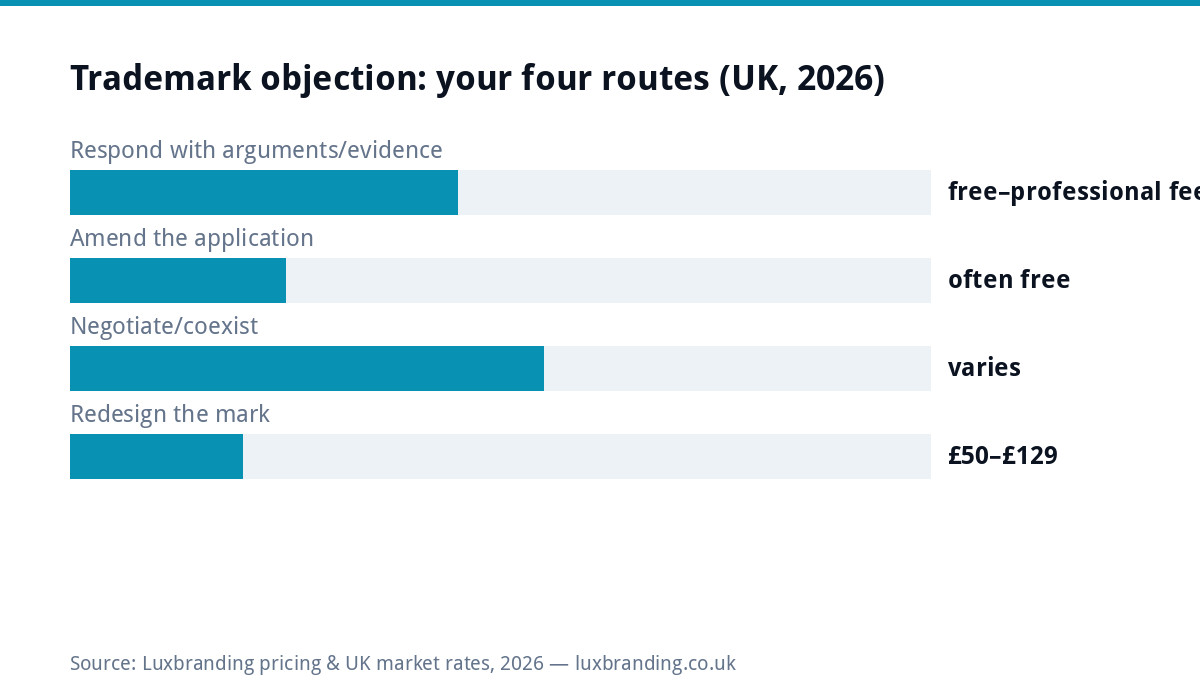
An objection letter is a position, not a verdict, and you have four routes: argue back (respond with evidence and legal argument), amend (narrow the goods/services classes or adjust the application), negotiate (consent and coexistence agreements settle many earlier-mark conflicts), or redesign the mark, which at £50 to £129 is frequently the cheapest exit when the honest problem is that the logo was never distinctive enough to register. Which route fits depends on which objection you got, so that is where this guide starts. (General information, not legal advice; trademark disputes with real money attached deserve a professional.)
First, read what you actually received
Two different documents get called “an objection”, and they route differently. An examiner’s objection arrives during examination from the IPO itself, most commonly under the absolute grounds: the mark is descriptive (“LONDON PLUMBING SERVICES” describes rather than distinguishes), too generic, or otherwise non-distinctive; the examiner may also notify you of earlier similar marks. An opposition arrives after your application is published, from another business claiming your mark conflicts with theirs, and it opens a dispute process where negotiation and settlement are common outcomes. The gov.uk trademark guidance maps the stages; your letter names its deadline, and the deadline is the one thing on the page that is not negotiable by mood.
The four routes, honestly costed
| Route | When it fits | What it costs |
|---|---|---|
| 1. Respond and argue | Descriptiveness objections where you have evidence of acquired distinctiveness, or the examiner’s reading is genuinely arguable | Free DIY; attorney responses at their quoted fees |
| 2. Amend | Conflicts confined to particular classes or wording you can narrow without losing what matters | Often free; strategic narrowing is attorney territory when stakes are real |
| 3. Negotiate/coexist | Earlier-mark conflicts where both businesses can live side by side (different sectors, geographies, forms of the mark) | Varies with lawyers involved; frequently cheaper than fighting |
| 4. Redesign the mark | The mark was never distinctive, or the fight costs more than the logo is worth | £50 edit to £129 full redesign, plus reprint reality below |
Route 4 deserves its honest hearing (the £129 exit)
Nobody who just paid application fees wants to hear it, but run the arithmetic before the sunk-cost reflex does: an attorney-drafted response with uncertain odds versus a £129 redesign that produces a MORE distinctive mark, refiles clean, and upgrades the brand it protects. Redesign fits three situations especially: descriptiveness objections where the mark really is just the trade plus the town in a font; generator-built logos assembled from shared icon libraries, whose weak distinctiveness this outcome was always latent in (the trade-off our generator-vs-designer comparison prices); and early-stage businesses whose rebrand cost is a reprint, not an identity crisis. Where only an element offends (a too-common icon beside a distinctive name), a £50 logo edit can swap the weak element and preserve the equity. Registration exists to protect an asset; when the fight costs more than a better asset would, buy the better asset.
If you argue: what actually persuades
DIY responses succeed most often on descriptiveness lines where you can show the mark has come to identify YOU: evidence of use (dated examples across years: invoices, advertising, signage, press), turnover under the mark, and how long the badge has been on vans and shopfronts. Assertions persuade nobody; dated exhibits do. For earlier-mark citations, the workable arguments live in the differences: sector, customers, look and sound of the marks, the classes claimed. Be realistic about the tier of the fight: a form response to an examiner is one thing; an opposition from a funded brand with attorneys is a dispute, and the register search you run today tells you who you are actually up against before pride writes a cheque.
Timelines and the business meanwhile
Expect months, not weeks: response windows, examiner reconsideration, and opposition procedures each add their own clock. The operational question is what to do with the brand meanwhile, and the answer is mostly “carry on”: an objection does not ban use, unregistered marks retain some passing-off protection, and pausing your marketing for a registry process is self-harm. The exception worth taking advice on is a conflict objection that revealed a real, similar, registered competitor; continued heavy investment in a mark you may have to retreat from is the scenario where the redesign route’s certainty starts beating the argument route’s odds. Whatever you choose, calendar the deadline the day the letter arrives; more applications die of diary than of merit.
What the process costs, benchmarked
The published baseline: a UK application starts at £205 for one class with additional classes at £60 each, per the IPO’s fee schedule, so a refile after a redesign is a modest cost rather than a catastrophe. Professional help prices by tier: attorney-drafted objection responses and oppositions run from hundreds into four figures as disputes escalate, which is exactly the arithmetic that makes route four honest: when the projected fight exceeds the £129 redesign plus a £205 refile, the fight needs a reason beyond pride, such as years of trading equity in the mark. Businesses with real equity should spend on the fight; businesses eighteen months in usually should not, and the register’s own search tool is free either way.
Worked example: the descriptive-mark exit
Composite: a cleaning company applies to register a wordmark that is essentially SPARKLE CLEANING [TOWN] in a nice font, and the examiner objects on distinctiveness, correctly, since the mark describes the service and the place. Options one to three all fight physics: no evidence of acquired distinctiveness exists at two years’ trading, there is nothing to amend toward, nobody to negotiate with. Route four resolves it in a fortnight: a £129 redesign produces a distinctive mark (an invented word-plus-symbol lockup the business had half-wanted anyway), the refile sails through examination, and the van reprint doubles as the refresh the brand needed. The lesson to carry: the objection was information, arriving late, that the original mark was built to describe rather than to distinguish, which is a design decision every future brand can make correctly on day one for the same £129.
Prevention, for the next mark (or the refile)
The whole page compresses into pre-flight habits: search first, the register and the obvious app stores and domains, before attachment forms; design for distinctiveness, since invented and arbitrary marks register easily while descriptive ones fight for their lives, which is a design-brief instruction as much as a legal one and exactly what a professional process bakes in from the start; specify classes accurately, claiming what you genuinely trade in rather than everything imaginable; and keep the ownership paperwork clean, because registration in the wrong name is its own future dispute, per our copyright and trademark guide. A distinctive mark with a clean search behind it sails through examination; this page exists for everyone who learned that in the second-cheapest way, and the price list covers the design half of the fix.
Keep the summary honest: read which document you actually received, calendar the deadline the same day, price the fight against the £129 redesign before pride chooses, and let the register search you should have run first be the one you definitely run next time.
Get the UK Branding Budget Worksheet (free)
A printable worksheet: decide what your brand needs now and price it against fixed published prices and the IPO trademark fee.
No spam. UK GDPR compliant. We only use your email to send this resource, unless you tick the box to hear from us.
Frequently asked questions
What does a trademark objection mean in the UK? +
During examination the IPO can object, most commonly that your mark is too descriptive or not distinctive enough, or flag earlier similar marks. An objection is the examiner's position, not a final verdict: you can respond, amend, or rethink, within the deadline the letter sets.
What is the difference between an objection and an opposition? +
An objection comes from the IPO's examiner during examination. An opposition comes from another business after your application is published, arguing your mark conflicts with theirs. Objections are argued with the examiner; oppositions are a dispute with the opponent, with settlement common.
How much does it cost to deal with a trademark objection? +
Responding yourself costs nothing beyond time; trademark attorneys quote fixed or hourly fees for responses and negotiations. Amending classes is often free. If the honest answer is the mark was never distinctive, a £50 logo edit or £129 redesign is frequently the cheapest exit.
Can I keep using my logo if my trademark application fails? +
Usually yes: registration failure does not itself ban use, and unregistered marks have some passing-off protection. The exception is where the objection revealed a real conflict with someone else's registered mark, where continued use carries infringement risk worth taking advice on.
How do I avoid objections before applying? +
Search the register before you apply and before you fall in love with a name or mark, design for distinctiveness (invented and arbitrary beats descriptive; generator logos built from shared libraries start weak), and specify classes accurately. Ten minutes of searching prevents most of this page.