
Quick answer
The honest version first: the purchase was a mistake, but a recoverable one, and the cheapest recovery is the one where you never press send. UK law (PECR) requires consent for marketing email to individuals, and a broker’s consent does not meaningfully transfer to you; practically, sold lists are salted with dead addresses and spam traps that poison your domain’s reputation for months. The five steps below cover both the not-sent-yet and the already-sent cases, and the rebuild route costs between £0 and £149, which is less than the list did.
Why it seemed sensible (forgive yourself, then delete it)
The pitch is seductive arithmetic: 50,000 “targeted UK contacts” for less than a decent ad budget, when your own list holds ninety addresses. Every small business meets this temptation the month it discovers email’s returns, because the channel’s economics really are excellent, on one condition the brokers never mention: the economics belong to PERMISSION. Email earns because the recipient chose you; strip the choosing and the same channel becomes cold-calling with a paper trail. The list was an attempt to buy the harvest without planting; the rest of this page is about not salting the field on the way out.
The legal reality, in plain English
Two regimes apply. PECR governs the act of sending electronic marketing: to individuals (including sole traders and most consumers) you need their consent, and “they consented to a broker’s partner list in 2021” is the kind of consent the ICO’s direct-marketing guidance exists to demolish. UK GDPR governs holding the data at all: you need a lawful basis, transparency about where you got it, and answers when someone asks. The corporate-email corner (mail to role and business addresses at companies) has more latitude, which is the grain of truth brokers stretch into a licence; even there, honesty, relevance and easy opt-out are required, and fines for unlawful marketing are a routine item in the ICO’s enforcement listings. None of this is legal advice; all of it is the reason the safe path smells like the delete key.
The deliverability poison (why senders lose even when nobody sues)
The practical punishment arrives faster than the legal one. Sold lists are old, recycled and, crucially, seeded: they contain spam traps, addresses that exist purely to catch senders using bought data, and hitting them flags your domain to the blocklist ecosystem. Add the organic disaster (recipients who never heard of you smashing “report spam”, double-digit bounce rates from dead addresses) and your domain’s sending reputation, the thing that decides whether ANY of your email reaches inboxes, takes damage that outlasts the campaign by months. The bitter irony: businesses discover their invoices and quotes landing in junk because a marketing blast last spring taught the filters to distrust the domain. All the authentication work in the world cannot outvote behaviour; SPF and DKIM prove who you are, and the bought list then proves who you are is a spammer.
The five steps
| Step | Not sent yet | Already sent |
|---|---|---|
| 1. Stop | Never load it into your sending tool | Halt all campaigns now, including to your real list |
| 2. Quarantine | Delete the file (and the temptation) | Purge bought addresses from the tool entirely; never mix them with consented contacts |
| 3. Assess | Nothing to assess: you dodged it | Check bounce and complaint rates from the send, and run your domain through public blocklist lookups |
| 4. Cool down | Not needed | Days to weeks of minimal sending; resume gently with your most-engaged genuine subscribers first |
| 5. Rebuild right | Channel the same appetite into consented capture (next section); the energy was correct, only the shortcut was wrong | |
Rebuilding: the list that actually earns
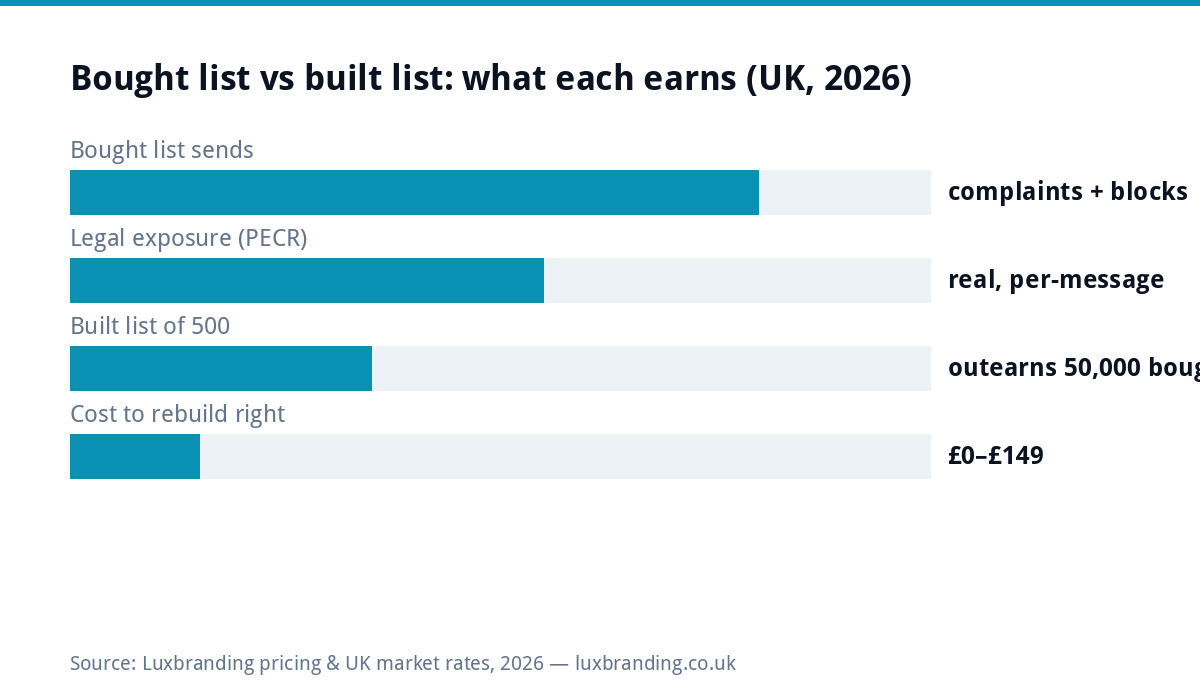
The consolation is genuine: permission lists are easier to build than the broker economy implies, and they monetise absurdly better. The capture stack for a small business: a website signup with a real incentive (a useful guide, a first-order code, the template-style artifacts this blog itself uses), capture at the natural moments (job completion, till, quote follow-up), and a welcome email that lands while the interest is warm. Five hundred people who chose you will out-open, out-click and out-buy fifty thousand who did not, at zero legal risk and with deliverability that improves rather than degrades. Our small-business email guide covers the cadence, and the £149 setup service wires the capture, welcome flow and compliance in one pass, which costs less than most brokers’ minimum order.
The provider problem (your sending tool has rules too)
Beyond law and deliverability sits a third enforcement layer nobody warns buyers about: your email platform’s own terms. Mainstream sending tools prohibit purchased lists outright, monitor the complaint and bounce signatures bought data produces, and suspend accounts that trip them, taking your legitimate list and scheduled campaigns hostage mid-suspension. The platforms are not moralising; complaint rates above fractions of a percent damage THEIR shared sending infrastructure, so they cut fast. Practical consequences: never import the bought file “just to store it” (imports are what get scanned), and if a send already triggered warnings, engage the platform’s support honestly about cleanup rather than hoping, because the account’s history follows you and a suspension email is how most buyers discover this entire page’s subject the hard way.
Worked recovery: ninety days from the mistake
Composite timeline of a clean recovery. Week one: sends stopped, bought file purged, blocklist lookups run (one listing found), domain authentication verified per the email setup guide. Weeks two to four: near-silence, then gentle sends to the fifty most-engaged genuine subscribers only, rebuilding the positive signals inboxes actually read. Month two: website capture live with a real incentive, the till-and-job-completion asks running, list growing by forties monthly, every address consented and dated. Month three: deliverability normal, the built list’s open rates embarrassing the bought list’s projections, and the £149 automation doing the welcome-and-nurture work. Total cost of recovery: patience plus at most £149; total cost of the shortcut it replaces: this paragraph.
The prospecting question (what the appetite was really for)
Often the bought list was standing in for a legitimate need: reaching businesses who have never heard of you. That job has honest tools: researched, individual, relevant business-to-business outreach (prospecting, not blasting), partnerships and referrals, and the inbound engine, being findable when the buyer searches, which is what this site’s whole visibility playbook exists for. Each converts a fraction differently, but all of them compound, none of them torch your domain, and none arrives with a broker’s invoice attached to a legal caveat. The bought list was a symptom; the growth appetite behind it deserves better machinery, and every piece of that machinery is priced publicly on the price list.
The one-line version to keep: lists are grown, never bought; the law, the inbox filters and your own sending platform all enforce the same rule from different directions, and the £149 capture-and-welcome setup costs less than most brokers’ minimum order while building the only kind of list that ever earned anyone a penny.
Get the UK SEO DIY Audit Checklist (free)
A 32-point checklist UK SMEs can run against their own website in an afternoon. Surfaces the quick wins before paying for a paid audit.
No spam. UK GDPR compliant. We only use your email to send this resource, unless you tick the box to hear from us.
Frequently asked questions
Is it illegal to buy an email list in the UK? +
Buying is not the offence; SENDING to it usually is. PECR requires consent for electronic marketing to individuals, consent given to a list broker does not transfer to you in any meaningful way, and the ICO can and does fine unlawful marketing senders. The narrow business-to-business corporate email space has more room, but far less than brokers imply.
What happens if I email a bought list? +
Practically: high spam-complaint rates, hits on spam-trap addresses seeded into sold lists, blocklisting, and lasting damage to your domain's sending reputation, which then hurts delivery of your legitimate email too. Legally: PECR exposure per unlawful message. The list poisons the well it was meant to fill.
I already sent to a bought list. What do I do now? +
Stop all sends immediately, quarantine the list away from your real subscribers, check your domain's standing (bounce and complaint rates, blocklist lookups), and let your sending cool down before slowly resuming to genuinely consented contacts only. Do not "clean and retry" the bought data.
Can I use a bought list for anything at all? +
Delete it is the safe answer. The only defensible corner is narrow, researched business-to-business outreach to corporate addresses, individually relevant, honest and with easy opt-out, which is prospecting, not list-blasting, and even that carries risk the broker's marketing never mentions.
How do I build an email list legally from zero? +
Capture consent on your website (a genuine incentive, a clear tick, records kept), at the till or job completion, and through lead magnets. Five hundred people who chose you outearn fifty thousand who never heard of you, in revenue as well as deliverability.