
Quick answer
You can audit an SEO agency in about an hour, without their cooperation, because real SEO leaves fingerprints: Search Console history shows whether visibility moved, the site itself shows whether anything changed, and a written deliverables request shows whether they can name what the invoices bought. The verdicts sort into three: genuine work needing more time (it happens), passive retainer-farming (the common one), or actively harmful work (rarer, worse). Each has a different next move, and all three end with you holding your own logins, which is where this guide finishes.
First, the fair test: what “working” looks like at each stage
SEO’s slowness is real, which is what bad agencies hide behind, so calibrate before judging. Months one to three of honest work produce visible ACTIVITY (technical fixes, improved pages, new content) and early leading indicators: impressions curving up in Search Console, more queries appearing, new pages indexing. Months three to nine produce the lagging results: clicks, positions, enquiries. The damning pattern is not “no clicks yet”; it is no leading indicators and no visible activity while invoices flow. Our own SEO pricing guide sets out the same timeline from the buying side; agencies that quoted it honestly deserve the patience they asked for, and agencies that promised page one by month two set the standard they should now be judged against.
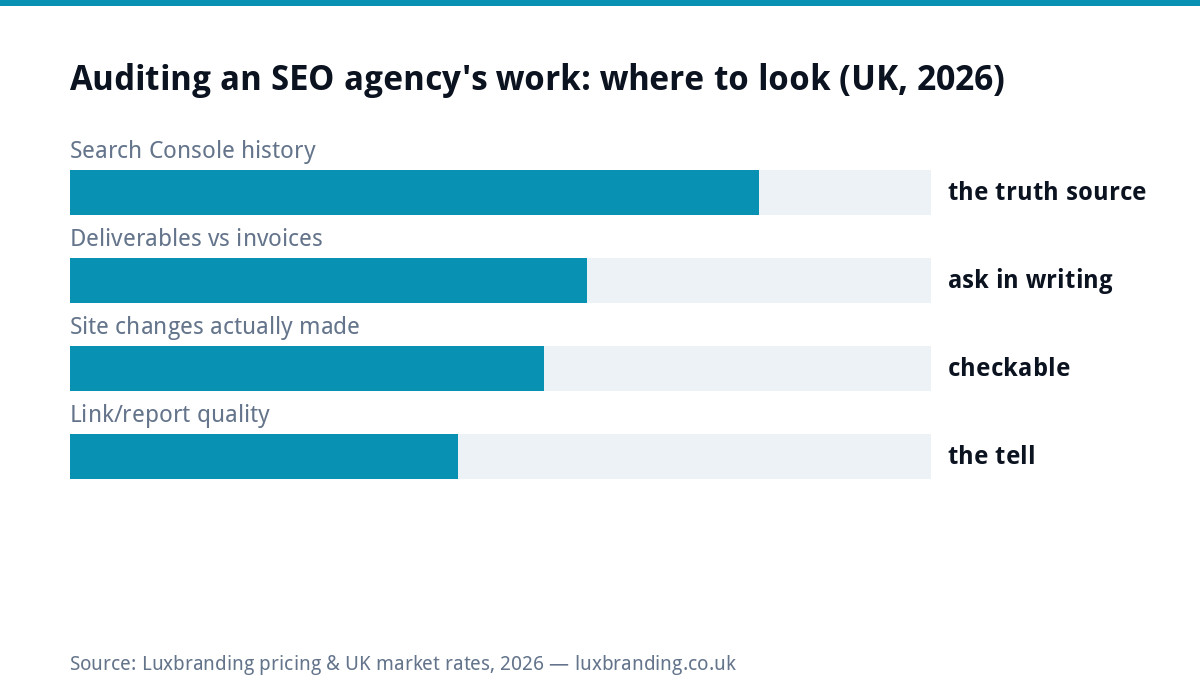
The one-hour audit, step by step
| Check | How | What it proves |
|---|---|---|
| Search Console trends | Performance report, 12 to 16 months: impressions, clicks, query count. Pages report: indexing trend | Whether visibility moved at all; the graph does not attend meetings |
| Visible site changes | Compare key pages against Wayback Machine captures from contract start: titles, content, new pages | Whether anything was actually done on-site |
| The deliverables letter | One written request: “itemise the work delivered each month against each invoice” | Whether they can name what you bought; vagueness here is the verdict |
| Report autopsy | Reread their reports: do they show business metrics (clicks, enquiries) or only rankings for terms nobody searches? | Ranking-report theatre is the industry’s oldest cover |
| Link check | Ask for the list of links built; spot-check the linking sites for quality | Whether “link building” was real outreach or a penalty risk purchased in your name |
Reading the verdict: patience, passivity, or poison
Patience case: visible work, leading indicators moving, honest timeline given at signup. Stay, but convert the relationship to measurable reporting (see below). Passivity case, the most common finding: a setup flurry in month one, then automated ranking reports and invoice-farming, with the deliverables letter answered in adjectives. Exit cleanly; every further month buys nothing. Poison case: the link check surfaces bulk directory spam, foreign-forum links or link networks, or the site sprouted thin doorway pages you never approved. This needs an exit PLUS a cleanup assessment, because Google’s spam policies attach consequences to the site, not the vendor, and you keep what was built in your name. Poison is rarer than passivity, but it is why the audit checks links even when the instinct is just to leave quietly.
The conversation before the exit (one meeting, one agenda)
Where the audit reads passive rather than poisonous, one structured meeting is worth holding before notice, if only because switching costs are real and some agencies genuinely improve under a client who starts measuring. The agenda is three items, sent in advance: the Search Console trends on screen (theirs to explain), the deliverables list against the last quarter’s invoices (theirs to complete), and the go-forward terms (monthly itemised work, business-metric reporting, your account ownership confirmed). The response tells you everything: an agency that engages specifically has just become worth ninety more days on probation; one that answers with slideware about “domain authority trends” and “the algorithm” has confirmed the audit. Either way you leave the meeting with a decision made by evidence, which beats both loyal drift and angry impulse.
What it should have cost (calibrate before rebuying)
Part of the sting is not knowing what the money should have bought, so anchor it: UK small-business SEO runs £249 to £600/month at the honest end for genuine monthly work (strategy, content, technical upkeep, links earned rather than bought), with our own £249/month service at the flat-fee end of that band and agency retainers climbing with scope. Below roughly £200/month, full-service promises are arithmetic fiction (nobody does strategy, content and outreach for three hours of billable time), which is how the passive-retainer model survives: it prices where real work is impossible and hopes nobody audits. The band also explains why “we do it all for £99” outfits cluster at the bottom of every horror thread: at that price the only deliverable that scales is the invoice. Pay for hours that can exist, then verify they happened; both halves are the lesson. The corrected budget question is not “cheaper next time” but “verifiable next time”, and the one-hour audit you just ran is now your standing quarterly habit with any provider, including us.
The clean exit (assets first, notice second)
Order matters, because a minority of agencies hold assets hostage. Before serving notice: confirm you have owner-level access to Search Console, Analytics and the website itself in YOUR accounts (the same un-hostage-able rule as our developer-recovery guide); request the handover pack in writing (work done, content created, links built, any credentials they hold); then serve notice per the contract’s terms, in writing, without relitigating the relationship. Legitimate agencies hand over without drama. If access is suddenly difficult or the handover evaporates, you have confirmation rather than a dilemma, and the recovery routes (host verification, platform account recovery) are the developer-guide’s territory. Rankings, to repeat the reassurance, live on your site and your domain: leaving a bad agency risks nothing that was real.
Buying it better next time (the contract that prevents the sequel)
The audit’s findings write your next agreement, whoever it is with. Demand in writing: monthly itemised deliverables (what was done, where, links listed), YOUR ownership of all accounts with the agency as invited user, reporting on business metrics (clicks, enquiries, calls) rather than vanity rankings, no guarantees (honest vendors refuse to promise Google’s decisions), and a notice period measured in weeks not quarters. Then judge on the same leading-indicator timeline you now know: activity immediately, impressions by month three, money metrics building from there. That is exactly the shape of reporting our own £249/month SEO service commits to, and the standard any competent provider meets without being asked twice. If the budget needs a breather first, the free layer (a worked Business Profile, the self-serve audit) keeps the lights on while trust rebuilds; every paid price is public on the price list.
The closing discipline: run the one-hour audit quarterly on every SEO relationship you ever hold, ours included, because the habit that catches a bad agency in month four instead of month fourteen is worth more than any refund, and the provider who welcomes the audit is the one who was doing the work all along. Verifiable beats cheap, leading indicators beat promises, and your own Search Console login beats every report ever formatted.
Get the UK SEO DIY Audit Checklist (free)
A 32-point checklist UK SMEs can run against their own website in an afternoon. Surfaces the quick wins before paying for a paid audit.
No spam. UK GDPR compliant. We only use your email to send this resource, unless you tick the box to hear from us.
Frequently asked questions
How do I check what my SEO agency has actually done? +
Three verifiable places: Search Console history (impressions, clicks and indexing trends do not lie), the site itself (changed titles, new or improved pages, technical fixes are all visible), and a written deliverables request listing what was done each month against the invoices. An hour tells you most of the story.
How long should SEO take before I see results? +
Honest SEO shows leading indicators (impressions growing, new pages indexing, more queries appearing) within two to three months, and meaningful clicks in competitive markets within four to nine. Zero movement in ANY indicator after four months of invoices deserves the audit, not more patience.
What are the red flags of a bad SEO agency? +
Reports that show only rankings for obscure terms nobody searches, refusal to say what was actually done, no access for you to Search Console, "proprietary techniques" secrecy, guaranteed rankings, and link-building they will not itemise, which risks Google penalties you inherit.
Can bad SEO work actually harm my website? +
Yes: spammy purchased links, doorway pages and stuffed content violate Google's spam policies and can suppress the site. Part of the exit audit is checking what was built in your name, because you keep the consequences after the agency is gone.
How do I leave an SEO agency without losing my rankings? +
Rankings belong to the site, not the agency; leaving does not undo legitimate work. Before notice: secure your own access to Search Console, Analytics and the site; request a handover of work done and links built; then serve the contract's notice. Anything held hostage was a red flag confirmed.