
Quick answer
A launch that made things worse has a short list of usual suspects, and they are checkable in one focused day: old URLs dying without redirects (the classic, and the redirect audit below finds it), indexing accidentally blocked (the noindex leftover), the silently broken contact form, and speed regressions. Most damage is fixed forward for £0 to £99; full rollback is the rare last resort. Separate panic from problem with the numbers first, then work the seven days below, and expect mechanical fixes to show in Search Console within a fortnight.
First: is it damage or is it dust? (the honest baseline)
Every migration kicks up dust: Google recrawls, rankings wobble, analytics changes make comparisons lie. Before declaring disaster, get three numbers: organic sessions this fortnight against the same fortnight pre-launch (not last week against launch week), enquiries counted at the inbox (not the dashboard), and Search Console’s indexed-pages trend. A gentle sag with intact enquiries is usually dust that settles inside two or three weeks. A cliff (traffic halved, enquiries dead, indexed pages falling) is damage, and the distinction matters because dust rewards patience while damage punishes it: every week a redirect hole stays open, rankings drain that took years to earn. When in doubt, run the audit anyway; it is an hour, and it is free.
Day 1: the redirect audit (where most launches bleed)
The single most common launch wound: the new site changed URLs and nobody mapped the old ones, so every ranking, bookmark and backlink now hits a 404. The audit: list your important OLD URLs (from the old sitemap, Search Console’s top-pages history, or the Wayback Machine if nothing else survives), visit each, and record what happens. Every old URL should 301-redirect to its closest new equivalent: service page to service page, post to post, never everything to the homepage (a blanket homepage redirect tells Google the specific pages died, which is only marginally better than the 404). Fix by adding the missing redirects, then watch Search Console’s 404 report drain over the following week. This one afternoon reverses the majority of bad-launch traffic cliffs, which is why it outranks every other response including anger at whoever launched without it; the full prevention checklist lives in our redesign guide.
Day 2: the four other mechanical suspects
| Suspect | Check | Fix |
|---|---|---|
| Indexing blocked | View source on key pages for a stray noindex; check the discourage-search-engines toggle; fetch /robots.txt for a blanket Disallow | Remove the leftover; request indexing; days to recover |
| Broken enquiry path | Submit your own form; ring the displayed number; check notifications reach the inbox (and spam) | £0; the silent form is the launch killer nobody sees |
| Speed regression | PageSpeed Insights mobile score vs any pre-launch reading | Usually oversized new imagery; the sudden-slowness sequence applies |
| Analytics lying | Was tracking reinstalled on the new site? Consent settings changed? | Reinstall/verify; some “traffic collapses” are measurement collapses |
Days 3 to 5: content parity (what the redesign quietly deleted)
With mechanics fixed, hunt the softer losses: pages that earned traffic on the old site but got merged, thinned or dropped in the redesign. Search Console’s pre-launch top-pages list is the inventory; for each earner, confirm the new site has an equivalent at least as substantial, and where the redesign “simplified” a ranking page into a paragraph, restore the substance (the old content is retrievable from archives if nobody kept copies). This is also the moment to check titles and descriptions survived rather than reverting to defaults, and that the new pages kept the headings and wording the old rankings were built on. Redesigns lose rankings through deletion far more often than through design, which is why “we made it cleaner” and “traffic fell” so often arrive together, and why restoration beats invention during recovery week.
The enquiry-path autopsy (when traffic held but leads died)
The crueller variant: analytics look fine, the phone stopped. This is a conversion-path wound, and the test is doing exactly what a customer does, on a phone, today: find the number (is it tappable, is it the RIGHT number, did the new design bury it below three screens of hero imagery?), submit the form with a real address and watch where the notification lands (new sites routinely send form mail to the developer’s test inbox, or to an address whose deliverability was never set up, so enquiries have been arriving in a void), and click every call-to-action button on the money pages. Launches change enquiry plumbing more often than they change traffic, and this five-minute autopsy finds the leak the dashboards cannot see, which is why it runs on day one alongside the redirect audit whatever the traffic numbers say.
Who fixes it: the accountability question, handled cleanly
If an outside developer launched the damage, the professional ask is specific and fair: “the launch is missing redirects for these URLs, the form fails this test, and mobile speed regressed from X to Y; please fix within the week as part of the project”. Competent builders fix launch defects without quibbling, because redirects and working forms are deliverables, not extras. Refusal, invoicing for the repair of their own miss, or vanishing moves you into the supplier-recovery playbook, and doing the audit yourself first means the conversation happens with evidence rather than vibes. Either way, hold the repair list to the mechanical facts this guide surfaced; launches are argued productively in URLs and milliseconds, never in taste.
Rollback: the honest decision rule
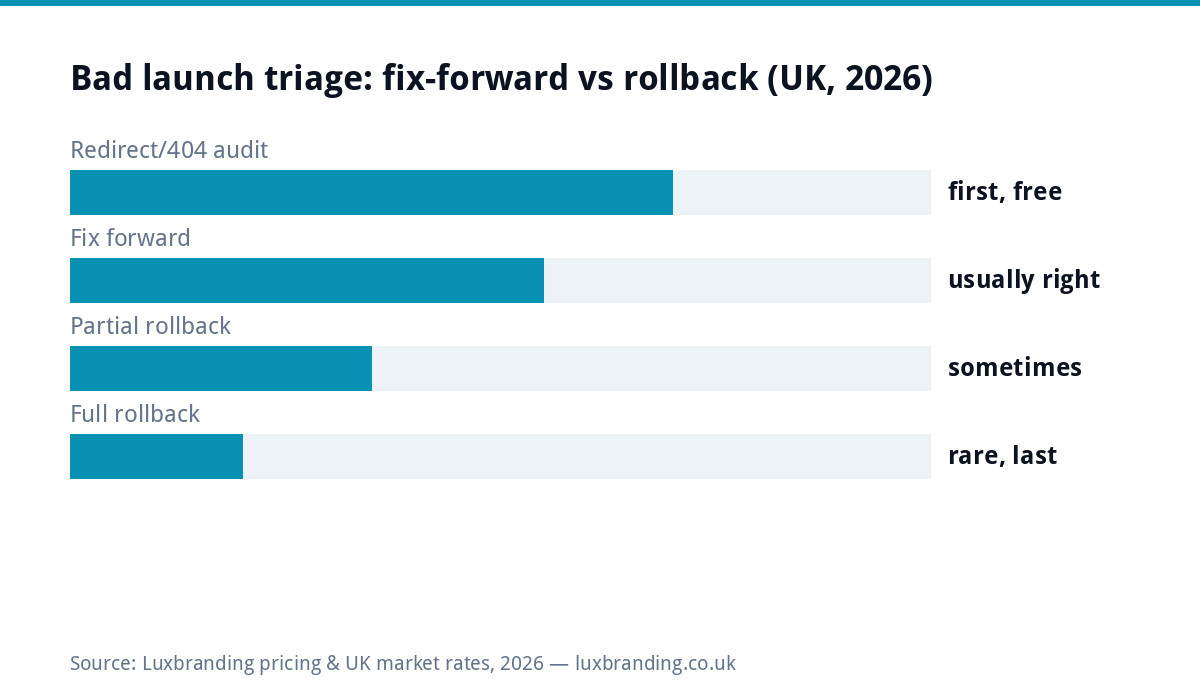
Fix forward when the new site is fundamentally sound with mechanical wounds, which is most cases: redirects, indexing flags and forms are hours of work, while a rollback is a second migration with its own risks, repeated later when you relaunch. Roll back (fully or partially) only when the new site is structurally broken (unusable on mobile, checkout dead on an e-commerce site losing real money daily) AND the old site still exists intact and restorable; then treat the rollback as an anaesthetic while the new site is repaired properly, not as a verdict. The worst option, chosen distressingly often, is the frozen middle: leaving the wounded launch untouched for months while deciding. Damage compounds weekly; either direction beats paralysis, and the £99 professional pass exists for the cases where the honest answer is “let someone else find the last leaks”.
The aftermath: making it not have been for nothing
Once the bleeding stops, two closing moves. First, verify recovery with the same three numbers from the baseline, fortnight by fortnight, until they cross their pre-launch line; Search Console’s coverage and 404 trends confirm the mechanical healing. Second, bank the lesson as process: the launch checklist for every future change is now yours (URL map and redirects BEFORE switching, noindex sweep, form test, speed reading, analytics check), and it converts the worst week of your website’s life into the reason there is never another. If the deeper conclusion is that whoever launched it cannot fix it, the supplier-recovery guide covers taking ownership, and the redesign cost guide prices doing it properly next time. Full prices, as ever, on the price list.
Get the UK Website Project Brief Template (free)
A two-page template for briefing any UK web designer: sitemap, integrations, audience and deliverables. Cuts revision rounds in half.
No spam. UK GDPR compliant. We only use your email to send this resource, unless you tick the box to hear from us.
Frequently asked questions
Traffic dropped after my new website launched. Is that normal? +
A small dip for a couple of weeks can be normal as Google recrawls. A cliff (half your traffic or worse) almost always means mechanical damage: old URLs dying without redirects, pages deleted, or indexing accidentally blocked. The redirect audit finds it in an hour.
What is the first thing to check after a bad launch? +
Search Console's pages and 404 reports, plus manually visiting your ten most important OLD URLs. If old addresses die instead of redirecting to their new equivalents, every ranking and bookmark attached to them is bleeding, and 301 redirects are the tourniquet.
Should I roll back to the old website? +
Usually no: most launch damage (redirects, noindex leftovers, broken forms) is faster to fix forward than to unpick with another migration. Roll back only when the new site is fundamentally broken and the old one still exists intact, and even then treat it as buying time, not the destination.
How long does recovery from a botched launch take? +
Mechanical fixes (redirects, indexing flags, forms) show improvement within days to a couple of weeks as Google recrawls. Rankings that had months of damage before anyone noticed take longer to climb back, which is why the day-one audit matters so much.
My enquiries died but traffic looks fine. What broke? +
The conversion path, not the visibility: test the contact form yourself end to end, check the phone number is tappable and correct, and confirm form notifications actually reach your inbox. The silent broken form is the most common and most invisible launch casualty.