Quick answer
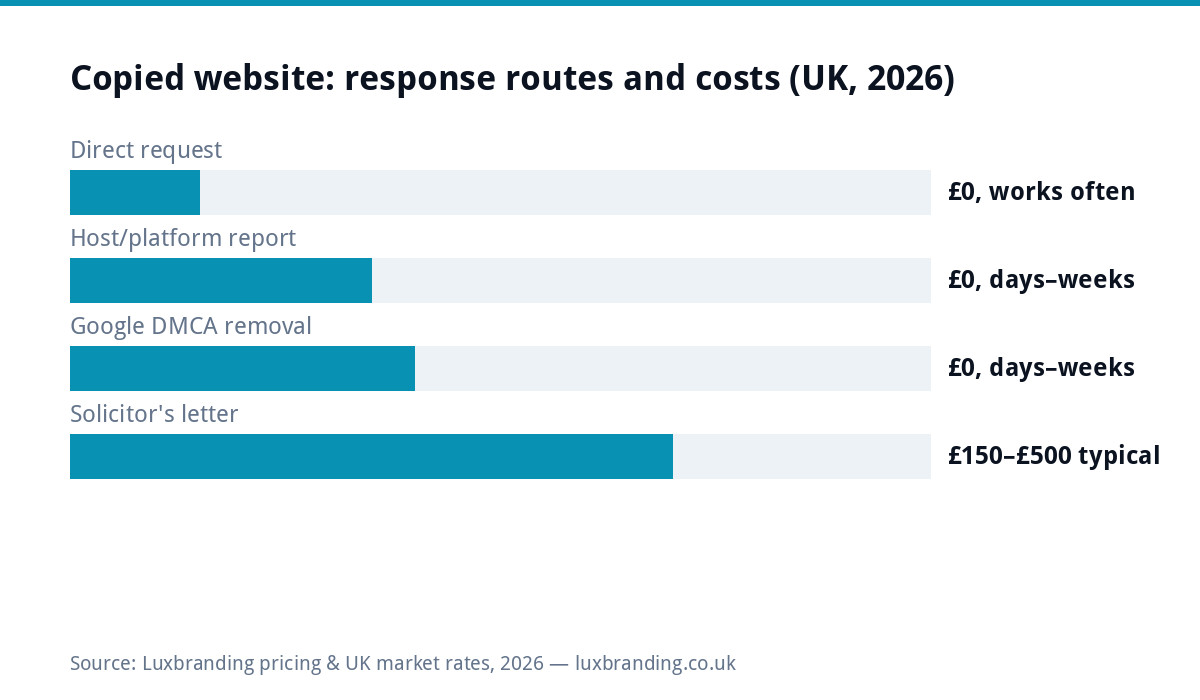
Anger later, evidence first: screenshot and save both sites today, dated, before the copier can quietly edit. Then climb the ladder in order: the direct request (free, resolves more cases than pride expects), the host or platform report (free), Google’s DMCA removal (free, and it attacks the commercial damage by removing their copies from search), and only then the solicitor’s letter (£150 to £500 at typical published rates). Most cases end on the free rungs, and the copier’s customers were never really yours to lose; the goal is removal, not war.
Step 0: build the evidence file (twenty minutes, today)
Every route below asks the same two questions: what was copied, and can you show yours came first? Answer both before contacting anyone. Full-page screenshots of the offending pages and your originals, with visible dates and URLs. Saved copies (browser save or print-to-PDF) of both. Priority proof: your pages’ publish dates, your Search Console records showing indexing history, Wayback Machine captures of your site from before their copy appeared, and for photographs, your original camera files, whose embedded dates and resolution no copier can fake. Twenty minutes of filing turns every later conversation from he-said-she-said into paperwork, and paperwork is what hosts, Google and solicitors act on.
What copyright actually protects (and what it does not)
Calibrate the claim before making it. Under UK copyright law, protection arises automatically for original work: your written page copy, your photographs, your graphics and logo. Solid ground: paragraphs lifted wholesale, your job photos on their gallery, your service descriptions with the town name swapped. Not protected: ideas and information (they can describe the same services), common industry phrasing, general page layouts, and facts. The grey middle (a suspiciously similar structure with lightly reworded text) is real but harder, and usually not worth fighting past the free rungs. The strongest, cleanest cases are photographs and verbatim text, so lead every complaint with those, and note that your logo adds a second claim entirely if they took that, covered in our logo copyright guide.
The ladder, rung by rung
| Rung | How | Cost and timeline |
|---|---|---|
| 1. Direct request | One professional email: what was copied, evidence attached, removal within 14 days requested | £0; resolves a surprising share, because most copying is a lazy web designer, not a scheming rival |
| 2. Host or platform report | Identify the host via a WHOIS/DNS lookup; submit their abuse/infringement process (builders like Wix and Shopify have dedicated forms) | £0; days to weeks; hosts process these routinely and can pull pages |
| 3. Google DMCA removal | Google’s copyright removal process against the copied URLs | £0; days to weeks; removes their copies from search, where the harm actually lives |
| 4. Solicitor’s letter | IP or dispute solicitor sends a letter before action | £150 to £500 typical published rates; most stubborn cases fold here |
Writing the first email (firm, boring, effective)
The direct request works best stripped of heat: “It has come to our attention that [pages] on your website reproduce text and photographs from ours, published earlier (evidence attached). This content is our copyright. Please remove it within 14 days, after which we will pursue removal via your hosting provider and Google’s copyright process.” No insults, no legal cosplay beyond the facts, one deadline, sent to their contact address and any info@ you can find. Two truths make this rung worth taking seriously: much copying is committed by a cheap web designer the competitor hired, who cloned a nearby site without telling them, so the owner’s first reaction is often embarrassment and removal; and the email you send becomes exhibit one of your reasonableness if the ladder climbs. One email, one follow-up at the deadline, then escalate without further correspondence; arguing is the rung that does not exist.
The rankings question (mostly reassurance)
The panic under this situation is usually “will their copy outrank me or get me flagged as the duplicate?”, and the answer is usually no: Google identifies originals well, and your pages’ age, indexing history and site signals almost always win. Check reality rather than fearing it: search a distinctive copied sentence in quotes and see who ranks. If you rank first, the copy is a nuisance, not an emergency, and the free rungs can grind at their pace. In the rarer bad case (their copy placing above yours, or your page slipping), the DMCA rung becomes urgent, and it is worth confirming your own site’s health signals are strong (indexing clean per our visibility guide, no sudden technical problems muddying whose site Google trusts). Either way, keep publishing: a site that keeps adding original content out-signals its imitator by default.
By situation: how hard to push
Lazy partial copy (your text, their photos): rungs one to three, minimal emotion; this is web-designer plagiarism and dies quietly. Wholesale clone (your site re-skinned): all four rungs briskly, because a full clone confuses customers and occasionally hosts phishing later; the host report carries particular weight here. Photos only: often the easiest win, since photo copyright is clean and your originals are unanswerable; lead with the DMCA. They copied your BRAND (name, logo, near-identical trading style): different and more serious than content copying; that is passing-off territory and the trademark conversation, where the solicitor rung moves up the order. You genuinely cannot tell who copied whom (both sites used the same template or the same hired designer): stand down and differentiate instead; the fix is original content, not correspondence.
If YOU are accused (the mirror case, briefly)
Occasionally the letter arrives in your inbox instead: a rival claims your site copies theirs. The same evidence rules protect you in reverse: your publish dates, archive captures and original files establish independence, and template coincidence (two sites bought the same theme, or the same budget designer recycled a layout) is the most common innocent explanation. Respond factually, replace anything a hired designer genuinely lifted (their plagiarism becomes your problem the day you are notified of it), and treat the incident as the same differentiation prompt: original photos and specific copy end accusations in both directions, because content only you could have made is content nobody can claim.
Turn the incident into an upgrade
The best revenge is structural: sites get copied because generic content is copyable, so use the incident to become uncopyable. Original photography of your actual work replaces anything a rival can lift (they cannot photograph your jobs), written copy full of your real specifics (prices, process, place names) is poison to a copier because it advertises you even when stolen, and a distinctive custom-built site makes clones look like the tribute acts they are. Businesses that respond this way usually find the copying stopped mattering before the ladder finished: customers can tell the original from the echo when the original keeps moving. Every price for the rebuild-and-differentiate route is on the price list; the evidence file from step zero costs nothing and starts now.
The one-line summary: evidence today, the free ladder in order, the solicitor only for the stubborn few, and originality as the permanent fix, because the business that keeps publishing what only it could publish has already won the argument the copier started.
Get the UK Website Project Brief Template (free)
A two-page template for briefing any UK web designer: sitemap, integrations, audience and deliverables. Cuts revision rounds in half.
No spam. UK GDPR compliant. We only use your email to send this resource, unless you tick the box to hear from us.
Frequently asked questions
A competitor copied my website. What do I do first? +
Preserve evidence before anything: dated screenshots of both sites, saved copies of the pages, and proof your version came first (publish dates, Wayback Machine captures, original photo files with metadata). Evidence first, because copied pages vanish the moment you complain.
Is copying a website illegal in the UK? +
Copying substantial text, photos or design assets typically infringes copyright, which arises automatically when original work is created. You do not need a registration. Ideas, general layouts and common phrases are not protected; your written copy and your photographs are.
How do I get copied content removed without a lawyer? +
Two free routes work in most cases: a report to the copier's hosting company or website platform (they process infringement notices routinely), and a DMCA removal request to Google, which removes the copied pages from search results, where the commercial damage lives.
Does copied content hurt my Google rankings? +
Usually the copier loses: Google is good at identifying the original, especially when your version is older and indexed first. The real risks are customer confusion and the rare case where the copier outranks you; the DMCA route addresses that directly.
When is it worth paying a solicitor? +
When free routes fail and the damage is real: a persistent copier, confused customers, lost work. A solicitor's letter before action at typical published rates of £150 to £500 resolves most stubborn cases; actual litigation is rare and reserved for serious commercial harm.