Quick answer
A landscaping website costs £299 as a one-pager or from £499 with a page per service, and in this trade the second tier earns its keep faster than almost anywhere, because patios, decking, turfing and maintenance are separate searches with separate buyers and separate price bands. The two sector truths that shape everything: before/after photos decide the sale (landscaping is bought with the eyes), and the build window is winter, so the site is ranking when the spring surge hits. Costs, structure and both truths, worked through below.
How landscaping is actually bought
The landscaping customer is planning a project they will look at every day for a decade, often spending four or five figures, and their journey is visual from the first search: “patio ideas”, “garden transformation [town]”, “landscapers near me”, then twenty minutes comparing whoever shows real work. Price matters, but proof matters first, because the customer’s core fear is paying serious money for a result that disappoints in their own garden. That fear is answered by exactly one thing: photographs of comparable gardens you transformed, ideally nearby (“we did the clay-soil garden two streets over” is the strongest sentence in the trade). The website is the only channel that presents that proof at ranking-scale, which is why this trade’s site converts harder per pound than flashier sectors, and why the platform profiles, useful as demand taps, never replace it: their galleries are cramped, their layouts generic, and their visitors comparison-shopping five firms in one scroll.
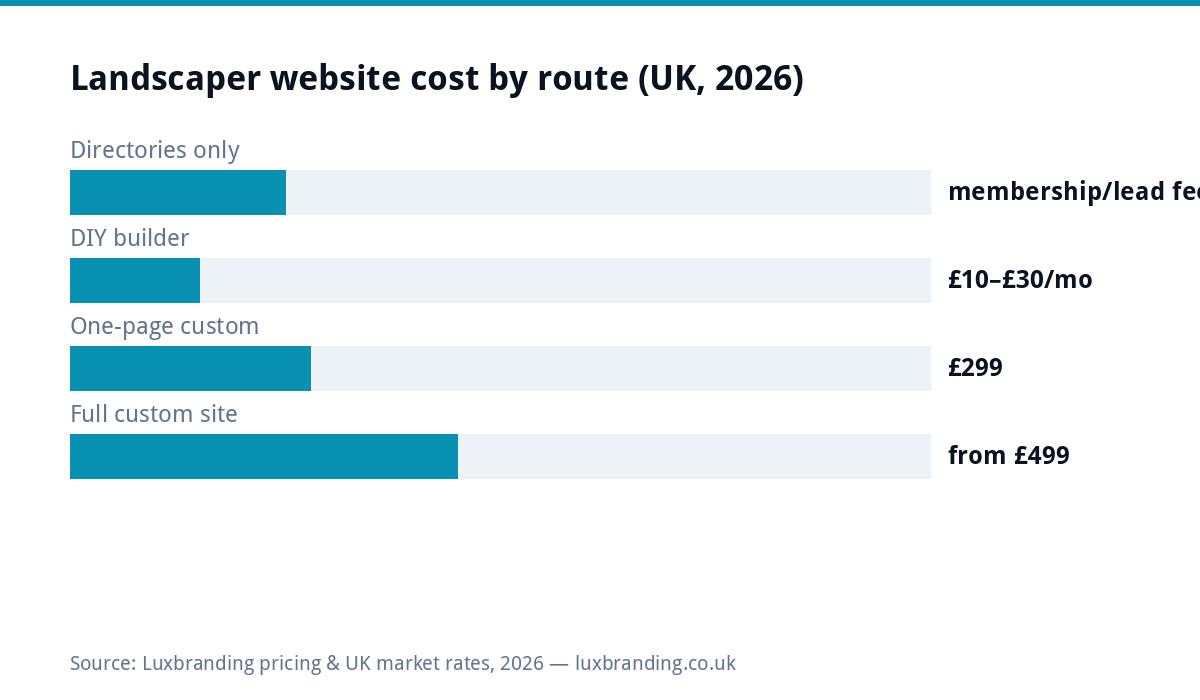
What each route costs the trade
| Route | What you pay | Right for | The catch |
|---|---|---|---|
| Directories only | Membership or per-lead fees | Demand this month | Five-firm comparisons by design; your photos in their cramped template |
| DIY builder | £10 to £30/mo | First-year sole traders | Gallery templates mangle exactly the photos that sell you |
| One-page custom | £299 | Maintenance-led rounds; single-service specialists | Project services cannot each rank from one page |
| Full custom | from £499 | Design-and-build firms with 3+ service lines | Needs your project photos organised first (the real work) |
The before/after system (the trade’s whole conversion engine)
Transformation photos are so decisive here that they deserve process, not luck. The habit: photograph every job on day one from three fixed spots (phone, normal light, wide), then again from the same spots at completion; same angles make the transformation undeniable. Present them as pairs with a two-line caption: the brief, the solution, the rough band (“full redesign with porcelain patio and raised beds, typical range £9 to 14k”). Eight strong pairs beat forty singles, and one per major service (patio, decking, turf, full redesign) lets each service page carry its own proof. Ask clients for permission at handover (almost all say yes, proudly), and note gardens photograph best in the season after planting, so a June follow-up shot of a March job is worth the diary reminder. Portfolio inspiration sites like Houzz set the presentation bar your customers browse; matching it on your own ranking pages is the play.
Projects versus maintenance: two revenue shapes, two pages
Landscaping firms live on two economies and the site should sell both deliberately. Project work (patios, decking, design-and-build) is high-ticket, seasonal and comparison-shopped: its pages carry the galleries, the guide bands, and the process (“design visit, itemised quote, typical lead time”), converting the £5k to £20k decisions. Maintenance (rounds, commercial grounds) is the annuity that smooths winter: its page sells reliability, visit pricing from £30, and the round-slot scarcity that makes locals commit (“Thursday round has two slots”). The maintenance economics mirror the cleaning sector’s recurring model: one converted round customer is a years-long annuity, which is why the page deserves better than a footnote under the glamour projects. Commercial grounds care, where you do it, gets the facilities-buyer treatment (contracts, RAMS, invoicing) on its own section.
Guide prices: anchoring without fix-pricing
Project landscaping cannot be fix-priced unseen, but the page can still do the pricing work that converts: honest ranges per service (“standard porcelain patio, typically £4,500 to £12,000 by size and spec”), what moves the number (access, groundworks, materials), maintenance rates stated flat, and the process promise (“site visit free within our area, itemised quote within a week, the written-quote discipline that wins comparisons per UK consumer-rights norms for home-improvement work”). Ranges filter the £500-budget patio dreamer before a wasted site visit, reassure the realistic buyer they are in the right shop, and feed the price-intent searches (“patio cost [town]”) that a silent site forfeits. It is the estimates discipline from the quote template applied upstream, and it pairs with the itemised written quote that wins this trade’s comparisons.
The winter build window (this trade’s sharpest timing rule)
Landscaping demand is a spring tide: enquiries surge March through June, exactly when firms are too busy to think about marketing, then fall quiet in the months when they finally have time. Rankings mature over weeks, so the arithmetic writes itself: build in November to January, while the diary is thin and last season’s photos are organised, so the site is indexed, reviewed and placing by the first warm weekend, when “landscapers [town]” demand peaks and this year’s prices apply. A site built in May monetises the season’s tail at best. The same window suits the photo system (winter is when the before shots of spring projects get taken) and the profile overhaul, and if winter cashflow is the honest blocker, the £79/month route exists so the calendar rather than the bank balance times the launch.
Worked example: one patio from one page
The composite that recurs across the trade: a firm builds the from-£499 site in December, patio page carrying six before/after pairs and the honest £4.5k to £12k band. By April the page places for “patio installers [town]”; a searcher comparing three firms picks the one whose photos show her exact problem garden (sloped, clay, tired decking) transformed, and signs a £9,000 job after one visit, mentioning she never called the firms without prices “because who knows what they’d say”. One job: the entire digital stack repaid several times, and the job’s own before/afters feed next spring’s page. That flywheel (work becomes proof becomes ranking becomes work) is the trade’s compounding loop, and the site is simply the wheel it spins on; the brand that ties van, workwear and site together makes the recommendation traceable back to it.
Reviews with photos: the trade’s double proof
Landscaping reviews carry unusual weight when they arrive with the customer’s own photos, and Google supports exactly that: the handover review ask should mention it (“if you’re happy, a Google review with a photo of the finished garden helps us enormously”). A review saying “transformed our sloped garden” beside the customer’s photo of it is proof no competitor can counterfeit, it enriches the profile the Map Pack ranks, and it feeds the same before/after engine as your own gallery from the customer’s side of the fence. Aim the ask at the handover walk-round, pride’s peak, and the yes-rate surprises everyone.
The full landscaping stack, priced
Site £299 to £499 · profile £199 or DIY, reviews asked at handover when pride peaks · van and workwear branding from £129 so the street-visible jobs advertise themselves · hosting £20/month. Owned outright for less than the margin on one modest patio, every figure public on the price list, and the from-£499 build turns a winter fortnight into the year’s best-converting asset. The only real prerequisite is the photo system, which costs nothing but the habit, and which no competitor can copy, because the gardens are yours.
Get the UK Website Project Brief Template (free)
A two-page template for briefing any UK web designer: sitemap, integrations, audience and deliverables. Cuts revision rounds in half.
No spam. UK GDPR compliant. We only use your email to send this resource, unless you tick the box to hear from us.
Frequently asked questions
How much does a landscaper's website cost in the UK? +
A custom one-page site is £299; a full site from £499 with pages per service (patios, decking, turfing, garden maintenance) so each ranks for its own searches. Landscaping is the most photo-decided trade online, so the build cost is really the frame for your before/afters.
What matters most on a landscaping website? +
Before/after project photos, by a distance: garden transformation is the product, and photos are the only proof. Then services split into project work versus maintenance, areas covered, from-prices where honest, and reviews. Design polish is the frame, not the picture.
Should landscapers show prices on their website? +
Guide figures convert: "patios typically £4,500 to £12,000 depending on size and stone", "garden maintenance from £30/visit". Project work cannot be fix-priced unseen, and saying so plainly while anchoring the realistic range filters dreamers from buyers before the site visit.
When should a landscaper build their website? +
Winter. Enquiries surge from March to June while diaries are already filling, and rankings need weeks to settle, so the site built in November to January is ranking exactly when the spring wave searches. Building in May means missing the year's demand at full price.
Project landscaping or maintenance: does the website differ? +
Yes, and the site should carry both distinctly: project pages (patios, design-and-build) sell transformations with galleries and guide prices; the maintenance page sells reliability and rounds with visit pricing. They are different buyers, and maintenance is the recurring revenue that smooths the winter.