Quick answer
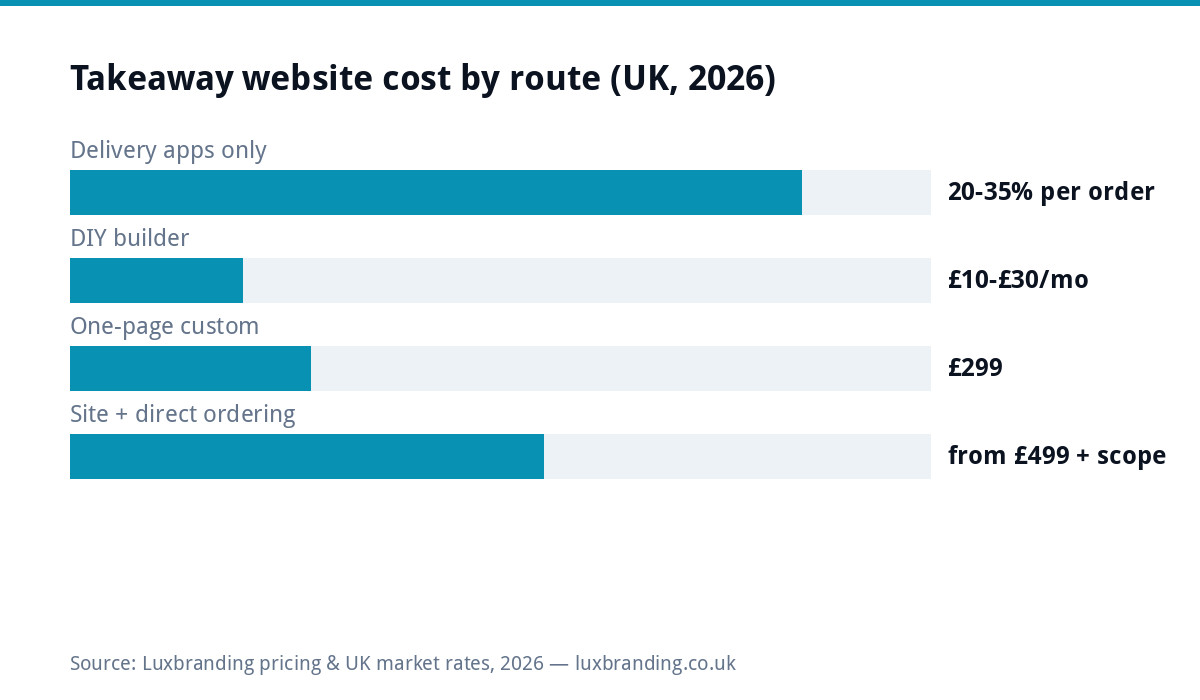
A takeaway website costs £299 flat as a custom one-pager (menu, hours, tappable phone, delivery zones) or from £499 with commission-free direct ordering scoped on top. The number that makes this the easiest website decision in hospitality: delivery apps’ published partner rates take 20-35% of every order. A takeaway doing steady app volume hands over more in a quiet month than the website costs once, which is why this guide spends as much time on the commission maths as on the build price.
The commission maths, on a napkin
Pull up last month’s partner statement and do the honest sum. A takeaway doing £6,000 a month through apps at a mid-band 25% rate pays £1,500 that month, £18,000 a year, for the channel. Now split those orders honestly: how many were strangers the app genuinely found you, and how many were regulars who know your name, have ordered five times, and use the app only because it is the path of least resistance? For most established takeaways the regulars are the majority, and every one of their orders pays acquisition-level commission on a retention-level relationship. That slice is the website’s target. Nobody sensible abandons the apps (their discovery is real, especially for new shops); the play is moving the REGULARS to a direct channel that costs card fees at published processor rates of roughly 1.4-2.9% instead of 20-35%. Move half the regulars of that £6,000 shop and the saving runs to several hundred pounds a month, every month, against a one-off build cost.
Route by route
| Route | What you pay | Right when | The catch |
|---|---|---|---|
| Apps only | 20-35% per order (published rates, e.g. Just Eat partner terms) | Brand-new shop needing demand this week | The percentage never stops; the customer data stays theirs |
| DIY builder | £10-£30/mo | Testing whether you will keep a menu updated | Menus rot as photos; ordering needs bolt-ons anyway |
| One-page custom | £299 one-off | Phone-and-collection shops, menu-led | Ordering stays on the phone (which suits many shops fine) |
| Site + direct ordering | from £499 + scoped ordering | Steady app volume worth repatriating | Someone must watch the order screen during service |
Where takeaway customers actually come from
Three streams fill the till. App browsers scrolling their area (the apps own this, and it is worth renting). Direct searchers typing “chinese takeaway [town]”, “pizza delivery near me” or your shop’s name after a recommendation, which is Google and Maps territory the apps barely touch: a one-pager plus a complete Business Profile captures it. And regulars, who order wherever you have trained them to order. The website’s double job is winning stream two outright and retraining stream three, and both jobs run on the same £299 page. Stream two alone justifies the build in most towns: the searcher typing your shop’s name who lands on an app listing gets shown YOUR menu next to three competitors and a sponsored rival, which is a strange place to send someone who already chose you.
The menu rule that decides your Google visibility
The single biggest technical decision on a takeaway site: the menu lives as page TEXT, never as a photo or PDF of the print menu. Text menus mean phone users read without pinch-zooming, dish-level searches (“katsu curry [town]”, “gluten free pizza delivery”) can find you, and price updates are an edit rather than a reprint-and-reupload. It also carries your allergen information properly, which the FSA guidance expects you to communicate clearly for distance orders. The same text menu feeds the printed version (our menu design guide covers that side at £79) so kitchen changes propagate everywhere from one source.
The direct-order push (how regulars actually move)
Building the direct channel is half the job; the other half is telling people it exists, and takeaways have the best retraining tools in local business because every order is a physical touchpoint. The proven kit: a slip in every bag (“Order direct at [site] and skip the app fees: 10% off your first direct order” if margins allow), a counter sign for collection customers, the link in the Business Profile and every social bio, and the phone script line (“you can order on our website next time, it is usually quicker”). Shops that run the full kit consistently report the regulars migrating within a quarter, at which point the app statement shrinks and the website has paid for itself several times over. The apps stay for strangers, which is the arrangement that was always fair.
Worked example: one Friday night, two channels
Composite but true to type: a kebab shop takes 60 orders on a Friday, £22 average. All-app scenario at 25%: £330 of commission on the night. Mixed scenario after six months of direct-push: 25 orders direct (card fees roughly £11), 35 through apps (£192.50 commission), total channel cost £203.50, saving £126.50 in one service. Multiply across a week and the £499-plus-ordering build stops being a website decision and becomes a margin decision. The honest caveats: direct ordering needs the tablet or till screen actually watched during service, delivery logistics stay yours on direct orders, and the discount that moves regulars costs real margin during the transition. Every shop’s numbers differ, which is why the napkin sum above comes first.
What converts on the page (takeaway specifics)
The visitor is hungry, on a phone, deciding in seconds. What wins: hours that are TRUE (including the 11pm question: are you still delivering?), delivery zones stated plainly with any minimum order, the phone number tappable in the header, real photos of your actual food (phone photos in decent light beat stock every time, and hungry people click photos), your rating pulled from Google, and collection details (parking, wait times) for the collect crowd. What loses: music, PDF menus, “welcome to our website” essays, and hours that lie on bank holidays, which is the one-star review machine working exactly as designed. Our restaurant website guide covers the sit-down cousin of every rule here.
By shop type: what to buy
Phone-and-collection shop, low app volume: the £299 one-pager is genuinely complete; ordering stays on the phone you already answer. App-heavy delivery shop: the from-£499 build with direct ordering scoped; you are the commission-maths case and the payback is fastest. New shop, week one: apps for demand now, one-pager alongside so brand searches land on you, ordering added once volume proves. Multi-shop operator: location pages with true per-shop details and zones, plus centralised menu management, which is where the e-commerce build conversation starts. Whichever type, pair the site with the Business Profile done properly: for “near me” hunger searches the Map Pack is the front line, and hours/menu consistency between profile and site is a ranking signal both ways.
Running costs and the stack, priced honestly
After the build: managed hosting around £20/month, the domain’s £10-£20 a year, card fees on direct orders at the published processor rates above, and the upkeep habits that cost diligence rather than money: menu edits when the kitchen changes, hours sacred, three fresh dish photos a month. The full stack for a launch-grade takeaway presence: site £299-£499, profile setup £199 (or careful DIY), menu design £79 when print needs match, all one-off, all owned, totalling less than two months’ commission for many shops. Every price is public on the price list, which is rather the point: fixed prices, no percentage of anything, forever.
Get the UK Website Project Brief Template (free)
A 2-page template for briefing any UK web designer — sitemap, integrations, audience, deliverables. Cuts revision rounds in half.
No spam. Unsubscribe any time. UK GDPR compliant — your email is only used to send this resource.
Frequently asked questions
How much does a takeaway website cost in the UK? +
A custom one-page site (menu, hours, phone ordering, collection info) is £299 flat. A full site from £499, with commission-free direct ordering scoped on top. Compare that one-off cost with delivery apps' published commissions of 20-35% of every order, forever.
Do takeaways need a website if they are on Just Eat and Uber Eats? +
The apps bring discovery but take their published cut on every order, including from regulars who would order direct if direct existed. A website captures the "takeaway near me" and brand-name searches, holds your menu where Google reads it, and gives regulars a commission-free route.
How much commission do delivery apps take from takeaways? +
Published partner rates across the major UK platforms generally run 20-35% per order depending on service level and whether their drivers deliver. On a £25 order that is £5-£8.75 gone, which is most of the margin on many menus.
Can a takeaway take orders through its own website? +
Yes: direct online ordering is a scoped build or a flat-fee ordering system plugged into your site, with payments going to you minus only card fees of around 1.4-2.9%. At steady volume the saving against app commission pays for the whole website within months.
What should a takeaway website include? +
The menu as page text with prices, opening and delivery hours kept true, delivery zones stated plainly, phone number tappable everywhere, collection details, allergen information, and your reviews. Photos of real dishes help; a PDF menu hurts.