Quick answer
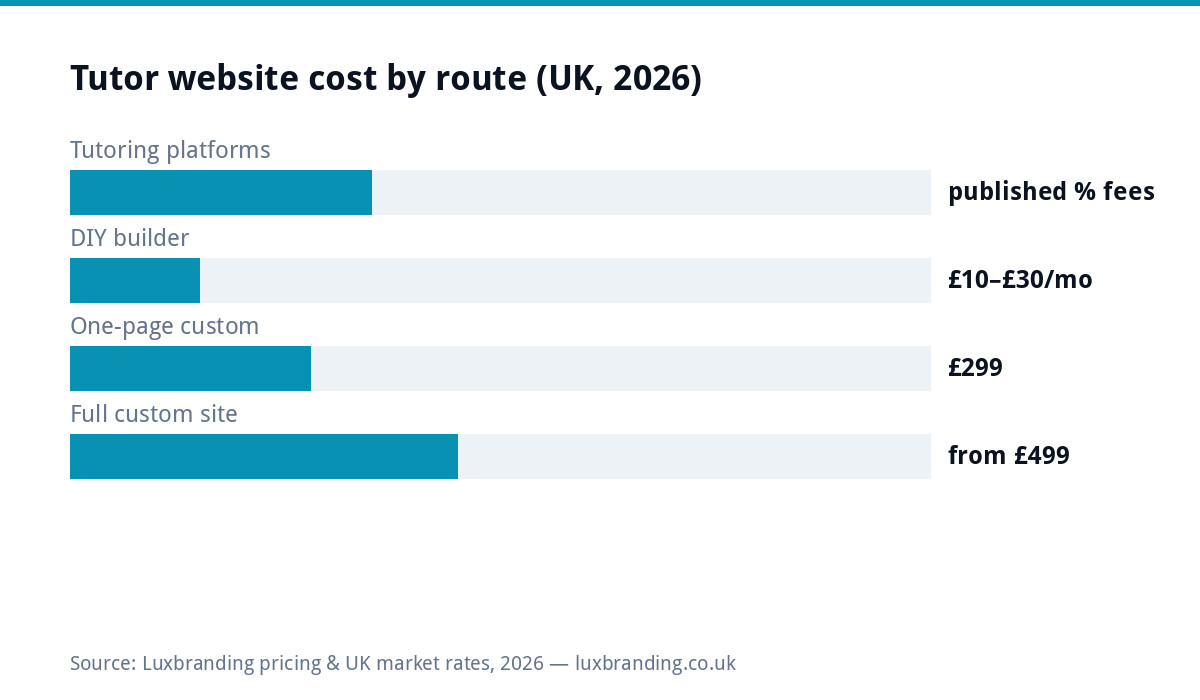
Most tutors need exactly £299 of website: one custom page carrying subjects and levels, published rates, online/in-person arrangements, availability and the safeguarding signals parents check. Agencies with tutor rosters justify from £499 with subject pages. The comparison that decides the spend is the platforms’ published commission on every lesson: the site converts referrals and local searches commission-free, and the maths tilts fast for anyone tutoring more than casually.
The buyer is a parent (design for the real audience)
Except at degree level, tutoring’s buyer is a parent: usually triggered by a wobbly mock result, a looming GCSE year, or a teacher’s comment, searching “[subject] tutor [town]” or “[subject] GCSE tutor online” at 9pm. Their audit is specific: does this person teach my child’s subject at my child’s level, what does it cost, are they safe, and will my child actually engage with them. A tutor site that answers all four in one calm page converts that parent before the platform tabs even load; one that answers none is a phone number they will not risk. Everything below serves that audit, and the Business Profile catches the local half of the searching.
Route by route, tuition edition
| Route | What you pay | Right for | The catch |
|---|---|---|---|
| Platforms only | Published commission per lesson (platform fee pages state the cuts) | Starting out, filling a first timetable | The cut never stops; the parent relationship is theirs |
| DIY builder | £10–£30/mo | Testing whether tutoring becomes the career | Safeguarding and rates sections usually end up vague |
| One-page custom | £299 | Solo tutors, however many subjects | Genuinely none at solo scale |
| Full custom | from £499 | Agencies and tutor teams | Subject pages need real substance per level |
The platform commission maths (run it once, honestly)
Platforms earned their place: they hand new tutors a marketplace and handle payments, for a published percentage of every lesson (the fee pages of Tutorful-class platforms state their cuts plainly). The arithmetic to run: your weekly platform lessons times your rate times that percentage, annualised. For a tutor doing ten platform hours a week, the yearly commission routinely exceeds the £299 site several times over, and, the sharper point, a growing share of those lessons are REPEAT students whose parents would happily book direct if direct existed. The mature pattern mirrors every marketplace vertical in this series: platform for discovery, owned site for repeat, referral and local-search business, and a yearly rebalancing as the owned channel compounds. The trades-platform version of this logic transfers almost line for line.
Subjects, levels and the words that rank
Tuition search is subject-times-level-times-place: “GCSE maths tutor [town]”, “A-level chemistry tutor online”, “11+ preparation [area]”. The ranking surface is simply whether your page says those words: solo tutors list every subject-level pair they teach, in text, with a line each (“GCSE Maths, foundation and higher, AQA and Edexcel”); agencies give the big families their own pages under the from-£499 build. Exam-board familiarity, named, is both a ranking phrase and a parent-converter, because the parent’s actual fear is “does this tutor know MY child’s syllabus”. Online tutoring widens the market and the competition simultaneously; “online” plus subject-level phrases belong on the page too, alongside an honest line about how online lessons run.
Safeguarding: the section that wins the trust decision
Parents are choosing an adult to spend unsupervised hours with their child, and most tutor websites leave the resulting anxiety entirely unaddressed. The page section that changes the conversion: your Enhanced DBS check stated with its date, how online lessons are safeguarded (parent welcome to sit in, lessons on a mainstream platform, recordings available on request), where in-person lessons happen (family home with parent present, library, your teaching room), and your qualifications with the subjects they cover. None of this is legally showy; all of it answers the question the parent was too polite to ask first. Tutors who address it plainly report the phone conversation starting warmer, because the trust work happened on the page.
Fees, blocks and availability honesty
Publish the rates per level (£35/hour GCSE, £40 A-level, block-of-ten discount), because parents comparison-shop tuition exactly like every service in this series, and the published number wins shortlists while filtering the mismatched budgets. Availability deserves the same honesty as the driving-school waiting list: term-time evenings fill first, so “September evening slots are full; join the waiting list or ask about daytime/weekend” converts overflow demand into a pipeline and quietly signals quality. Payment mechanics (blocks invoiced, cancellation policy in one line) finish the page: the parent paying £400 a term wants to feel a small professional operation, and a page this complete IS that feeling.
What tutoring costs parents (publish the context too)
A quietly effective page addition: the going-rate context. Parents arriving from a platform have seen its rates; parents arriving cold have no anchor, and a line like “UK private tuition typically runs £30–£50/hour at GCSE, more at A-level and for specialist subjects; mine are below” (attributed to the platforms’ own published rate pages) both educates and positions. It also feeds the “how much does a tutor cost” searches that sit beside the hiring ones, which is the same query-family logic the whole cost-guide series runs on. Pay attention to sibling economics too: families often buy tuition twice, and a stated sibling arrangement (same-family discount, back-to-back slots) converts the second child before the question is asked.
Group classes and holiday revision: the scalable pages
One-to-one hours cap income; small groups and holiday intensives scale it, and each deserves its page section once offered: group GCSE classes (price per seat, group size cap, how ability is matched), Easter and half-term revision days (dates, syllabus focus, the deadline urgency doing the selling), and mock-marking or exam-technique packages that parents buy as top-ups. These pages carry their own search families (“GCSE maths revision course [town]”, “Easter revision A-level chemistry”) with strong commercial intent and thin competition outside the big cities. The one-page tutor site can hold them as sections; a growing operation graduates them to pages under the from-£499 build, which is usually the exact moment the operation is becoming an agency anyway.
Worked example: the September effect
Composite: a maths tutor going independent over summer, £299 one-pager live in August plus a free careful profile setup. September: the back-to-school anxiety wave hits, “GCSE maths tutor [town]” finds the published-rate page, and the evening timetable fills by half-term, at which point the waiting list starts doing its quiet work. The platform profile stays live but its share of hours drops term by term as renewals and siblings book direct, commission-free; by the spring mocks wave, the site’s referral-conversion role (every recommended-by-a-parent enquiry checks the page before texting) is worth more than its search role. Total spend £299 against a term’s commission: the arithmetic parents would approve of.
The stack, and where the £499 tier earns it
Solo: £299 page, profile, reviews habit, £20/month hosting, done. Agency: the from-£499 build earns its step with subject pages, tutor profiles (each with DBS and qualifications, multiplying the trust section), and an enquiry route that matches student to tutor, plus the booking-system conversation once volume justifies owning the diary. Either way the whole owned stack costs less than one student-term, and every price is public on the price list.
Get the UK Website Project Brief Template (free)
A 2-page template for briefing any UK web designer — sitemap, integrations, audience, deliverables. Cuts revision rounds in half.
No spam. Unsubscribe any time. UK GDPR compliant — your email is only used to send this resource.
Frequently asked questions
How much does a tutor website cost in the UK? +
A solo tutor needs the £299 custom one-pager: subjects and levels, rates, online/in-person, availability and DBS status. Tutoring agencies with multiple tutors and subjects justify the from-£499 build with subject pages. Platforms charge published commission on lessons instead.
Is a website worth it if I get students through tutoring platforms? +
Platforms take their published cut of every lesson, forever, and own the parent relationship. A £299 site captures the searches platforms cannot ("GCSE maths tutor [town]"), converts word-of-mouth referrals commission-free, and holds the waiting list. Established tutors usually run both, then rebalance.
Should tutors publish their hourly rates? +
Yes: parents shortlist by subject, level and rate, and "£40/hour, GCSE and A-level maths, online or in Stockport" wins shortlists that "rates on enquiry" never enters. Publish per-level rates and any block pricing.
What safeguarding signals should a tutor website show? +
An Enhanced DBS check stated with its date, your policy for online lessons (parent present or recorded, platform used), and qualifications with subjects. Parents are choosing an adult to be alone with their child; the site that addresses it plainly wins the trust decision before the first call.
Do tutors need a page per subject? +
Solo tutors: one page listing subjects and levels in text is enough. Agencies: a page per subject-and-level family ("A-level chemistry tutors") ranks for its own searches and justifies the from-£499 build. The words on the page are the ranking surface either way.