Quick answer
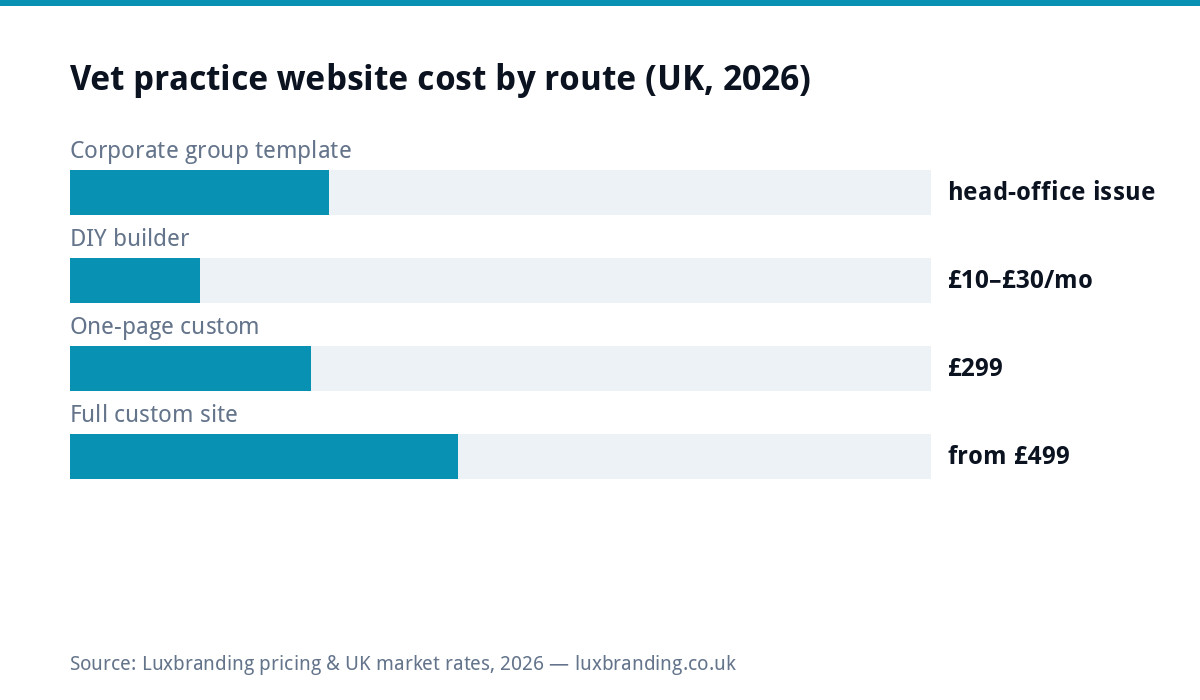
An independent veterinary practice pays £299 for a custom one-page site or from £499 for the full build with a page per service in 2026, against four-figure quotes from vet-specialist agencies whose premium buys familiarity rather than different technology. The sector’s three website deciders are distinctive: the register-a-pet flow (the conversion that matters), published fees in a market regulators have pushed hard toward transparency, and the emergency page a panicking owner finds at 2am. All three travel with whichever tier you buy.
How pet owners actually choose a practice
Registrations cluster around three moments: a new pet, a house move, and a falling-out with the current practice over fees or availability. All three start the same way now: “vets near me”, “vets in [town] prices”, “vet accepting new patients”, followed by a twenty-minute comparison of whoever appears. The comparison questions are consistent: are they taking registrations, what does a consultation cost, how do they handle emergencies, and do they feel like people who will be kind to the animal. A website that answers all four converts the postcode’s movers and new-puppy households on autopilot; a brochure that answers none leaks them to the corporate group up the road, whose head-office template at least states its prices. The Business Profile catches the “near me” half of this; the site converts it.
What each route charges and delivers
| Route | Typical fees | Right for | Watch out for |
|---|---|---|---|
| Corporate group template | Head-office issue | Group-owned practices (no choice) | Generic, fee-shy, and independents should not imitate it |
| DIY builder | £10–£30/mo | A locum going independent, pre-launch | Fee pages and registration flows usually end up half-built |
| One-page custom | £299 | Small single-site practices | One ranking theme; fine until services deserve their own pages |
| Full custom | from £499 | Most independents | You supply the clinical content; an evening of a vet’s time |
| Vet-specialist agency | Four figures up | Multi-site groups buying a programme | Benchmark against this page before signing |
Fees on the website: the transparency question is settling itself
Veterinary pricing has spent two years under the regulator’s lamp: the CMA’s market investigation into vet services has made price transparency the direction of travel for the whole sector, and pet owners have noticed. The practical move for an independent is to get ahead of it: publish consultation fees, vaccination and neutering from-prices, and dental bands, plainly, on a fees page that ranks for the “vet prices [town]” searches owners now type. Transparency converts twice over: it wins the comparison shoppers corporate templates leave cold, and it pre-frames the practice as the honest option in a market whose trust has been publicly questioned. The same published-fees mechanics work for dentists and every vertical in this series; vets simply have a regulator’s tailwind behind the habit.
The register-a-pet flow: your actual conversion
Practices measure website success in registrations, so the registration route deserves the engineering: a visible “Register your pet” button on every page, a short form (owner details, pet name and species, previous practice if any), and one plain paragraph on what happens next (“we’ll confirm within one working day and request your pet’s history”). Two frictions kill registrations on typical vet sites: forms that demand the pet’s full clinical biography upfront, and no statement about whether the practice is even accepting new patients, which sends anxious owners to the phone queue the website existed to relieve. If you run waiting lists for new registrations, say so and take names; a waiting list captured is future revenue, the same mechanics as any booking pipeline.
The emergency page: write it for a panicking human
“Emergency vet [town]” is typed one-handed while the other hand holds a sick animal. The page that search deserves: whether you see emergencies, in the first line; the number to call, tappable, enormous; your out-of-hours arrangement stated exactly (own rota, shared provider, or a named partner service with its address); what the caller should do right now for common crises (keep the animal warm, do not induce vomiting, bring the packaging); and what an emergency consultation costs, because fee-fear delays care and the honest number beats the feared one. Practices that outsource out-of-hours still need this page, because the owner searching at 2am does not know that yet, and the practice that told them what to do earns the daytime registration that follows.
Trust signals, veterinary edition
The checkable layer: RCVS registration and any practice accreditation displayed as text and logo, the clinical team with names, roles and the species interests owners genuinely choose by, and real photos: the building (arrival anxiety is a pet-owner thing too), consult rooms, the team mid-cuddle with patients whose owners consented. Reviews complete it: pet owners write long, emotional, detailed reviews, and surfacing the best on the site while running the review-ask habit compounds the practice’s warmest marketing asset. Respond to the hard ones with extra care and zero clinical detail; confidentiality instincts apply to patients with fur as much as the response scripts apply everywhere.
Worked example: an independent’s launch quarter
Composite but typical: a two-vet independent, £700 all-in (from-£499 build plus £199 profile setup), launched in a quiet spring. Month one: name searches and the Map Pack carry existing clients; the fees page immediately halves the front desk’s “how much is a consult” calls. Month two: “vets in [town]” places on page one locally; the register-a-pet form starts producing three to five new registrations a week, mostly movers and new puppies, each worth years of consultations, vaccinations and the occasional surgical estimate. Month three: the emergency page ranks, and even the out-of-hours calls it routes elsewhere convert into daytime registrations from owners who remember who helped at 2am. The shape to notice: every converting element was information a practice already possessed, written down where searchers could find it, which is the recurring story of this entire vertical series.
Content only a practice can write (gather it first)
The build moves at the speed of the practice’s materials, so assemble before briefing: the fee schedule you are willing to publish (consultations, vaccinations, neutering bands, dental bands, with the honest asterisks); the services list split the way owners search (puppy and kitten care, vaccinations, neutering, dental, senior pets, emergencies); the out-of-hours arrangement stated exactly as it works; team names, roles and the species interests clients choose by; RCVS numbers; and fifteen real photos, building, consult rooms, team with patients whose owners said yes. One partners’ meeting and a photo hour covers the lot, and it is the difference between a five-day build and a five-week email chain. The same gather-first rule runs through every vertical in this series; veterinary just adds the fee-schedule decision, which the CMA climate has made easier to justify to sceptical partners.
Pet owners read reviews like medical references
No local sector’s reviews are read more emotionally: owners describe sick-animal crises, kindness under bad news, and money handled fairly, at length. That makes the review flow disproportionately valuable and the ask-at-the-happy-moment habit (vaccination done, recovery check-up passed) the practice’s cheapest marketing engine. It also raises the stakes on replies: respond to criticism with warmth and zero clinical detail, because confidentiality reads as professionalism even when the patient has four legs. A practice with two hundred warm, replied-to reviews and published fees is, in local-search terms, unassailable by any corporate template.
Running costs and the stack
After the build: managed hosting around £20/month, the domain’s £10–£20 a year, and upkeep that fits practice life: fees kept true (the page loses its power the day it drifts), team changes reflected, seasonal notices (fireworks season, Easter chocolate) reused yearly. The full owned stack, site from £299–£499, profile setup £199, review habit free, lands under one dental procedure’s invoice, and every price is public on the price list, which is rather the point this page has been making about fees all along.
Get the UK Website Project Brief Template (free)
A 2-page template for briefing any UK web designer — sitemap, integrations, audience, deliverables. Cuts revision rounds in half.
No spam. Unsubscribe any time. UK GDPR compliant — your email is only used to send this resource.
Frequently asked questions
How much does a vet practice website cost in the UK? +
An independent practice pays £299 for a custom one-page site or from £499 for a full build with pages per service (vaccinations, neutering, dental, emergency). Specialist veterinary agencies charge four figures for comparable work; the premium buys sector familiarity, not different technology.
Should vets publish prices on their website? +
Increasingly yes. The CMA's market work on veterinary services has pushed hard on price transparency, pet owners now expect published consultation and procedure fees, and practices that state them convert comparison shoppers that "call for prices" loses. From-prices for common procedures are the workable minimum.
What should a vet website include? +
The register-a-pet route front and centre, published fees for consultations and common procedures, an emergency/out-of-hours page with the exact protocol, your RCVS registration and team, real practice photos, and services split into pages so each ranks for its own searches.
Do vets need an emergency page? +
Yes, and it is the highest-intent page on the site: "emergency vet [town]" is searched by someone with a crisis in progress. State plainly whether you see emergencies, your out-of-hours arrangement or provider, the number to call, and what the visitor should do right now.
How do practices win new registrations online? +
Make registering feel like one small step: a short register-your-pet form (owner, pet, previous practice), a plain explanation of what happens next, and published fees so the decision needs no phone call. Most competitor sites make new owners work for it; the practice that removes the friction wins the postcode.