
Quick answer
A driving instructor’s website costs £299 as a custom one-pager; a multi-instructor school covering several towns justifies from £499 with coverage and intensive-course pages. The sector’s website economics are unusually clean: learners shortlist by published per-lesson and block prices, choose by reviews and availability, and the perennially full instructor’s waiting list is a convertible asset almost nobody captures. This guide prices the tiers and the three levers.
How learners (and their parents) actually choose
The buying unit is often two people: a seventeen-year-old searching “driving lessons [town]” and a parent paying who wants legitimacy and a fair price. The shortlist forms from whoever appears with prices attached; the decision closes on reviews, first-lesson availability, and the feel of the thing (a friendly photo and a plain paragraph outperform fleet graphics). Both audiences punish the same gaps: hidden prices read as expensive, vague coverage reads as “probably not my area”, and no availability signal means the enquiry goes to whoever answers first. The website’s whole job is surviving that twenty-minute double-audience audit, and at £299 it is among the cheapest customer-acquisition assets in the trade, next to the Business Profile that catches the Map Pack half of the search.
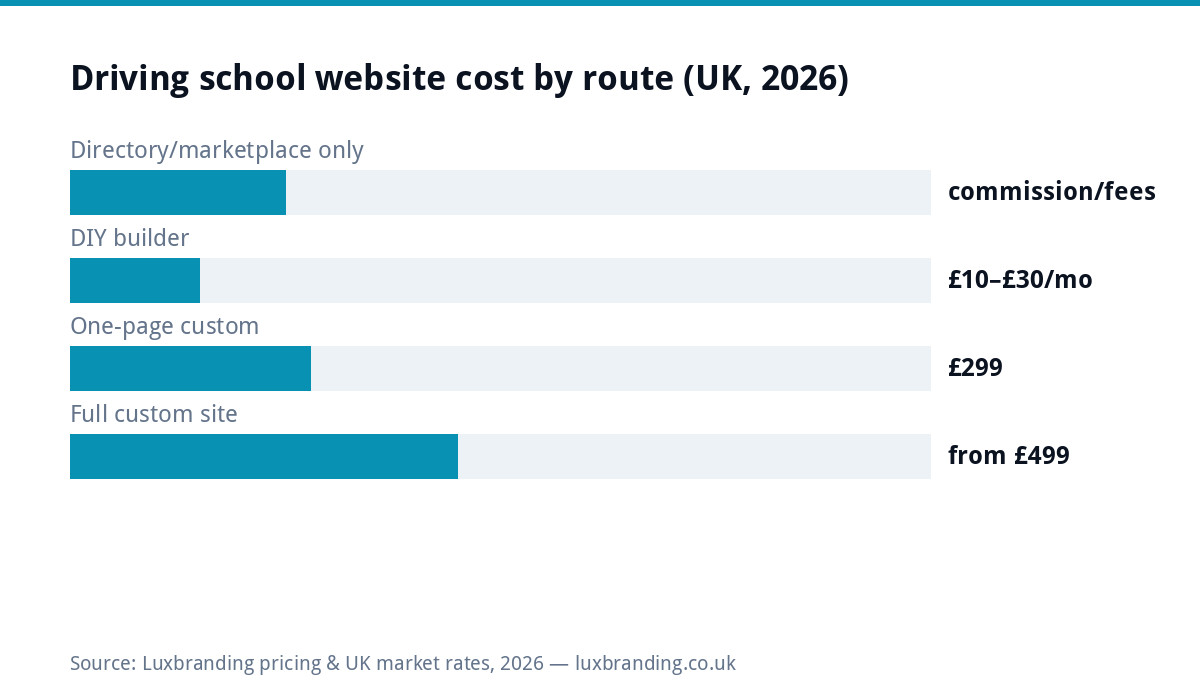
Route by route for schools and solo instructors
| Route | What you pay | Right for | The catch |
|---|---|---|---|
| Marketplace/directory only | Commission or listing fees | Filling a brand-new diary | Renting demand; the platform owns the learner relationship |
| DIY builder | £10–£30/mo | Testing independence from a franchise | Subscription outlives the saving; price tables rot |
| One-page custom | £299 | Solo instructors, one town + surrounds | One ranking theme, which suits one patch perfectly |
| Full custom | from £499 | Multi-instructor, multi-town, intensives | Coverage pages need real local substance (below) |
Publish the prices: the sector’s comparison currency
Driving tuition has a per-lesson price culture, and fighting it costs enquiries: learners compare hourly rates the way cafes are compared on coffee, and the instructor whose site says “£38/hour, £360 for a 10-hour block, automatic +£2” is IN the comparison while “contact me for rates” is not. Publish the hourly fee, the block pricing that rewards commitment, the manual/automatic split, and any test-day package, then keep them true (a price list that lags your actual charges burns trust at the first phone call). The pattern repeats across this series from gyms to accountants: published prices filter, reassure, and rank, and the fear they attract cheapskates is upside down; hidden prices attract precisely the enquiries that evaporate at the number.
Coverage pages: the honest version of local SEO
“Driving lessons [town]” is the sector’s core search family, and a school genuinely covering four towns should have four pages saying real things: which test centres you know (naming the local test centre and its quirks is the substance that separates honest local pages from doorway spam), pickup arrangements, and that town’s waiting time. A solo instructor’s one-pager handles this with a plain coverage section instead: the towns and postcodes served, in text, because those words are the ranking surface. What neither should do is fabricate thirty suburb pages with swapped names, the classic pattern Google’s spam systems eat; the test is whether each page could only have been written by someone who teaches there.
The waiting list: turn “sorry, I’m full” into next quarter’s revenue
Good instructors spend half the year at capacity, bouncing enquiries with an apologetic text, which is quietly the sector’s biggest wasted asset. The website fix is one honest block: “Current waiting time: about six weeks. Join the list and I’ll confirm your start window.” A short form (name, area, manual/auto, availability), an expectation, and suddenly fullness converts into a pipeline instead of a leak, while signalling exactly the demand that justifies your rates. When a slot opens, the list fills it same-day with zero advertising. Schools can route list entries per instructor and area; the mechanics are the same booking-pipeline arithmetic every appointment business runs, in miniature.
Trust, credentials and the pass-rate question
The checkable layer: your ADI status (learners are told to check the official guidance on choosing instructors, and test waiting times are public via the booking service, so display the green-badge fact plainly), years instructing, car and dual-controls reassurance for nervous parents, and DBS status where you teach under-18s, which is most of the market. On pass rates: publish only what you can stand behind, framed honestly (“most of my learners pass within X attempts” beats a suspiciously precise percentage), because the claim is uncheckable and savvy parents discount it; verified reviews mentioning first-time passes do the same work with credibility attached, which is what the review-ask habit exists to harvest. A learner review that names the town and “passed first time” is the strongest sentence the site can carry.
Worked example: a solo instructor’s first season
Composite: an instructor leaving a franchise, £500 all-in (£299 one-pager plus £199 profile setup), built in the autumn. Weeks one to four: name searches convert franchise-era word of mouth that previously leaked to the franchise’s site; the published block price starts anchoring enquiries at ten hours instead of one. Months two and three: “driving lessons [town]” places locally, the diary fills, and the waiting list starts accumulating, which becomes the negotiating position for a rate rise the following term. The franchise fee saved covers the entire build inside two months, and the learner relationship, reviews and rankings now belong to the instructor rather than the brand. The pattern is the same rent-to-own arc as the trades version, with franchise fees playing the directory’s role.
Intensive courses: the page with the biggest tickets
Intensive and semi-intensive courses (a week or fortnight of stacked lessons plus a test) carry the sector’s biggest single transactions, and “intensive driving course [town]” is its own search family with buyers who have a deadline: a job offer, a university start, a test slot they finally landed. The page that converts them: course structures and prices published (30-hour and 40-hour bands), what is included honestly (test booking or not, car hire for the test), realistic candour about who intensives suit and who they fail, and availability handled by the same waiting-list mechanics as lessons. For schools, this one page often out-earns the general enquiries; for solo instructors, even a section stating whether you offer them captures or politely releases the demand.
What learners check that instructors forget
The comparison details that swing decisions and rarely appear: which car (make, size, dual controls, automatic availability, because nervous learners and tall learners both care), pickup logistics (home, school, work), lesson-length options and whether the first is discounted or assessed, payment mechanics (per lesson, blocks, refunds on cancelled lessons in one honest line), and what happens around test day (car hire for the test, warm-up lesson). Each is one sentence; together they answer the parent’s practical audit and fill the page with the natural vocabulary the searches use. The instructor whose page reads like the FAQ of a well-run small business is most of the way to the booking before the first text message.
The stack and the calendar
Site £299–£499, profile setup £199 or a careful DIY, reviews free and compounding, and hosting at £20/month. Timing: demand surges with test-booking waves and post-exam summers, and seventeenth birthdays arrive year-round, so the build window is simply “before your next capacity trough”. If cashflow is the blocker, the £79/month pay-monthly route spreads it. Every price on this page is public on the price list, block-pricing logic included.
Get the UK Website Project Brief Template (free)
A 2-page template for briefing any UK web designer — sitemap, integrations, audience, deliverables. Cuts revision rounds in half.
No spam. Unsubscribe any time. UK GDPR compliant — your email is only used to send this resource.
Frequently asked questions
How much does a driving school website cost in the UK? +
A solo instructor needs the £299 custom one-pager (prices, areas, availability, booking route). Multi-instructor schools covering several areas justify the from-£499 build with coverage and intensive-course pages. DIY builders run £10–£30/month ongoing.
Should driving instructors publish lesson prices? +
Yes: per-lesson and block prices are the sector's comparison currency, learners (and the parents often paying) shortlist by them, and "message for prices" loses the shortlist. Publish hourly rate, the 10-hour block, and intensive-course bands.
What should a driving instructor's website include? +
Prices including block discounts, exact areas covered, manual or automatic, availability honesty (waiting list included), your ADI status, pass-rate claims only if you can stand behind them, learner reviews, and one obvious booking or enquiry route.
What if I have a waiting list rather than availability? +
Say so and capture it: "current waiting time around six weeks, join the list" converts demand you would otherwise bounce. A named waiting list is future revenue and the strongest possible social proof, where silence just sends learners to the next result.
Do driving schools need a page per area? +
A page per genuinely served town is legitimate and ranks ("driving lessons [town]" is the sector's core search); a page per suburb you rarely visit is the spammy version. List real coverage, with local test-centre knowledge as the substance that makes each page honest.