

Quick answer
A gym or fitness website costs £299 as a custom one-pager or from £499 with membership, class and timetable pages in 2026; personal trainers rarely need more than the first tier. Booking systems price separately, from free widget embeds to scoped custom builds. The sector-specific truths that decide whether it earns: publish your prices, build for the January wave in November, and treat “gym near me” as the search the whole site exists to win.
Where members actually come from (and where the site fits)
Fitness joins follow a pattern: a trigger (January, a wedding, a health scare), then “gyms in [town]” or “personal trainer near me”, then a shortlist built in twenty minutes of comparing websites and reviews, then one visit that converts or doesn’t. Instagram feeds the aspiration layer and retains members; the booking apps run logistics; but the shortlist moment is website-versus-website, and the gym without one is shortlisted only by people who already walked past. That is the £299–£499 question in context: it buys entry to the twenty minutes where joining decisions actually happen, alongside the Business Profile that gets you into “near me” results at all.
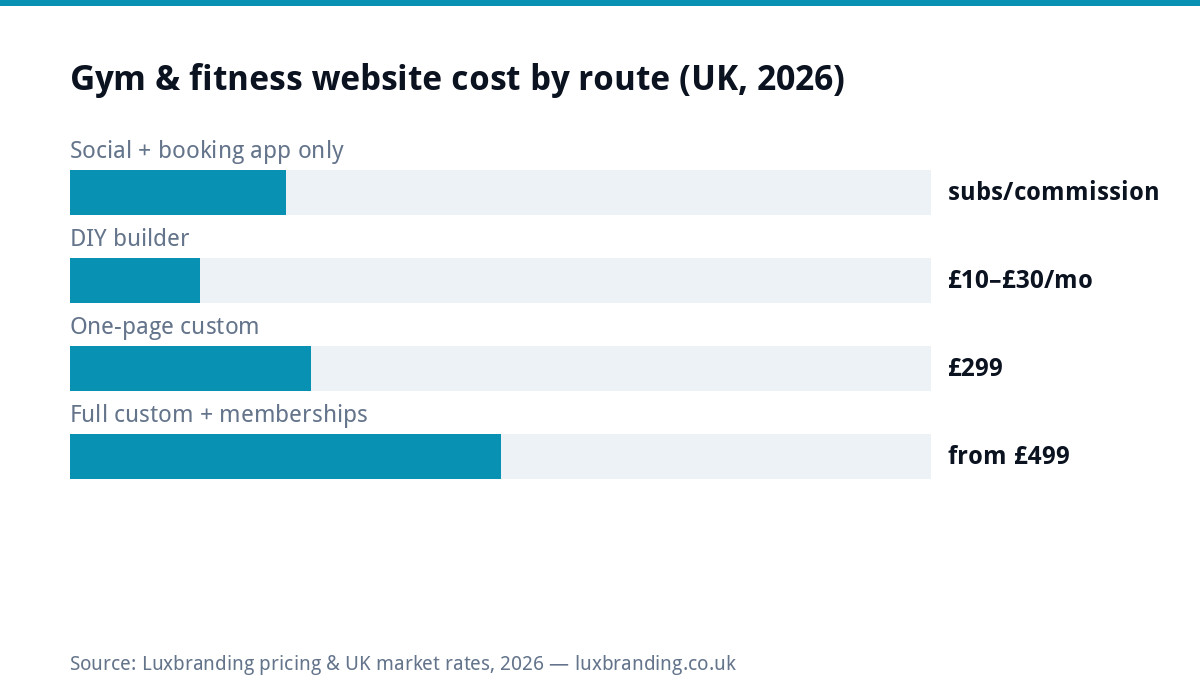
What each route costs, fitness edition
| Route | What you pay | Right for | The catch |
|---|---|---|---|
| Social + booking app only | App subs/fees | Class-based studios with full books | Invisible to every searching joiner; prices hidden in DMs |
| DIY builder | £10–£30/mo | Brand-new PTs testing the waters | The template look undercuts premium pricing fast |
| One-page custom | £299 | PTs, bootcamps, single-offer studios | One page, one ranking theme; fine for one clear offer |
| Full custom | from £499 | Gyms with memberships, classes, facilities to sell separately | Booking flow scoped on top when you want it owned |
The price-publishing argument, fitness edition
No sector hides prices harder or pays more for it. The joiner’s fear is universal (locked-in contracts, hard sells), and “enquire for membership options” confirms it, while published tiers, honest joining fees and a plain cancellation line disarm it. The gyms that publish convert the shortlist; the ones that don’t get compared anyway, minus the trust. Same mechanics as every sector we price (salons, dentists): the from-price filters and reassures at once, and it is the same fixed-price psychology our own price list runs on. Add the timetable as page text (not a screenshot: searchers and Google both read text, and “spin classes tuesday [town]” is a real query family).
By business type: what to buy
Personal trainer: the £299 one-pager, specific to the niche you actually serve; “PT in [town]” is competitive, “postnatal strength coaching [town]” converts. Results photos with written permission are your portfolio currency. Class studio (yoga, spin, bootcamp): £299–£499 depending on whether classes deserve separate ranking pages; timetable as text, first-class offer prominent, booking via your existing app embedded cleanly. Full gym: the from-£499 build: membership tiers, facilities, classes and PT services as their own pages in the from-£499 custom build (each ranks for its own family), day-pass route for visitors, and the join flow reduced to fewest possible clicks. Franchise or multi-site: location pages per site with true local details, which is the honest version of local landing pages, not the spammy one. Booking ownership questions (deposits, no-shows, app fees at volume) route to the same arithmetic as every booked-service business: the booking system guide runs it.
The mistakes fitness sites repeat (all free to avoid)
The sector’s recurring own-goals, from audits: prices hidden behind “enquire” (covered above, still the biggest); the timetable as an Instagram screenshot that expired in March; “transformation” stock photos that scream template; the join flow burying the actual join button under philosophy; music/video autoplay ambushing desk browsers; and no answer to the three questions every nervous first-timer has (what do I bring, where do I park, will I be judged?). That last one deserves its own honest paragraph on any gym’s site, because beginner anxiety is the sector’s real conversion barrier and almost nobody addresses it in writing. Every fix here is content, not budget, which is the recurring truth of this whole series.
Retention: the website’s second shift
Acquisition pages get the budget, but fitness economics are churn economics, and the site helps there too at zero marginal cost: the timetable members actually check weekly (text, current, bookmarkable), a members’ info page answering the questions that otherwise DM the owner (freeze policy, guest passes, holiday hours), programme pages that upsell existing members into PT blocks and courses, and the results-story section that reminds wobbling members why they joined. None of this needs new spend; it needs the from-£499 build’s pages pointed at both audiences. A member who checks your timetable on your site weekly is also seeing your PT offer weekly, which is how owned channels quietly out-compound the booking app’s transactional screen.
Photography and proof, fitness edition
The sector’s conversion currency is believable transformation, and the rules are specific: real members (with written permission) beat models; activity shots beat posed equipment; the space photographed busy-but-not-rammed beats empty sterility; and results presented as stories (“Sarah, 8 months, couch to first 10k”) beat before/after body close-ups, which also travel badly with ad policies if you ever boost them. A phone, a bright morning class and ten minutes of permission-asking builds a photo library worth more than any stock subscription, and it feeds the site, the profile and the socials from one shoot, the same one-source-many-surfaces economics as the template kit.
The January maths (when to build)
Fitness demand is the most seasonal in local business: the January wave decides the year, with September’s back-to-routine surge second. Rankings need weeks to settle, which makes October–November the build window: live and indexed before resolution season, photos shot while the gym is quiet, offers ready. A January-built site spends the wave invisible and matures into February’s dead zone; the same site built in autumn compounds through the exact weeks members are deciding. If cashflow says wait, the £79/month pay-monthly route exists so the calendar, not the bank balance, times the launch. All prices public on the price list.
PT packages online: the pricing-page mechanics
For trainers specifically, the packages section does the selling: three tiers (single session, block, programme) with prices and what each includes, the middle tier positioned as the sensible default, and the honest line about what results need (“most clients train twice weekly for at least twelve weeks”), which pre-frames the block purchase as the rational choice rather than the upsell. Add the logistics that kill enquiries when missing (where sessions happen, times available, how payment works) and the enquiry form asking goal, availability and experience, and the page converts cold searchers into consultations without a single DM exchange. It is the same publish-the-prices mechanics as the whole vertical series, tuned to the sector where “DM me” pricing is most epidemic and most costly.
The one-line summary for a busy owner: publish the prices, keep the timetable text-true, photograph real members with permission, build in the autumn, and let the £299–£499 question answer itself from how many services deserve their own ranking page. Everything else in fitness marketing works better standing on that base, and none of it works well without it.
Get the UK Website Project Brief Template (free)
A 2-page template for briefing any UK web designer — sitemap, integrations, audience, deliverables. Cuts revision rounds in half.
No spam. Unsubscribe any time. UK GDPR compliant — your email is only used to send this resource.
Frequently asked questions
How much does a gym website cost in the UK? +
A custom one-pager (offer, photos, prices, sign-up route) is £299; a full site with membership, class and timetable pages runs from £499. Class-booking systems layer on top, from free calendar embeds to custom builds. Personal trainers usually need the £299 tier.
Do gyms need a website if they use a booking app and Instagram? +
The apps run your timetable and Instagram shows the vibe; neither wins "gyms in [town]" or "personal trainer near me" searches, where joining decisions start. The site converts those searchers and holds membership pricing somewhere findable, which the DM-us-for-prices approach loses daily.
Should gym membership prices be on the website? +
Yes. Price-hiding is the sector's biggest conversion leak: joiners comparison-shop, and the gym whose prices are findable gets shortlisted while "enquire for our best rate" reads as expensive and salesy. Publish tiers plainly; filter tyre-kickers before the sales conversation.
What should a personal trainer's website include? +
One page done well: who you help (specific beats general), real client results with permission, your prices or packages, how sessions work, a photo that looks like you, and one clear booking route. Specificity ("strength training for women over 40 in Didsbury") is the whole SEO and conversion game.
How do gyms handle class bookings through their own site? +
Three tiers: embed your existing booking app's widget, keep the app but link it cleanly from a proper timetable page, or scope a custom booking build when volume and no-show deposits justify owning the flow. The right tier follows your class volume and what the app charges.

