Quick answer
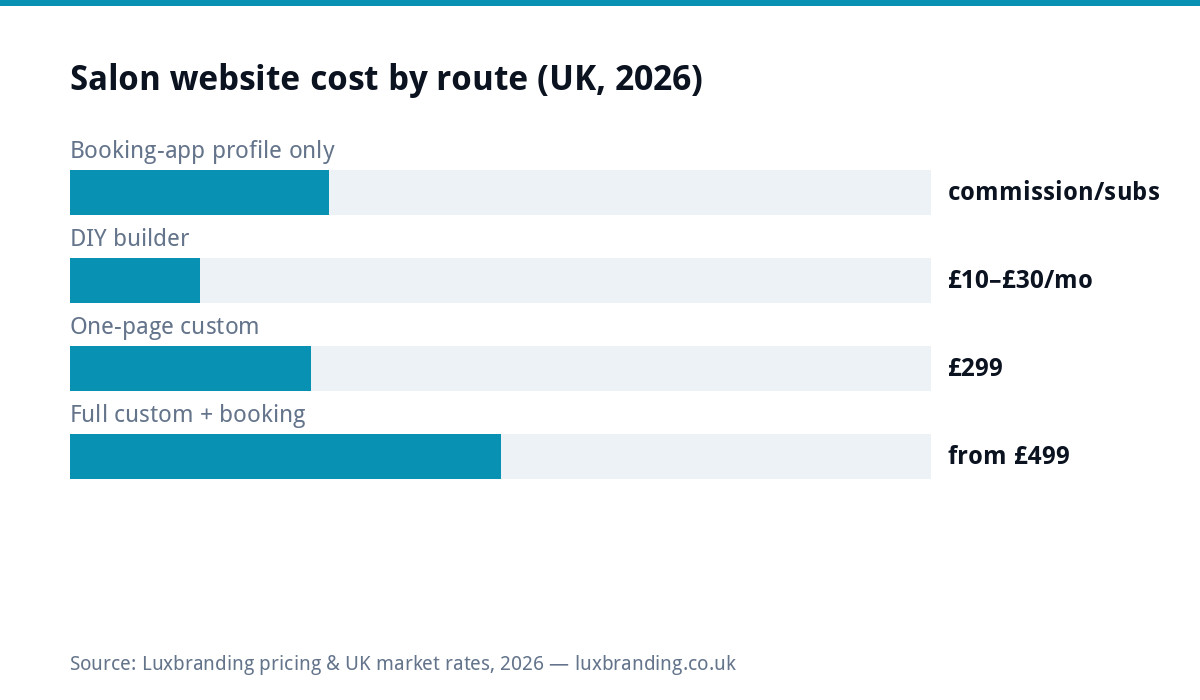
A hair or beauty salon website in the UK costs £299 flat for a custom one-page website (price list, gallery, booking link) or from £499 for a full custom WordPress site with booking woven in. That is the design fee; what most salons actually pay today is different: booking-app subscriptions and new-client commissions that never stop. The maths between those two numbers, rent versus own, is the real decision this guide prices.
Where salon clients actually come from
Three streams fill chairs. Word of mouth and social (Instagram is the industry portfolio), the booking apps (Fresha, Booksy: genuine discovery, priced via subscriptions, features and new-client fees), and Google searches the apps barely touch: “balayage [town]”, “mens fade near me”, your salon’s own name after a recommendation. That third stream is the website’s territory, and it converts the warmest traffic a salon gets: someone already told about you, checking prices and vibe before booking. No website means that check happens on your busiest competitor’s Instagram instead.
Route by route: what you pay and what you get
| Route | What it costs | Right when | The catch |
|---|---|---|---|
| Booking app only | Subscription and/or new-client fees | New salon filling chairs fast | The app owns your client list and charges for growth forever |
| DIY builder | £10 to £30/mo ongoing | Testing whether you want a site at all | Evenings spent; the subscription outlives the saving |
| One-page custom | £299 one-off | Single salon, clear services, booking handled by your app | One page ranks for one theme; fine for most single-location salons |
| Full custom + booking | from £499 | Busy salons ready to take direct bookings commission-free | Booking scope priced per your rules (deposits, staff diaries) |
The price list: your highest-converting page
Hair and beauty is the sector where publishing prices matters most and salons resist it hardest. The client behaviour is unambiguous: price-checking precedes almost every first booking, and a complete, current price list converts searchers that “DM us for prices” loses to the salon up the road. Publish the full menu with prices, mark the from-prices honestly (colour corrections vary; say so), date nothing (a “2024 price list” PDF reads as a closed salon), and keep it as page text rather than an image so Google reads every treatment name. Every treatment listed is its own search phrase: “brow lamination [town]” finds the salon whose site says those words with a price beside them.
Booking: the fee maths by salon size
By situation, honestly. Solo stylist or new salon: stay on your booking app and put the £299 one-pager in front of it; the app’s fees are worth the discovery while every chair-hour matters. Established salon, mostly regulars: run the numbers on what the app charged you last quarter against how many of those bookings were people who already knew you. Regulars rebooking through a fee-charging channel is pure rent; a booking-enabled site at £499+ moves them to a channel you own, and the apps stay for genuine newcomers. Multi-staff salon at volume: deposits against no-shows matter more than any fee (card-at-booking collapses no-show rates), and your own system enforces YOUR deposit rules per stylist and treatment; a scoped build through our web application service runs exactly your deposit and diary rules. Whichever stage, ask the apps the exit questions you would ask any supplier: can you export your client list, and who is allowed to market to it?
Worked example: the app-fee arithmetic for one salon
Picture a four-chair salon doing steady volume through a booking app. Add up last quarter’s statement: subscription, feature tiers, and any new-client fees, then split the bookings behind it into genuinely-new clients versus regulars rebooking. The pattern salons find when they do this honestly: the majority of app bookings are regulars, people who would book direct if direct were as easy, which makes their share of the fees pure channel rent. Moving even half the regulars to a booking-enabled site pays for the £499 build within months at typical app pricing, while the app keeps earning its keep on the true newcomers. The point is not that apps are bad (their discovery is real); it is that paying acquisition prices for retention is the sector’s quietest margin leak, and the website is the tool that plugs it.
What it costs to run after launch
The ongoing bill, so nothing surprises: managed hosting around £20/month (backups, updates, someone to call), the domain’s £10 to £20 a year, and upkeep that suits how salons already work: new photos from the chair monthly (you post them to Instagram anyway; the site gets the best three), price list edits when yours change, holiday hours twice a year. No retainer needed at single-salon scale. The one recurring habit that outearns everything: the review ask at the till, because “best balayage [town]” is won in Google reviews long before it is won in design.
Hair salon website design: what converts
Your work, photographed properly: before/afters and finished looks from your own chairs, because in this sector the photos ARE the argument, and clients can spot a stock blow-dry instantly. Your people: stylists with names, specialities and a friendly photo (clients book people, not chairs). The practical layer: hours kept true everywhere including holidays, parking and access notes, and a visible cancellation policy that protects your diary without sounding like a threat. And reviews woven in from Google rather than typed testimonials; the Business Profile feeding those reviews is the other half of salon discovery, worth the £199 setup or the DIY afternoon. Instagram gets embedded, linked and fed; it just stops being the only address you have.
Speed and mobile: the checks clients never mention but always feel
Salon browsing is a phone activity, often on a bus, and slow galleries are silent bounce machines. Two checks before launch and quarterly after: the mobile reading on PageSpeed Insights (aim for the green band; heavy image galleries are the usual salon culprit, and compressing them is free), and the thumb test on your own phone: can you reach the booking link, the price list and the phone number without pinching or hunting? A beautiful site that fails those two loses the very clients the photography earned.
Common salon website mistakes (all free to avoid)
The sector’s recurring own-goals: the Instagram-only presence (invisible to every Google search that fills quiet Tuesdays), price lists as photos of the printed menu (unreadable on phones, invisible to search), booking links buried two taps deep when they belong on every section, treatment names only insiders use (searchers type “eyebrow tattoo” as often as “microblading”, so say both), and hours that drift out of truth across site, profile and socials until a locked door earns a one-star review. None of these costs money to fix; all of them cost bookings weekly while they stand. The £299 build avoids them by construction, but so can a careful hour on whatever you run today.
For the whole market in one place, from DIY builders to full agency builds and the running costs after launch, see the full UK website pricing guide.
The whole salon stack, priced
Website £299 to £499. Business Profile setup £199 (or DIY with our guide). A £79 social template kit so the feed that fills chairs stays on-brand between posts. Logo and brand refresh from £129 if the fascia deserves better. All one-off, all owned, totalling less than a quiet month’s app fees for many salons; every price is public on the price list. Build it in your January lull and it is ranking by wedding season.
Get the UK Website Project Brief Template (free)
A two-page template for briefing any UK web designer: sitemap, integrations, audience and deliverables. Cuts revision rounds in half.
No spam. UK GDPR compliant. We only use your email to send this resource, unless you tick the box to hear from us.
Frequently asked questions
How much does a hair or beauty salon website cost in the UK? +
A custom one-page site (services, prices, booking link, gallery) is £299 flat; a full site from £499. Booking apps like Fresha and Booksy charge subscriptions or new-client fees instead, and many salons run both: apps for discovery, their own site for direct bookings.
Do salons need a website if they are on Fresha or Booksy? +
The apps bring discovery but charge for it and own the client relationship. A website captures the searches the apps don't ("balayage [town]", your salon's name), takes bookings without new-client fees, and holds your reputation somewhere no algorithm reorders. Most established salons benefit from both.
Should salon prices be on the website? +
Yes, in full. Price-checking is the number one pre-booking behaviour in hair and beauty, and salons that publish a complete price list convert searchers that "price on consultation" salons lose. It also filters clients your pricing does not suit before they occupy a chair.
What should a salon website include? +
The full price list, online booking (or a booking link), real photos of your work and your space, your stylists, opening hours kept true, and location with parking notes. Instagram embeds help; relying on Instagram alone leaves you invisible on Google.
How do salons take bookings through their own website? +
Three routes: embed your existing booking app's widget (fastest), use a standalone booking system, or have booking built into a custom site with your own deposit and cancellation rules. Which pays best depends on your booking volume and what your current app charges.