Quick answer: what this template does
A one-page brief is the cheapest website upgrade you will ever make: it costs £0 and routinely swings quotes by hundreds of pounds, because vague projects get priced defensively. Copy the nine blocks below into an email, fill in each one, and send it to whoever is quoting, whether that is a freelancer or an agency. With us, fixed-price builds are ordered at the published price. Order online, and within one working day we email you a few short questions about your business; having this brief ready makes them quick to answer. Custom work is quoted in writing. Designers quote tight when the unknowns are removed; this template removes them.
Why briefs change the price you pay
When a designer reads “we need a website, roughly five pages, fairly soon”, they price the risk: the content that might never arrive, the page count that might double, the decision-maker who might appear at the end and reverse everything. That padding is real money. A specific brief lets a professional commit to a fixed number with confidence, which is exactly how fixed-price builds like our £499 custom WordPress service stay fixed.
The template: copy everything below the line
Each block has a prompt in brackets. Delete the prompts, keep the headings, answer in plain sentences. Nobody is grading your prose.
| Block | What to write |
|---|---|
| 1. About us | Two sentences: what the business does, who buys it, where you operate |
| 2. The job of the site | The one action a visitor should take: call, book, buy, request a quote. Everything else supports it |
| 3. Page list | Every page you expect, one line each on its job. Example: Services, split by the three services we sell |
| 4. Content | Who writes the words and supplies photos, and by when. Say honestly if you want it written for you |
| 5. Design references | Two or three sites you like and the specific thing you like about each. Also one you dislike, and why |
| 6. Functionality | Anything beyond pages: booking, payments, a price list that changes, customer login, a blog you will actually use |
| 7. Budget band | A range, not a number. It filters proposals honestly in both directions |
| 8. Timeline | The real deadline and what drives it: a launch, a season, a lease starting |
| 9. Sign-off | Who approves the design and who can kill it. If those are different people, say so now |
Filling in the budget band honestly
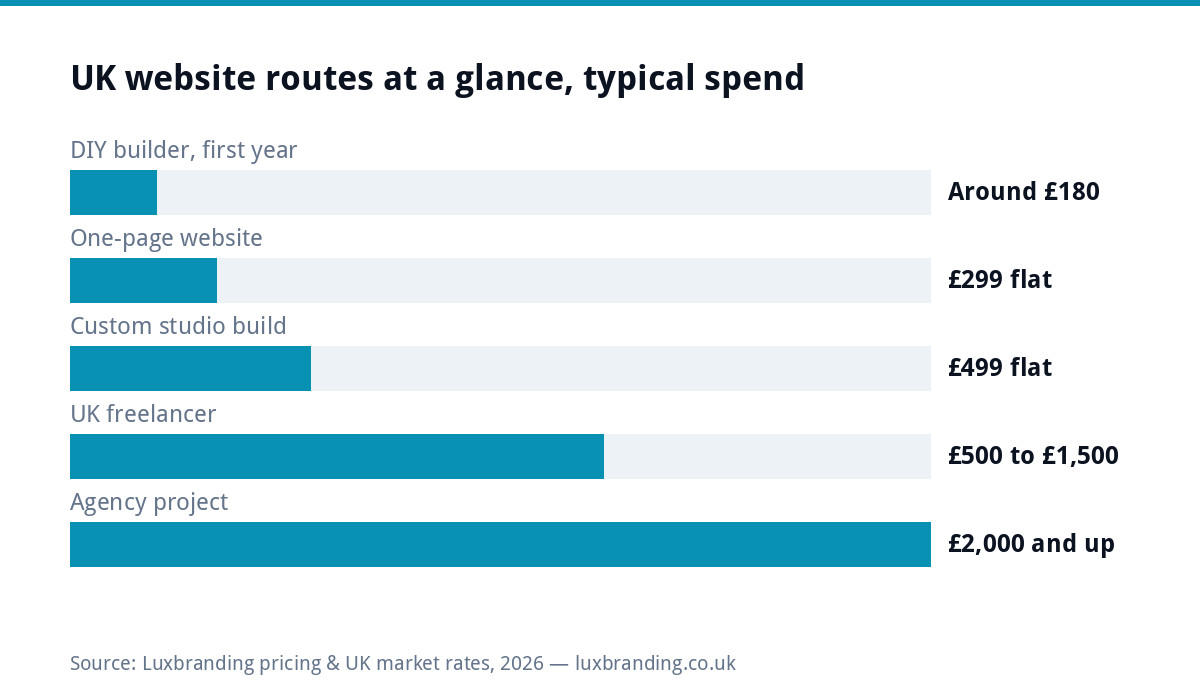
Budget is the block people skip, and it is the one that saves the most time. Anchor against the real UK market rather than guessing: DIY builders run £10 to £40 a month of subscription plus your evenings, a professional one-page site is around £299, a custom multi-page business site sits near £499 at a fixed-price studio and £500 to £1,500 with a good freelancer, and agencies price from £2,000 upward. The full picture, with what each band includes, lives in our guide to what a website costs in the UK, and the website cost calculator turns your specific answers into a range in under a minute.
| Band you write | What it signals | Right when |
|---|---|---|
| Under £300 | One-page or landing page territory | New business, single service, speed matters |
| £300 to £700 | Custom multi-page build, fixed price | Most trading UK small businesses |
| £700 to £1,500 | Freelancer or studio with extra scope: content, e-commerce, migrations | Established firms with bigger content needs |
| £1,500 plus | Larger builds, strategy, complex functionality | Portals, big catalogues, funded launches |
The mistakes that inflate quotes
Four phrases do most of the damage. “Make it pop” transfers design authority to nobody and guarantees revision rounds. “About five or six pages” prices as eight. “We will sort content later” adds weeks and often a copywriting invoice at the end. “Just something simple” means wildly different things to a buyer and a builder, so the quote hedges. The template kills all four by forcing specifics up front.
What designers actually do with your brief
A good one reads it twice, quotes against blocks three, four and six, designs against block five, and schedules against block eight. The first thing we check on any brief is the gap between the page list and the budget band: when they disagree, we raise it in writing before money moves rather than after. A brief also becomes the reference document when scope questions appear mid-build, which protects both sides.
When a one-page brief is not enough
Booking systems, customer portals, stock that syncs, anything where the software is the product: those need proper scoping, not a bigger form. The brief still starts it, but expect written scoping questions and a written specification before a serious number. Our guide to what separates a brochure site from an application, website versus web app versus mobile app, explains where that line sits and why prices jump across it.
A worked example: filled in fifteen minutes
A two-van cleaning company briefing us wrote: about us, domestic and end-of-tenancy cleaning across Reading; job of the site, quote requests via a short form; pages, Home, Domestic, End of Tenancy, Prices, About, Contact; content, we will write bullet points, please tidy them, photos are ours; references, two competitor sites with “calm, not corporate” noted; functionality, quote form emailing both directors; budget, £300 to £600; timeline, live before September school term; sign-off, both directors, jointly. Six lines of gaps removed, quoted at £499 fixed the same day, live in three weeks. That is the entire trick.
If you are briefing a rebrand or logo at the same time
Websites and identities get briefed differently: a site brief is about pages and actions, an identity brief is about audience and feeling. Use the companion design brief template for the logo and brand side, and send both together if the project covers the lot; it is exactly the pairing our bundles are built around, with every price on the public price list.
Before you hit send: the three-minute check
Read block two aloud: is it one action, or three competing ones? Check block four names a human, not “we will sort it”. Check block seven is a band you could actually spend. Then send it to two or three providers at different price points and compare like for like. If a proposal ignores your brief, that tells you how the project would go.
Adapting the template for a redesign
Redesign briefs need two extra lines: what must survive from the current site, and what is driving the change. List the pages that already earn traffic or bookings so they are preserved and redirected properly, and be blunt about the trigger, whether that is embarrassment, a rebrand, or a site that collapses on phones. A redesign scoped without those two lines routinely deletes the only pages Google cared about, which is how businesses relaunch into invisibility. Budget-wise, redesigns price like builds with a discount for salvageable content: see what a redesign costs in the UK before writing block seven.
The content checklist that unblocks builds
Ninety per cent of stalled website projects are waiting for words and pictures, not design. Alongside the brief, start a folder with: your logo files, ten to twenty decent photos, one paragraph per service in your own voice, the exact wording of your contact details and opening hours, and any legal text your industry requires. Rough is fine; a designer can polish bullet points into pages, but nobody can polish an empty folder. Sites whose owners do this ship weeks earlier at the same price.
Sources and further reading
For planning the wider web presence around the build, the UK government-backed nibusinessinfo guide to developing a business website is solid and vendor-neutral. On content ownership and portability, the WordPress.org project explains the open-source model that keeps a site yours, which is worth understanding before choosing any platform.
Get the UK Website Project Brief Template (free)
A two-page template for briefing any UK web designer: sitemap, integrations, audience and deliverables. Cuts revision rounds in half.
No spam. UK GDPR compliant. We only use your email to send this resource, unless you tick the box to hear from us.
Frequently asked questions
What should a website brief include? +
Nine things: who you are, what the site must achieve, the page list, who supplies content, design references, required functionality, your budget band, your deadline, and who signs decisions off. That single page removes most of the guesswork designers price into quotes.
Should I tell a web designer my budget? +
Yes, as a band rather than a number. Hiding it does not get you a cheaper site, it gets you a padded quote or a mismatched proposal. A band like £300 to £600 lets a designer say quickly whether the scope fits, saving both sides a week of dancing.
How detailed should the page list be? +
Name every page you believe you need and one line on what each must do. Ten minutes of listing beats "about five or six pages", which is the phrase that turns a fixed quote into an estimate that grows later.
Who should write the website content? +
Decide before you brief: it is the most common hidden cost and the most common launch delay. Professionally written pages typically add £100 to £300 to a UK build, while DIY copy is the single biggest reason finished sites sit unlaunched.
Is a brief still needed for a £299 one-page site? +
Even more so. Small fixed-price builds move fast, and the brief is what makes the first draft close to right. Five of the nine blocks take one sentence each at that scale; it is fifteen minutes well spent.