Quick answer: what this is and what it costs
Testimonials are the highest-value marketing asset that costs £0: quoted proof from real customers that you control and can place on your website, proposals and social posts. Most businesses have delighted customers and no quotes, purely because nobody asked at the right moment with an easy enough request. Below are copy-paste templates for email, SMS and WhatsApp, the timing rule that decides whether you get a reply, three prompts that effectively write the testimonial for them, and the one-line permission sentence that keeps you on the right side of UK GDPR and the advertising code.
Testimonials versus reviews: collect both, differently
Reviews live on platforms you do not own and persuade strangers mid-search; testimonials live on assets you do own and persuade prospects mid-decision. The request moments are identical, so pair this page with our review request scripts: ask for the Google review first while the glow is hot, then follow with the testimonial request a day later. Same happy customer, two different assets.
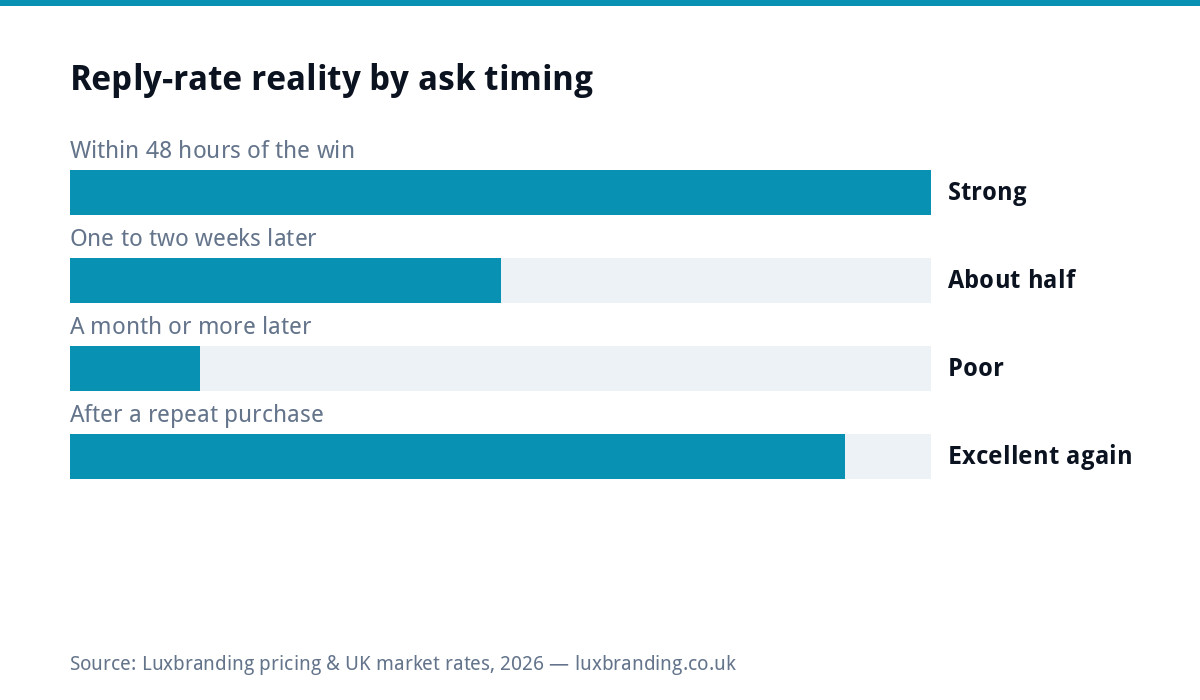
The timing rule that decides everything
| Moment | Reply rate reality |
|---|---|
| Within 48 hours of the delighted moment | Strong: the experience is vivid and reciprocity is high |
| One to two weeks after | Fading: expect half the replies and shorter quotes |
| A month or more after | Poor: silence from people who genuinely loved the work |
| After a repeat purchase or referral | Excellent second window: they have re-proven their satisfaction |
The delighted moment is not always completion day. For a builder it is the walkthrough; for a designer it is launch day; for a coach it is the client’s first win. Ask then.
The three prompts that write it for them
“Could you write us a testimonial?” produces a week of silence followed by “Great service, would recommend.” The fix is to replace the blank page with three questions: what was the situation before, what changed since, and what would you tell someone considering us? Their answers, lightly trimmed, are the testimonial. Every template below uses this structure.
Template 1: the standard email
| Copy and personalise |
|---|
| Subject: A quick favour, two minutes at most
Hi [name], Really glad you are happy with [the specific job]. Would you be up for giving us a short testimonial for our website? No need to write anything formal, just a line or two answering any of these: 1. What was the situation before we worked together? We would publish it with your first name and business name. If you would rather we did not, or you want to see the final wording first, just say. Thanks either way, |
Template 2: SMS and WhatsApp
| Copy and personalise |
|---|
| Hi [name], so pleased the [job] went well. Quick ask: could you send a sentence or two on how it went, for our website? Even one line helps. Happy to show you the wording before anything goes up. Thanks! [you] |
Message channels suit trades and mobile-first customers, and the reply arrives in their voice, which is exactly what good testimonials sound like. Keep it under four sentences; a message that scrolls feels like homework.
Trade-specific variants
After a completed job on site: “Now the [bathroom, garden, rewire] is done, would you mind a one-line testimonial we can show future customers? A photo of the finished work alongside it would be brilliant if you are comfortable.” After a project launch, for service businesses: “Now the [website, brand, campaign] is live, could you share a couple of sentences on the process and the result? We would love to quote you.” After a programme or block of sessions: “You have made real progress since [start point]. Would you put that into a sentence or two we could share with people wondering whether this works?”
The permission line that keeps you safe
A published name plus quote is personal data under UK GDPR, and the advertising code requires testimonials to be genuine and held in evidence. Both are satisfied with one sentence in the request and their written reply: “We would publish it with your first name and business name. If you would rather we did not, just say.” Keep the email or message thread as your consent record. If they later ask you to remove it, do so promptly; that is both the law and basic decency. The ICO’s consent guidance covers the detail, and the CAP Code section on testimonials and endorsements is the advertising side.
Editing etiquette: trim, never invent
You may tighten rambling and fix spelling; you may not change meaning, merge two customers into one, or write it yourself and ask them to sign. If you trim, send the final version back for a quick OK. That thirty-second step keeps the quote genuine, keeps your evidence file clean, and often prompts them to strengthen it themselves.
Where to deploy them once collected
One specific testimonial per service page, matched to that service; two or three on the homepage; the strongest ones in proposals and quote follow-ups where they answer live objections; and rotated into social posts, where a customer’s words outperform your own. Consistent presentation matters more than volume, which is part of what a coherent identity buys: our brand identity service builds the visual system those quotes sit inside, and testimonial-backed trust is a core asset if you ever aim at building a brand you could sell.
A worked example
A landscaper finishes a patio on Thursday, sends the review script that evening and lands a five-star Google review. Friday morning he sends template 2. The customer replies: “Garden was a state before, honestly. Now it is the best bit of the house, we are out there every evening. Lads were tidy and on time too.” Trimmed only for the typo, published with first name and street area after an OK, added to the quotes page and his next three estimates. Total cost £0, total time four minutes, and it will out-persuade any advert he could buy.
Video and photo testimonials: the premium versions
A thirty-second phone video of a customer saying what the written quote says is worth ten text testimonials, and the ask is only slightly bigger: “Would you be up for saying that on a quick phone video? One take, totally informal.” Offer to film it at handover when the mood is highest. For trades, the middle option is a photo of the finished work with the quote overlaid, which needs only the permission line you already collected plus a second consent for the image. Store originals, get the same written OK, and never script the words: the slight roughness is exactly what makes it believable.
Handling silence and the one-nudge rule
No reply within a week means one friendly nudge, then stop: “No worries if this slipped by, even one line would be great, and if now is not the time, all good.” Chasing beyond that trades goodwill for a quote that arrives grudging. Move on; the next delighted customer is a better use of the template. For the wider trust picture, including what to do when public feedback goes wrong, see our guide to responding to negative reviews, and the strategy view in Google reviews for small businesses. Everything we charge for the brand side sits on the public price list.
Get the UK Branding Budget Worksheet (free)
A printable worksheet: decide what your brand needs now and price it against fixed published prices and the IPO trademark fee.
No spam. UK GDPR compliant. We only use your email to send this resource, unless you tick the box to hear from us.
Frequently asked questions
What is the difference between a testimonial and a review? +
A review lives on a third-party platform you do not control, like Google or Trustpilot, and builds public trust. A testimonial is quoted content you collect directly and use on your website, proposals and social media. Strong businesses collect both, from the same happy moment.
When is the best time to ask for a testimonial? +
Inside 48 hours of the delighted moment: the job finished, the site launched, the result landed. Satisfaction decays fast. Asking a month later gets silence not because they are unhappy but because the glow has gone.
Do I need permission to publish a customer testimonial? +
Yes. Under UK GDPR a name attached to a quote is personal data, so get explicit consent to publish it with their name and business. One sentence in your request handles it, and written consent also satisfies the ASA requirement that testimonials are genuine.
Can I edit a testimonial a customer sends? +
Trim for length and fix typos, never change the meaning, and never invent one. The CAP Code requires testimonials to be genuine and used with permission; send the edited version back for a one-word OK before it goes live.
How many testimonials does a small business website need? +
Three strong, specific ones beat twelve vague ones. Prioritise quotes that name the problem, the outcome and a real detail. One per key service page plus a couple on the homepage is plenty to start.