

Quick answer: three distinct things, three different costs
The terms get mixed up in UK marketing materials. Here are the real definitions.
| Type | What it is | UK cost |
|---|---|---|
| Website | Public pages serving information or commerce, indexed by Google | £499 to £15,000 |
| Web app | Interactive application running in a browser, requires login | £5,000 to £200,000+ |
| Mobile app | Native or cross-platform app installed on a phone | £15,000 to £200,000+ |
| PWA (Progressive Web App) | Web app that can be installed and works offline | +10 to 25% on a web app build |
For most UK SMEs, the right answer is a great website plus, if the service benefits, a focused web app, rather than a native mobile app. Native apps are expensive and rarely justified under £500k annual revenue. A custom WordPress website starts at £499; a web application starts at £1,999, see full pricing.
The decision matrix
You need a website if
- You sell to anyone, businesses or consumers
- You want to be findable on Google
- You want the lowest cost, highest reach presence
Every UK business needs this: it is the foundation.
You need a web app (in addition to a website) if
- Customers log in to use a tool or service
- You have a subscription, dashboard or self-service portal
- Your business benefits from desktop and laptop use
Examples: fitness dashboards, learning platforms, and customer portals for small businesses.
You need a mobile app if
- Customers use it on the move, repeatedly
- You need camera, GPS, push notifications or offline access
- Competitors have apps and customers expect one
Examples: ride-sharing, banking, fitness tracking, delivery (Pret, Costa, M&S).
You need a PWA if
- You want app-like features without an app store
- Customers use you weekly but not daily
- You want to avoid Apple and Google’s revenue share
Twitter Lite and Pinterest run successful PWAs, covering most use cases for a fraction of a “full stack” build.
Cost comparison: building each for the same business idea
A UK personal training business shows the range clearly.
| Solution | Build cost | Ongoing | Reach |
|---|---|---|---|
| Just a website (booking form) | £499 to £1,500 | £20/mo | Searchable, all devices |
| Website plus simple web app | £8,000 to £20,000 | £100/mo | All devices via browser |
| Website plus PWA | £10,000 to £25,000 | £100/mo | All devices, installable |
| Website plus native mobile app | £30,000 to £80,000 | £200 to £500/mo | Mobile only |
| Website plus web app plus mobile app | £40,000 to £100,000 | £300 to £700/mo | All channels covered |
UK user behaviour: when each type actually works
Mobile web vs mobile app usage in the UK (2026)
UK users spend most mobile time inside apps but visit more unique websites than apps: websites win on discovery, apps win on retention.
Retention curves
Native apps typically see 25 to 35% retained after 30 days; PWAs and web apps see 15 to 25%. Websites have no comparable data but retention is lower still.
Conversion rates
E-commerce checkout completion: mobile app 60 to 80%, mobile web 30 to 50%, desktop web 40 to 60%, though apps require the install step first.
SEO implications: only websites get indexed
Websites: full SEO
Google indexes every public page, and a properly built site can rank for any relevant keyword.
Web apps: limited SEO
Authenticated content is not indexable; discovery happens through paid acquisition or word of mouth.
Mobile apps: app store SEO only
App Store Optimisation is a distinct discipline from web SEO, and apps cannot rank in Google search results.
PWAs: best of both
The marketing surface is web-indexable, and the installed app behaves like a native app for those who install it.
Maintenance burden differences
Website
Update content as needed, with major upgrades every 2 to 3 years. Typical annual cost: £200 to £2,000.
Web app
Continuous deployment, no app store delays. Typical annual cost: 20 to 30% of the build cost.
Mobile app
Apple and Google both require ongoing compatibility updates, and every release needs app store review. Typical annual cost: 25 to 35% of the build cost.
PWA
Same as a web app, with no app store dependency.
Real cost drivers: what actually pushes the price up
Two projects described the same way can land £20,000 apart. These variables move the number most.
- User roles. Separate admin, staff and customer permissions multiply the design and testing work.
- Integrations. Payment gateways and accounting software each add scoping and dependency risk.
- Platform count. Native iOS and Android is close to two builds; testing doubles even with a cross-platform framework.
- GDPR. Storing customer data needs a lawful basis and retention policy: legal time, not just code.
App store fees UK businesses should budget for
A mobile app is not a one-off cost: Apple and Google take a cut of purchases and subscriptions, a cost a website or web app never carries.
- Apple. Developers earning up to $1 million a year in App Store proceeds can apply for the App Store Small Business Program, cutting Apple’s commission to 15%. Above that threshold, Apple’s standard (higher) commission applies.
- Google. Per Google’s Play Store service fee page, participating developers pay 15% on the first $1 million USD of annual app revenue, rising to 30% above that, with a flat 15% on subscriptions regardless of revenue.
On a £5 monthly subscription sold through a native app, that is 15 to 30 pence of every pound gone before other costs, one reason to start with a website or PWA.
Maintenance and hosting costs over three years
Build cost is only part of the picture. Here is what three years of running each option adds on top.
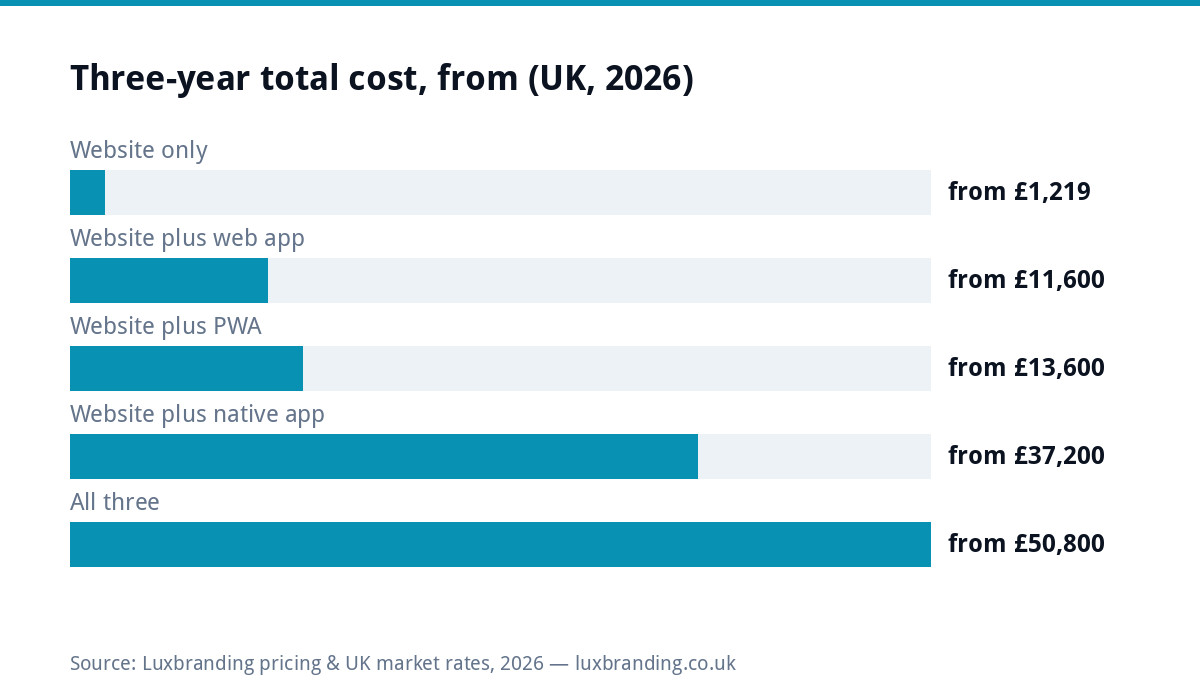
| Solution | Build cost | 3 year running | 3 year total |
|---|---|---|---|
| Website only | £499 to £1,500 | £720 | £1,219 to £2,220 |
| Website plus web app | £8,000 to £20,000 | £3,600 | £11,600 to £23,600 |
| Website plus PWA | £10,000 to £25,000 | £3,600 | £13,600 to £28,600 |
| Website plus native mobile app | £30,000 to £80,000 | £7,200 to £18,000 | £37,200 to £98,000 |
| Website plus web app plus mobile app | £40,000 to £100,000 | £10,800 to £25,200 | £50,800 to £125,200 |
Hosting alone barely matters; the gap opens from ongoing development and app store compliance, a multi-year commitment rather than a one-off purchase.
Hybrid: when each fits in a UK business
Pure website
Almost every UK SME starts here. Most stay here for years.
Website plus booking widget
Service businesses, restaurants and salons typically use a tool such as Calendly. No separate web app is needed.
Website plus dedicated web app
Subscription and professional services with customer portals fit here. Our custom web app cost guide breaks this down.
Website plus PWA
Content and e-commerce businesses that value offline or install capability but not device hardware.
Website plus native mobile app
High-frequency consumer services where mobile-first behaviour is non-negotiable: delivery, ride-sharing, banking.
All three
Mature businesses where each channel serves a distinct purpose, typically only justified above £1 million annual revenue.
When NOT to build a mobile app
- Your users would visit once or twice a month; they will not install an app for that
- You are an early-stage UK SME under £200k revenue, where £30,000 to £80,000 is rarely justified
- Competitors do not have apps either, so there is no channel expectation to lead on
- You cannot commit to ongoing maintenance; unmaintained apps get pulled from the stores within 12 to 24 months
A responsive website plus PWA is enough for most trades and service businesses whose customers visit rarely rather than daily.
Real-world UK business examples: which channel fits which use case
UK service businesses (plumber, dentist, accountant)
Website plus Google Business Profile covers most of the value; a mobile app is rarely worth it.
UK restaurants and hospitality
Website for discovery, booking and the menu; native only for chains with frequent repeat visits.
UK e-commerce
Website on Shopify or WooCommerce; a PWA suits repeat-purchase, native suits daily-use audiences.
UK SaaS and B2B
Website for marketing, web app for the product; mobile only if the workflow genuinely happens there.
UK fitness, health and wellness
A native app is often right here: daily use, push notifications, sensor data.
UK banks and fintech
These typically run all three together, the premium tier of channel investment.
A worked UK example: a plumber’s booking system
Take a two-van plumbing business in Leeds turning over roughly £180,000 a year, currently running on a Facebook page and word of mouth. A custom WordPress website from £499 gets them found on Google for “emergency plumber Leeds” with a booking request form, and typically pays for itself within a handful of enquiries. Before commissioning anything bespoke, an embedded booking widget on that website adds online scheduling for a few pounds a month. Only once staff need a shared job diary and invoicing in one place does a web application from £1,999 become worth quoting, via our web applications service. A native app would not make sense here: customers call once or twice a year, and the £30,000-plus cost plus ongoing app store fees would never be recovered. For bespoke builds beyond a web app, see our software and app development guide.
The cost trap: building all three at the same time
Why it fails
- Three codebases and pipelines from day one, tripling the maintenance burden
- The audience has not self-selected which channel it prefers
- The product itself is not validated, wasting budget across three unvalidated versions
The smart approach
- Launch with a website plus a simple web app if needed
- Validate product-market fit with real users
- Build a native app only once mobile-first usage clearly dominates
Migration paths between channels
From website to web app
Add authentication, personalised data and interactivity. Typically £8,000 to £30,000 over an existing website.
From web app to PWA
A service worker, offline cache and install prompt. Typically £2,000 to £8,000, the best value upgrade available.
From PWA to native app
A significant rebuild; the codebase is separate even if the logic transfers. Typically £15,000 to £80,000.
From native app to PWA
Usually driven by app store policy frustration or a wish to avoid store fees. Straightforward, but loses some device integration.
Get the UK Software Project Brief Template (free)
A two-page template for scoping any custom software project: user roles, features, integrations, timeline and success criteria.
No spam. UK GDPR compliant. We only use your email to send this resource, unless you tick the box to hear from us.
Sources & Further Reading
- Progressive Web Apps, web.dev, Google
- UK Mobile Internet Statistics, Statista
- UK Digital Economy, Office for National Statistics
- Google Search Central, Google
- App Store Small Business Program, Apple
- Google Play service fee, Google
Frequently asked questions
When do I actually need a mobile app vs a website? +
Native apps justify their cost when users visit you frequently (daily/weekly), need device features (camera, GPS, push, offline), and your customer base is heavily mobile-first. For most UK SMEs, a great responsive website + PWA covers 80% of use cases at 25% of the native app cost.
What's a PWA (Progressive Web App)? +
A web app that can be installed on a phone like a native app, works offline, and feels like an app to users, but doesn't require App Store/Play Store. Twitter Lite, Pinterest, Forbes all run successful PWAs. Cost: 10-25% more than a web app, 60-75% less than a native app.
Can a website do what an app does? +
Increasingly yes in 2026. PWAs cover push notifications, offline mode, installation. Native apps still win on advanced device features (AR, advanced camera, deep iOS/Android integrations). For most service businesses, the website + PWA pair beats a native app on cost.
Which is cheapest long-term? +
Website wins on Total Cost of Ownership. Year 1 + 5 years maintenance: £499-£5,000 for a website, £30,000-£200,000 for a website + native app combo. PWA sits between, often the right balance.
Should I have a website AND an app? +
Yes if budget allows. Website covers SEO + discovery; app covers retention + engagement. The hybrid pattern (Website + PWA) is the most cost-effective version for UK SMEs under £1M revenue.
How much commission do Apple and Google take from app sales? +
Apple's App Store Small Business Program cuts its commission to 15% for developers earning up to $1 million a year in proceeds, with Apple's standard (higher) commission applying above that threshold. Google's Play Store charges participating developers 15% on the first $1 million USD of annual app revenue, rising to 30% above that, with a flat 15% on auto-renewing subscriptions regardless of revenue. This is a recurring cost that a website or web app never carries.
What does it cost to maintain a website, web app or mobile app over three years? +
Using typical UK build and running costs, a website-only setup runs to roughly £1,200 to £2,200 over three years including hosting. A website plus web app runs to about £11,600 to £23,600. A website plus native mobile app runs to £37,200 to £98,000 once ongoing OS compatibility work and app store compliance are included. The gap comes almost entirely from ongoing development, not hosting.


